Gioiella-Vaiano Villa
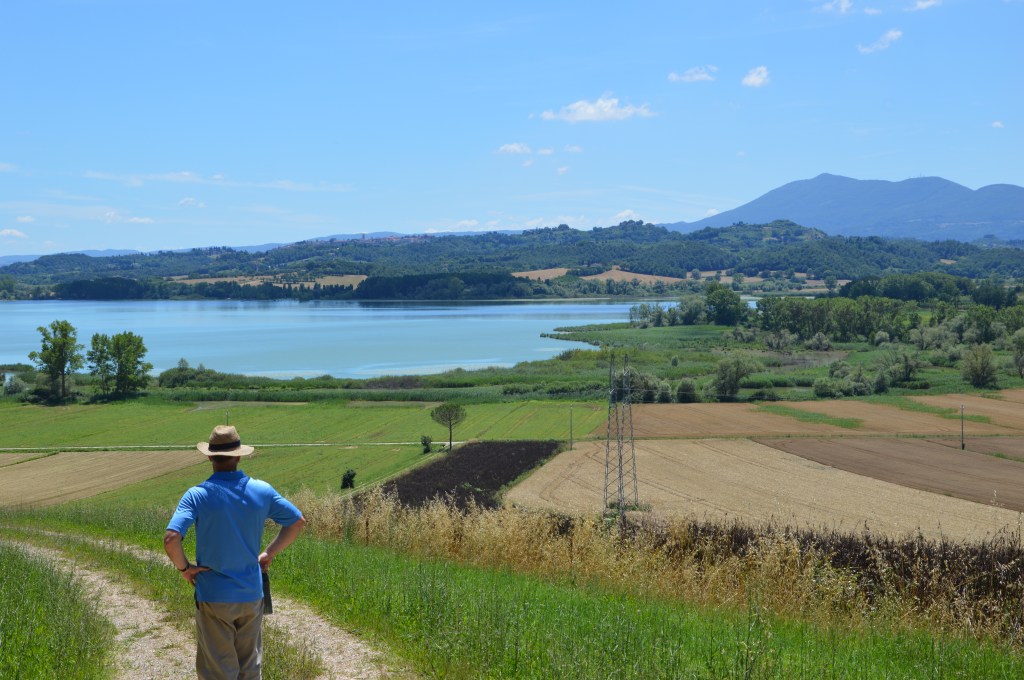
The Gioiella-Vaiano Villa site is located on the southwestern edge of Castiglione del Lago’s territory. The site overlooks Lago di Chiusi and the ancient city of Chiusi is visible in the distance. In antiquity, this part of the territory would have been closely tied to Chiusi. Etruscan tombs discovered in the vicinity of Gioiella and Villastrada (to the east) show a close cultural affinity with the art of Chiusi. The lake is actually a large swampy area, the remnants of the ancient river Clanis, which was navigable in antiquity. The Clanis ran from the Arno in the north, through the Valdichiana, and connected this region to the Tiber River and hence to Rome.
Ceramic evidence from the site indicates that it was occupied from the late 2nd century BC through the 4th century AD. The Roman villa was originally constructed over three levels rising above the river. Between 2015 and 2019, the TRAP team excavated on the central and lower levels. The most prominent feature of the Roman villa is a monumental nyphaeum designed for the display of water and possibly for dining. On the lower level, the team has excavated part of a bath complex. Although the site was abandoned in antiquity and its most precious building material robbed out and reused, the nature of the excavated buildings indicate that, at least in Roman Imperial period, this was a luxury villa with features similar to the imperial villas on the Bay of Naples.
The Central Area
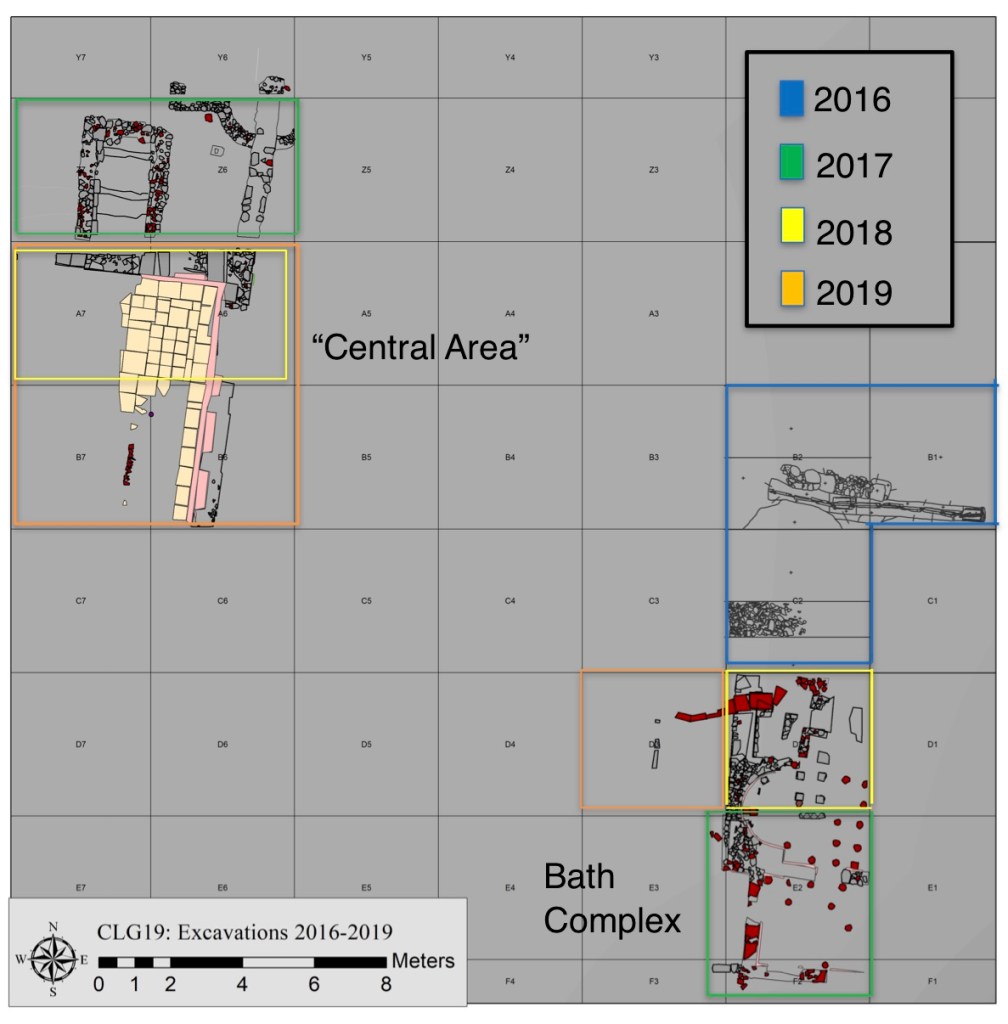
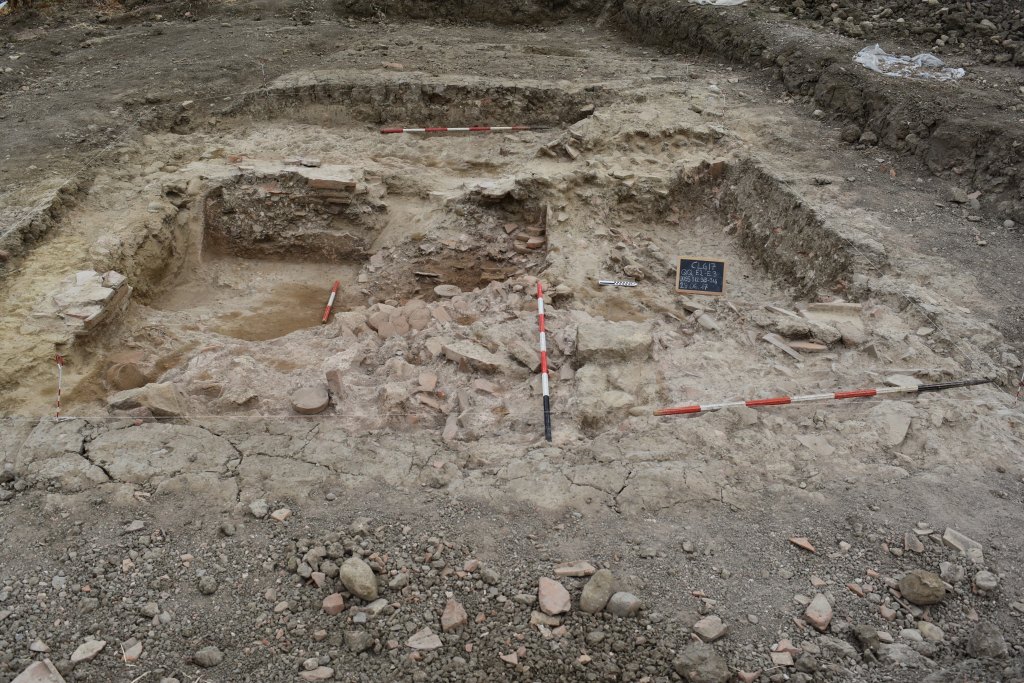
The Central Area of the villa is occupied by a large Roman nymphaeum that was likely constructed between the late 1st century and early 2nd century AD. The structure is 6.5 m wide and at least 8.30 m long (we never uncovered the south end). It has a north-south orientation and likely would have been open on the south side, providing a view directly towards Chiusi. The interior plan of the building comprises a series of niches alternating with pillars. At the north end there is a ‘stairway’ that descends into the space. The lower wall of the structure is made of a thick cocciopesto that is mortared into the tile flooring, making the entire space water-proof and forming a large pool. The niches are decorated with a rough plaster that includes small pieces of limestone and blue-glass tesserae, which would have sparkled when the sunlight reflected off the water. To contrast with the cave-like effect of the niches, the pillasters were covered in fresco decoration painted in alternating solid colors such as yellow, red, white, and black. The “stairway” at the back may have been part of the decoration, allowing water to flow into the pool.
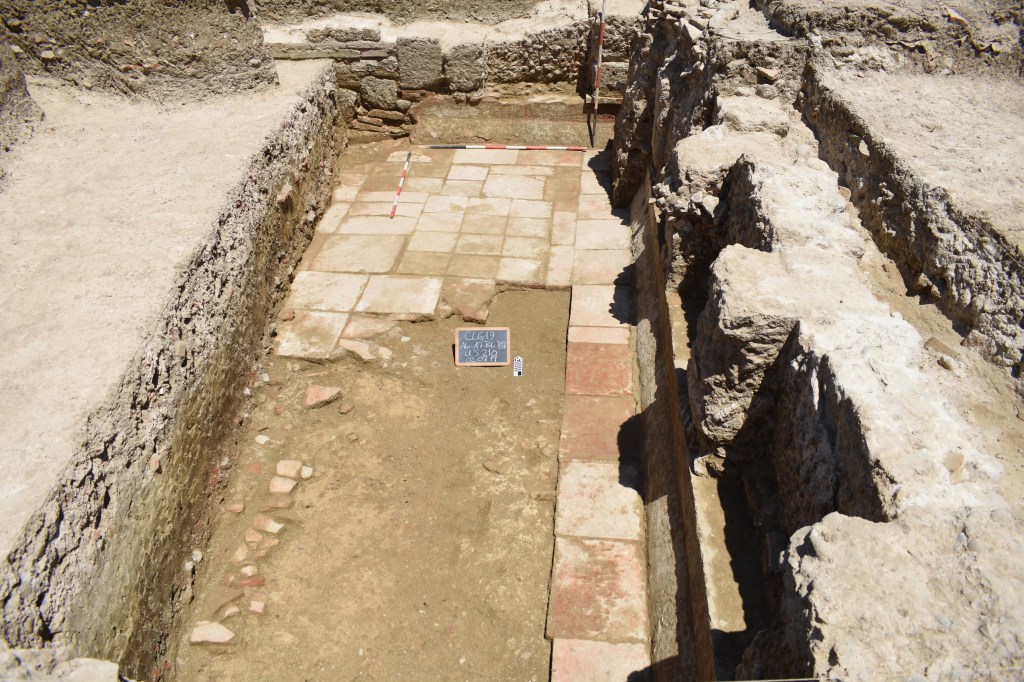
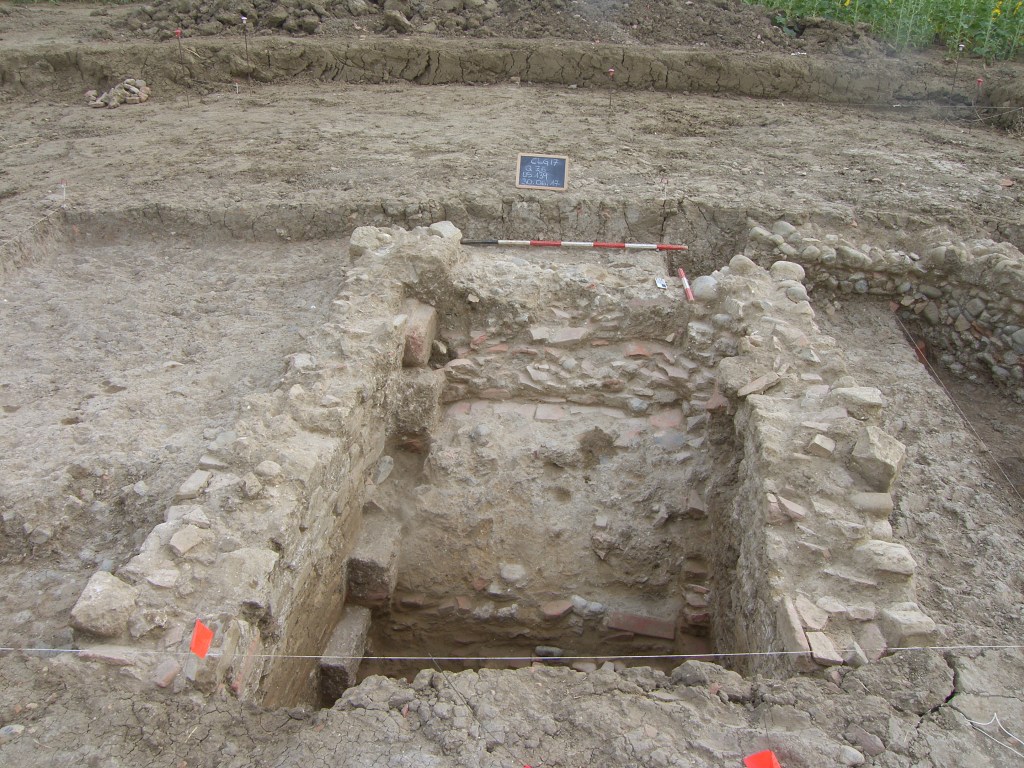
The upper walls have collapsed but the debris suggests a vaulted space. The building must have remained open after it ceased to function as a nymphaeum as the fill layers above the floor contained many pieces of the fresco that fell off the walls at a later date and dumps of ceramic material from later periods in the villa’s occupation. A later structure was constructed off the northeast corner of the nymphaeum, but its function is not yet understood.
More information about the Nymphaeum and its decoration can be found on the TRAP Digital Museum.
The Bath Complex
To the southeast of the Central Area, is a bath complex consistent with the type facility expected in a Roman luxury villa. The TRAP uncovered three rooms, which include the caldarium (hot room), the tepidarium (warm room), and what is likely the frigidarium (cold room). Although most of the black and white mosaic floor has been destroyed, many of the pilae, the stacked tiles, that supported the floor and allowed hot air to circulate below creating a hypocaust are still in situ. A water jug recovered from the lower floor of the hypocaust suggests that the bath building was abandoned. Pieces of colored marble and window glass indicate that the building would have been elegantly decorated. Finds from the bath complex can be found on the TRAP Digital Museum.
The Roman Villa at Gioiella-Vaiano appears to have gone through several transformations in its history. The pottery suggests that the site was first occupied in the 2nd century BC, perhaps shortly after the Roman conquest of Umbria. Sometime in the early imperial period, mid-1st century AD, the villa goes through a transformation. At that time, the nymphaeum is constructed and perhaps the bath complex, although that might be somewhat earlier. It seems that new owners, possibly from Rome and with connections to the imperial family, acquired the land and converted it to a luxury villa. This lasted until the 3rd century AD when the villa returned to being primarily for agricultural production. In the Late Antique period, the Clanis River began to silt up and it became more difficult to live in the Valdichianna. The villa was abandoned
 TRAP
TRAP 