The 3rd excavation campaign at the Via Belvedere site concluded on 3 July 2025. This year brought to light many important discoveries that will contribute to a reconsideration of the Etruscan and Roman periods in Castiglione itself as well as the entire Trasimeno region. Following an announcement of the discoveries at a press conference at the Palazzo della Corgna, some of the new evidence from the site was reported in Corriere dell’Umbria by Nicola Torrini.
Excavation trenches were opened in two areas of the site: the Roman bath complex on the middle terrace, which had previously been identified in 2023 and 2024; and on the upper terrace to the north of the cobble pavement. Those investigations have revealed evidence pointing to an Etruscan sanctuary along the upper part of the slope and a subsequent Roman fountain house and bath building that likely also had a religious significance.
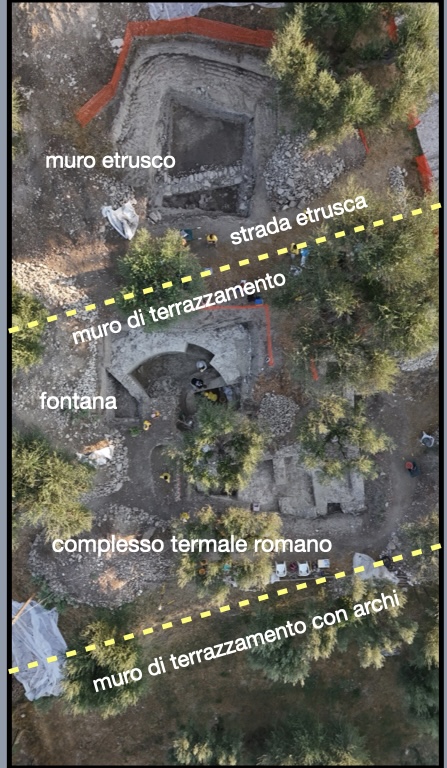
The cobblestone surface, first discovered in 2023, is a monumental roadway that extends from the southwest to the northeast with a gentle grade up the slope towards the top of the promontory. The construction, cobbles of selciato (a type of volcanic stone), and the width of the road, just over 4 m, indicates its function as a processional way. There are only a few other examples of roads like this from the Etruscan era. To the north of the road and parallel to it, there are the foundations of a large wall. This structure, the full dimensions of which are not yet known, was destroyed in a fire and evidence of the mud bricks from the wall were found in the burnt destruction layer. Dozens of ring-weights from fishing nets were recovered to the north of the wall and may have been part of votive offerings. This structure continues to the east and the west; further excavation will be necessary to determine its exact function.
The Etruscan structure was most likely destroyed at the beginning of the 1st century B.C. when the Romans conquered the territory from the Etruscans. At that time the processional road appears to have gone out of use. When the Romans reoccupy the site at the end of the 1st century or early 2nd century A.D., they constructed two terrace walls into the natural bedrock, one up against the former Etruscan road and the other 50 Roman feet to the south, and the water drainage channel on the east side of the Roman complex. Between the two terrace walls is a monumental fountain house and bathing complex. The size of the structures indicates that this was not a private feature but rather for public use.
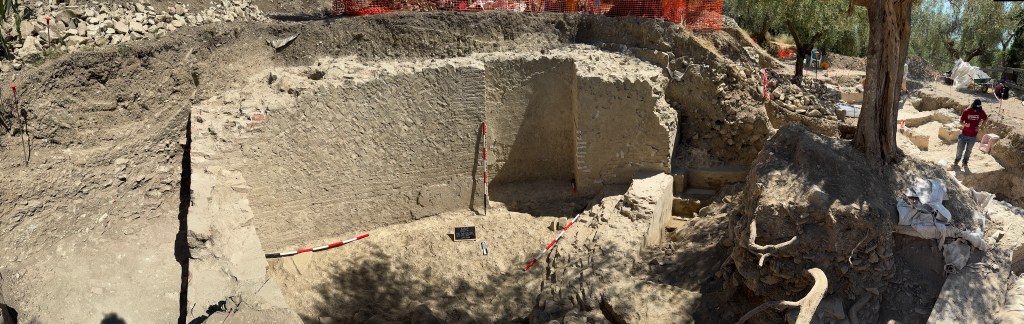
The 2025 excavations brought to light a semi-circular fountain house with niches, probably for statues that are now lost, on either side of a water basin. The steps leading into the basin are decorated with marble slabs, most of which were removed after the building fell out of use. At the bottom of the basin is a lead inlet pipe that appears to have conducted from a spring that had dried up by the early Middle Ages (when soldiers reported that there was no source of water at Castiglione del Lago). A cavity in the bedrock, which was observed during the excavation of a Late Antique cistern just to the south of the fountain house, indicates a fissure in the sedimentary rock where a spring could have emerged in antiquity. (For more on the evidence for a possible spring see the “Geology and Topography” page on our digital museum site.)
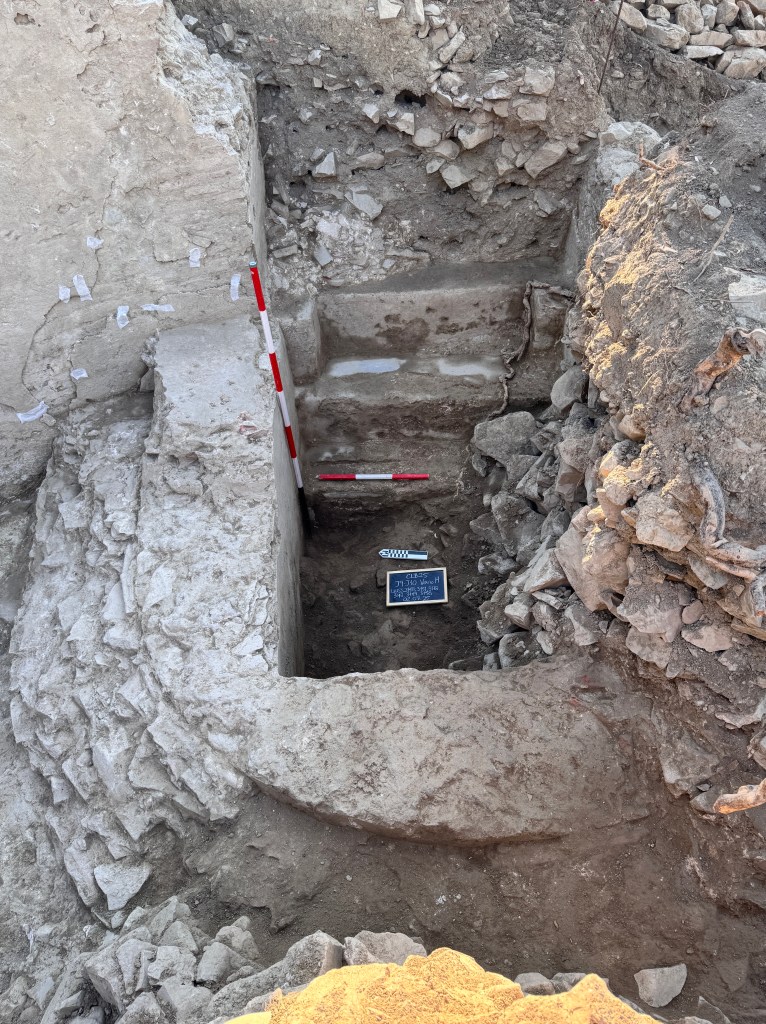
The fountain house, Vano H, is connected to the large rectangular room, Vano A, partially excavated in 2024. At the top of the water collection basin in Vano H there is an opening (doorway) into Vano A. However, it does not appear to be for people to move through but rather for overflow from the collection basin to fill the shallow pool in Vano A (see report from 2024). To the south of these two rooms, Vano B and C were heated rooms. Originally uncovered in 2023, excavation returned to that space in 2025.
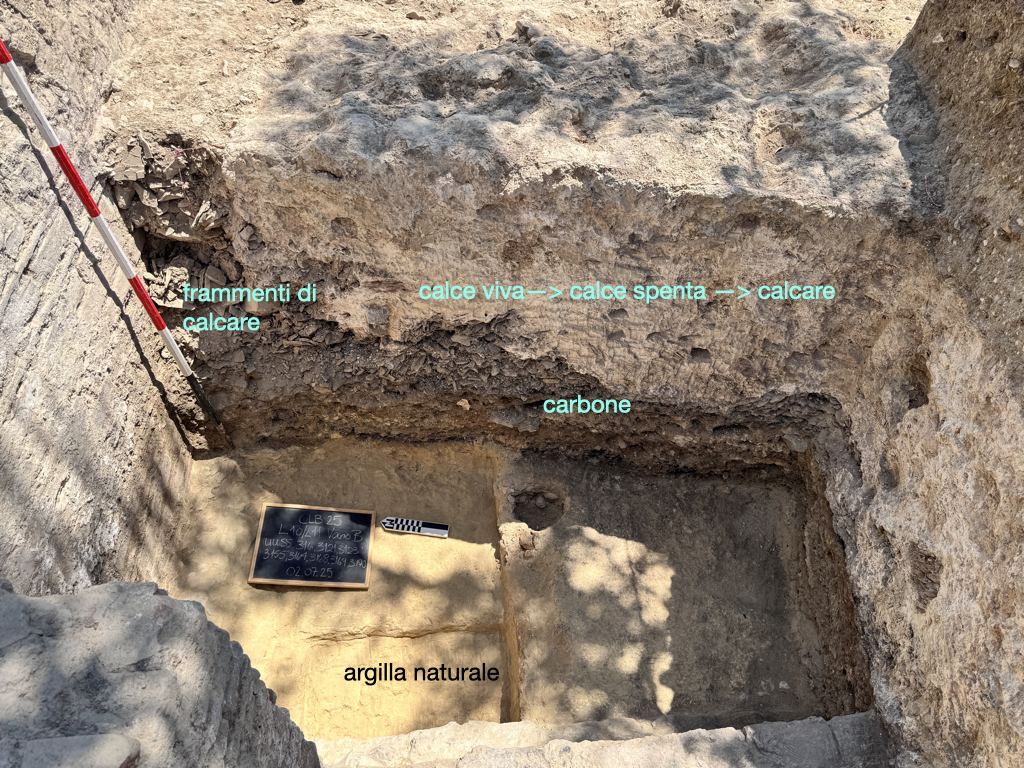
Post-Roman use of those spaces complicated the excavation. After the Roman complex was abandoned the structures must have remained open and accessible for a long period of time. The spring was probably still active at least into the Late Antique period as there is evidence for a Late Antique cistern. However, in the early Middle Ages, probably in the mid-13th century when Castiglione del Lago was resettled, Vano B and C were used as kilns to make quicklime. In Vano B, excavation revealed the “stratigraphy” of the quicklime process: the room was lined with charcoal, filled with chips of stone, then set on fire. Once the stone had burned, the powder could be used for making mortar. In this case, the burnt material was left in the “kiln” and, after a period of exposure to the elements, it re-hardened into a limestone mortar. Thus, only a small section of Vano B was excavated to the natural sediment.
Like the earlier Etruscan structures, the Roman fountain house and bath complex may also have served as a sanctuary. The deity or deities worshipped at this site are not yet known. G. Colonna (1976) speculated that Cel was the goddess of Castiglione del Lago but there is no direct evidence for that attribution (yet). We do know that the nymph of the lake was Agylla and that the lake takes its name from her mortal lover/victim Trasimenus/Tarsminas. But, the earliest literary account for Agylla is Silius Italicus’ 2nd century A.D. epic poem about the Punic Wars.
The 2025 excavations at Via Belvedere have revealed much about Lago Trasimeno’s lost Etruscan and Roman history but many more questions remain. The TRAP team plans to return to the Via Belvedere site in 2026.
 TRAP
TRAP 
Leave a comment