After two seasons of excavation at the Via Belvedere site on the south slope of Castiglione del Lago, the TRAP team has uncovered a Roman complex, mostly likely a villa, dating to late 1st century AD. The complex appears to have been constructed over three terraces, each approximately 50 Roman feet wide (ca. 15 m). In the center of the complex (Area B) is a large water-proof basin with a low bench on the south side. On the upper terrace (Area C) is an extensive area paved with cobbles forming a courtyard overlooking the lower part of the complex and the lake. Below those structures is an arched terrace wall (Le Buccace) and adjacent enclosed water channel, both of which were explored in 2023.

Excavations in 2024 focused on understanding the extent of the site to the west and the depth of the Roman levels. On the second terrace, excavation was conducted in Room E and Room A, as well as to the west of Room B. It appears that the rooms just above Terrace Wall 1 were used for storage as the floor was unfinished. To the west, we partially uncovered two additional rooms that were added to the building at a late date but which appear to have been constructed over early features, one of which had a vaulted ceiling. In the center of Area B is the large water-proof basin, which extends from the back of Rooms B & C to the bottom of the second terrace wall. During the Middle Ages, a lime kiln was constructed inside the basin, evidence that the Roman building was rich in marble and other decoration, all of which is now lost.
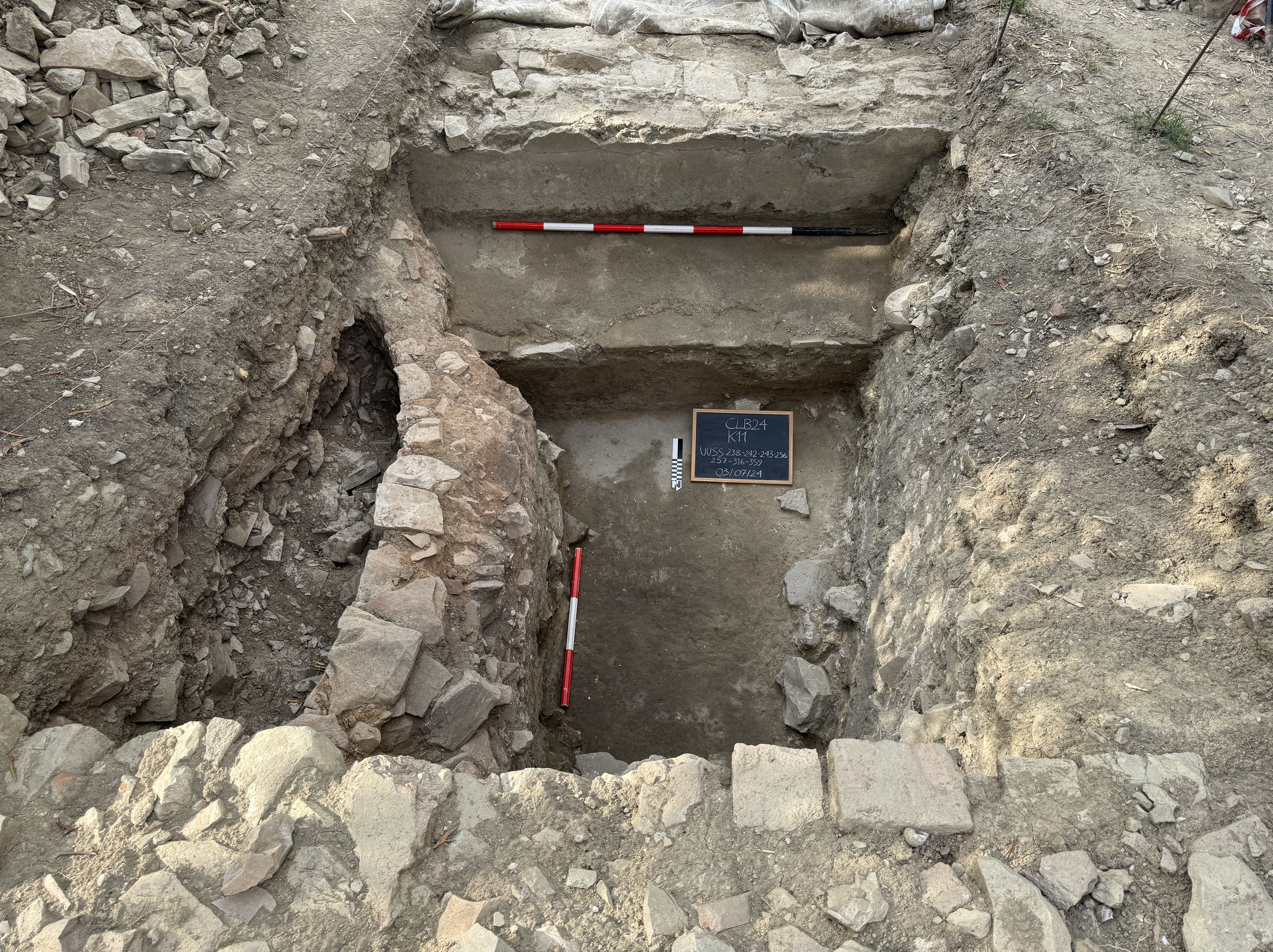
The wall of the basin is coated with white plaster, while the bench and the floor are covered in cocciopesto (water-proof cement). The function of this feature is not yet understood. It may be part of a bath complex but it may also be related to the fishing industry in Roman period and, thus, could have been for retaining and displaying live fish.
The second terrace wall supports a large paved area, made of selciato cobbles, that extends from the upper part of the water channel on the east for at least 14 m to the west. The northern extent of the pavement is not yet known.
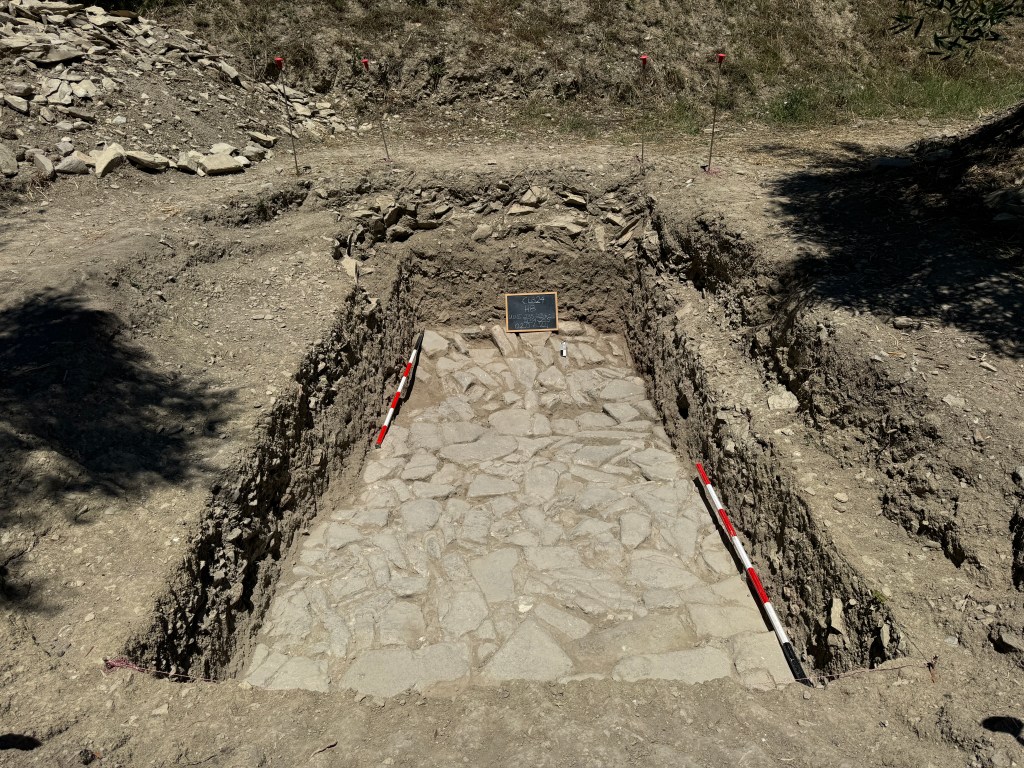
If this terrace was as wide as the one below, the Roman remains should continue for another 10 meters to the north. Hypothetically that is where the residential rooms for the villa may have been.
For the 2025 excavation season there are three objects: to explore the upper terrace; to learn the extent of the water basin to the west and its relation to rooms (B & C) to the south, and to understand the collection and distribution of water for the complex.
Follow our progress on Instagram @trasimenoscavi
 TRAP
TRAP 
Leave a comment