The 2023 excavations on the slopes of Castiglione del Lago have revealed a complex of Roman structures on at least three terraces. Roman activity on the slope has always been apparent due to the standing remains of an the Imperial period terrace wall and adjoining water channel. While archaeologists and historians have long believed that Castiglione must have been an important Roman settlement on the western side of Trasimeno, aside from those visible remains little evidence for such a settlement exists, until now.
The TRAP team was able to excavate on three of the six terraces that make up the tract of land from Via Belvedere to Via Garibaldi at the base of the hill.
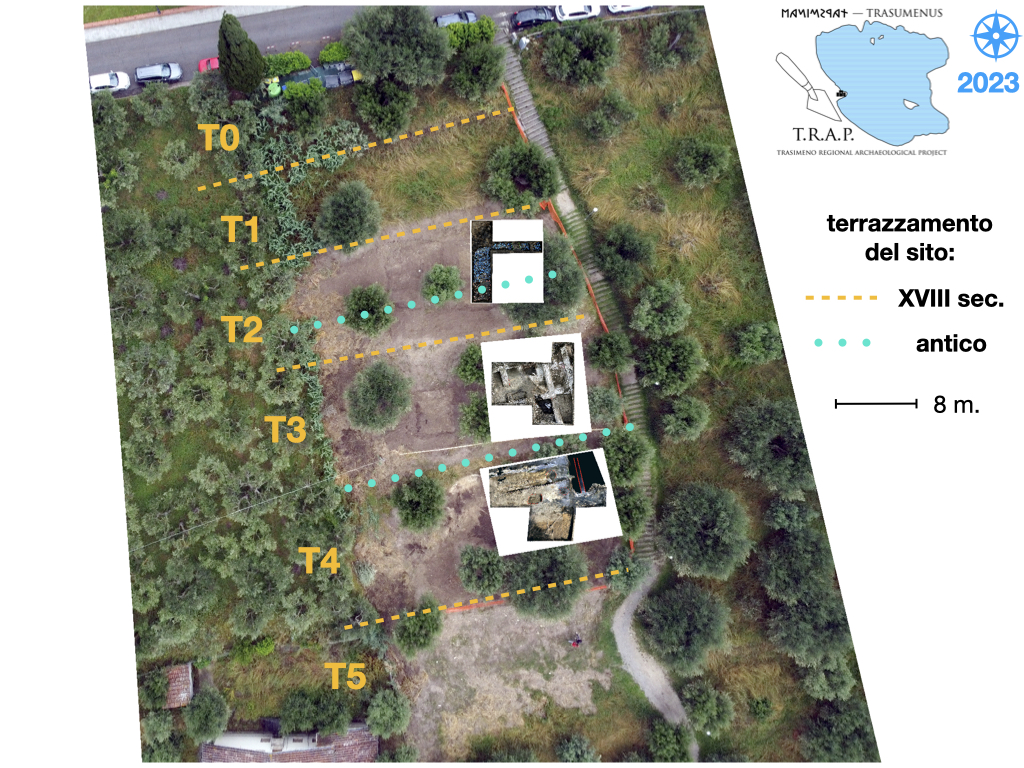
After the Roman period the slope was re-terraced at least twice: once in the Middle Ages for vines and again in the late 1700s for the olive grove the currently occupies the site. The intensity of that activity was presumed to have destroyed previous occupation on the slope. However, it now appears that the most recent terracing was accomplished by filling in the earlier terraces and then recutting them, effectively preserving the earlier occupation phases. In 2023, TRAP excavated on three of the six terraces in order to determine the extent of the site and to understand better the function of the arched terrace wall on fourth terrace (T4).
The opus mixtum construction of the arched terrace wall and water channel indicate that they were built in the late first or early second century AD. Unfortunately, later activity on Terrace 4 has destroyed the Roman period floor level leaving only a foundation trench in front of the structure, probably for posts used to support a shed-like roof, and at least one pit containing the remains of a dolium. That evidence suggests that the area in front of the arched structure was used for storage, probably of products from the lake. Dozens of ring-weights for fishing nets were recovered from the fills in front of the water channel.
Although the presence of the olive trees limited the excavations, the most remarkable finds were on Terraces 2 and 3. Moving up the hill from the arched structure, excavation on Terrace 3 revealed a complex of rooms dating to the same period as the arched structure and water channel. While the extent of the building is not yet known and its function cannot be determined, there is evidence for at least six rooms on that terrace. It appears that the building was abandoned at some point, perhaps due to a fire, and the rooms filled in with sediment allowing the structure to be preserved to a significant depth (we did not reach the Roman floor levels in 2023).
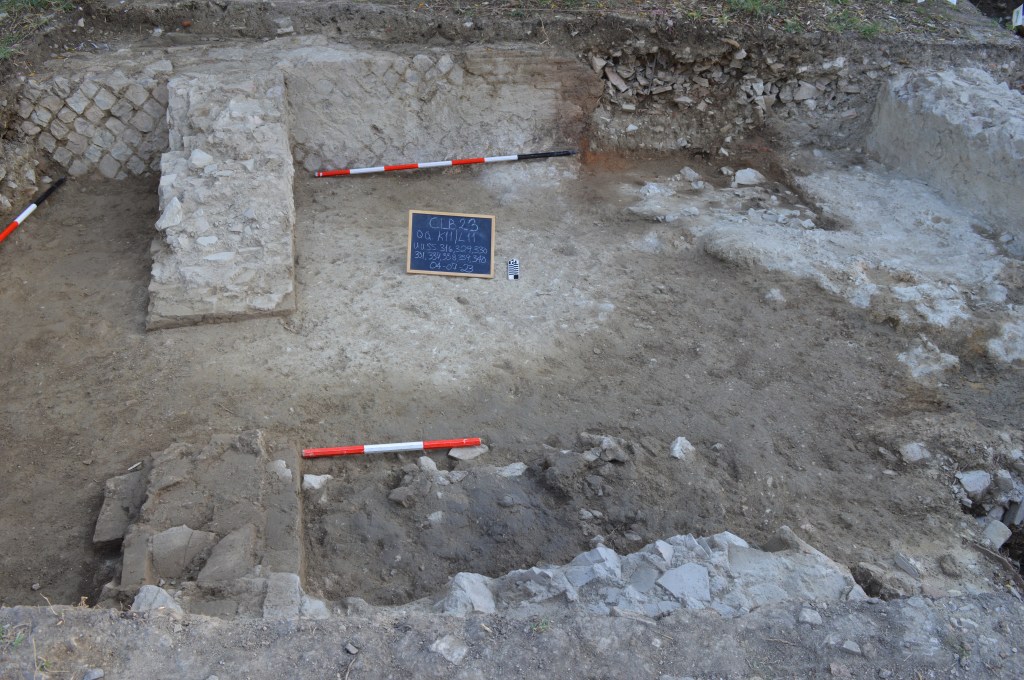
At a later point, perhaps in the Middle Ages, the upper part of the structure was reused and mortar surfaces were laid against the Roman walls.
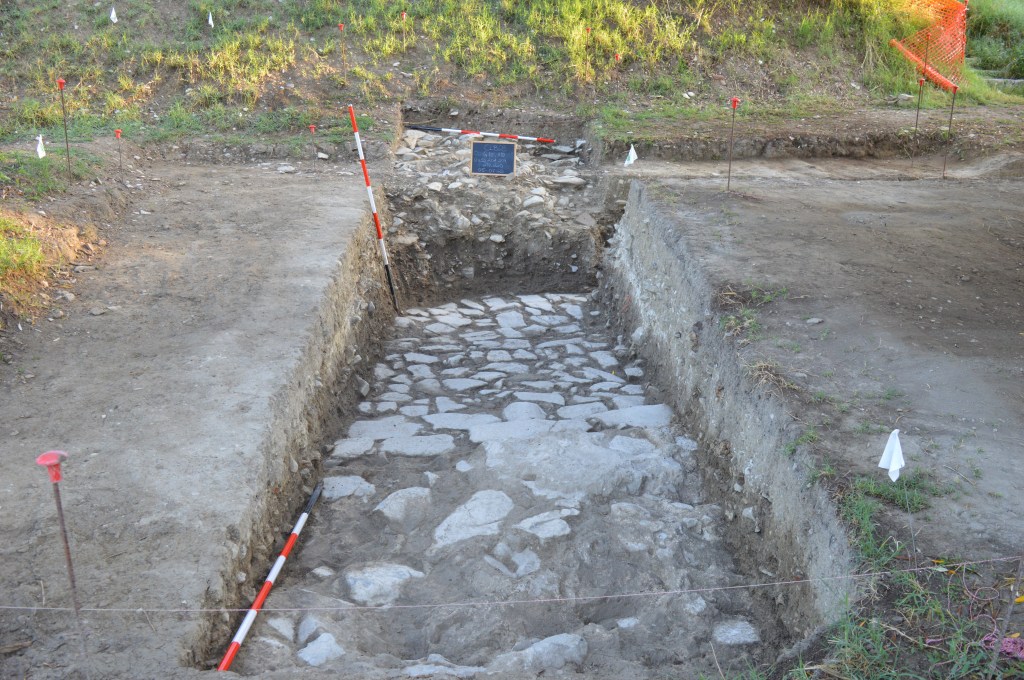
The initial cleaning of Terrace 2 revealed a small collection basin for water on the same axis as the channel below (T4). The basin and the channel (which we were not able to fully excavate) appear to be part of a drainage system. In order to determine better the function of the basin, we excavated to the north and west of the it. On this terrace (T2), about half a meter below the top soil, we uncovered a cobble surface both west and north of the basin. The construction suggests that it is either a road or a courtyard. To the south of the cobbles, at the edge of the terrace, is a concrete wall that is probably the ancient terrace wall. The date of the cobble surface is not as clear as the structures below. Pottery recovered from the sediment just above the surface is mostly black-glaze ware and earlier, including some Etruscan bucchero, indicating that the surface could be early Roman or even Etruscan.
The 2023 excavations in Castiglione del Lago have changed the history of Castiglione del Lago. We can now confirm that there was a significant Roman imperial period presence there. But, perhaps more importantly, the ceramic evidence indicates that occupation of the slope dates back even further, perhaps as early as the 6th century BCE based on the ceramics. We eagerly await the 2024 excavation campaign.
 TRAP
TRAP 
Leave a comment