By Max Fallin
While in Italy, I’ve seen more than a few examples of funerary monuments. Ranging from winding catacombs to humble stelae, the importance of funerary art and architecture in archaeology cannot be understated. However, one recurrent motif in particular caught my eye: the Roman rosette, a flower design, often with long petals and occasionally a spiraling quality.
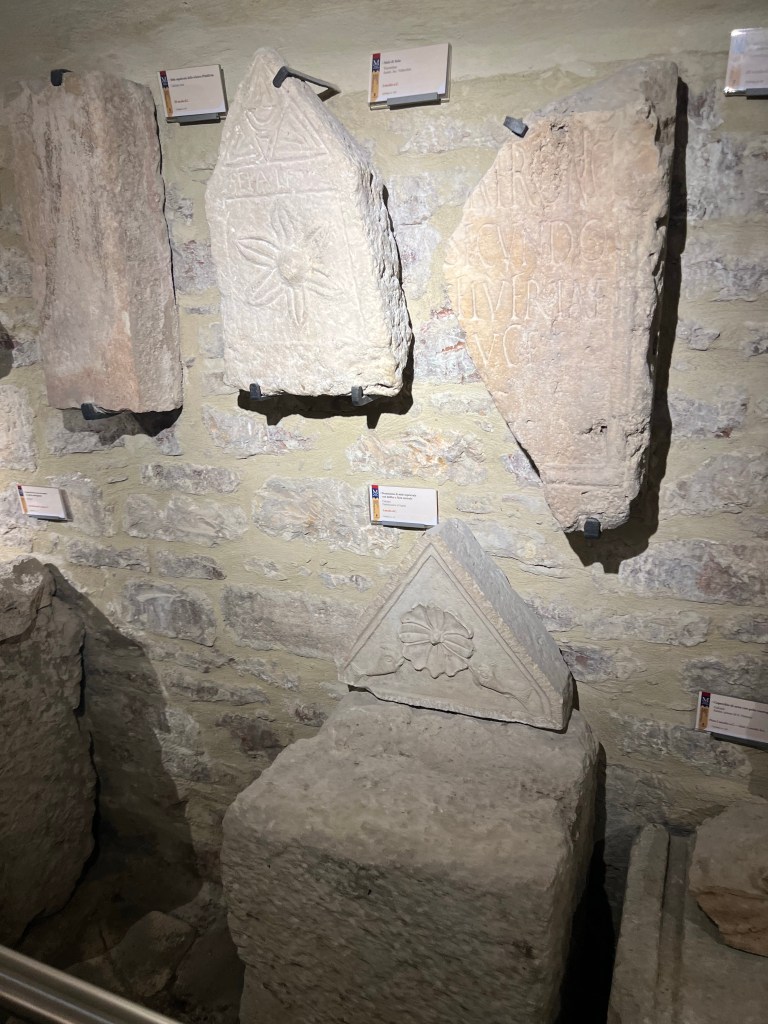
While this was nagging at me for a couple of weeks, the subject came into stark focus during our trip to Assisi, particularly because rosettes appear so frequently in the iconography of Assisi since the Roman period. As I took in the etched rosettes, I began to wonder what meaning they may have held for the Romans who carved them into their stelae.
Upon further research, I found some connection with Venus. A study of the funeral monuments in Viminacium, located in what is now Serbia, noted a connection between graves featuring rosette decorations and the practices of the cult of Venus Funeraria (Tapavički-Ilić, 2017), a cult mainly associated with the burial of young girls, particularly virgins. While not a complete confirmation of their relationship with Venus, it was a lead.
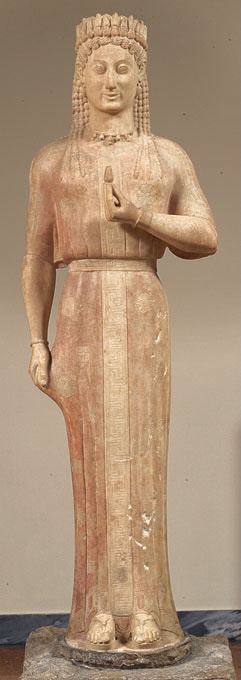
Interestingly, the next evidence I found for this theory comes from the Phrasikleia kore, an Attic sculpture from about 550 BCE. While not directly related to Venus or her predecessor goddesses (such as Aphrodite), a kore is a representation of the recently departed in the form of a youthful virgin. Interestingly enough, the portion of her garments below her belt features many rosettes, associating the rosette of the Greek world with female youth, an important aspect of the cult of Venus Funeraria, and perhaps a predecessor to the Roman use of the symbol.
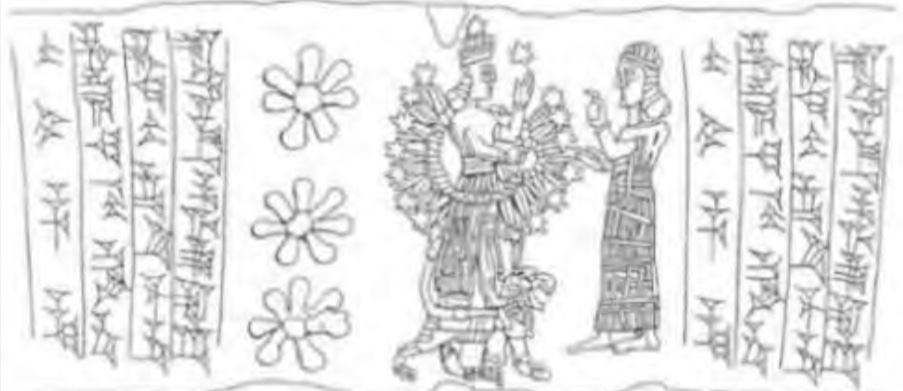
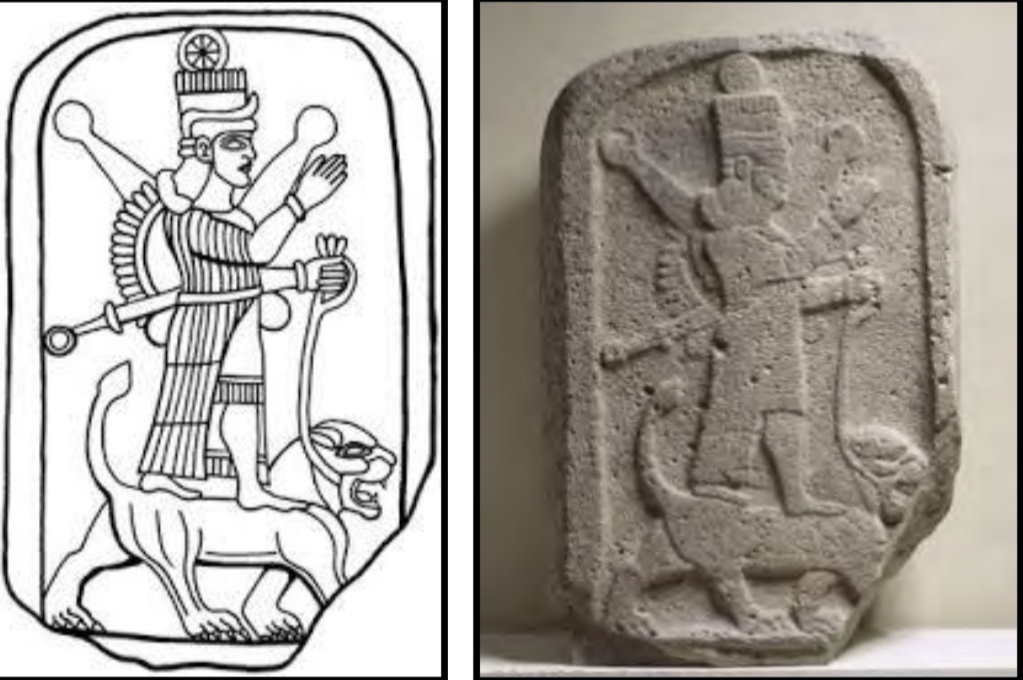
Next, I found usage of the rosette in the Sumerian predecessor of Venus, Ishtar/Inanna. The first is a depiction of Inanna in which she is surrounded by rosettes (Grobler 2021) and the second is a later depiction of the goddess in a late Bronze Age stele, when she was known more commonly as Ishtar, in which her polos contains a rosette (Grobler 2021). While not directly linked to Venus, the connection of the rosette with a predecessor deity of Venus is worth noting.
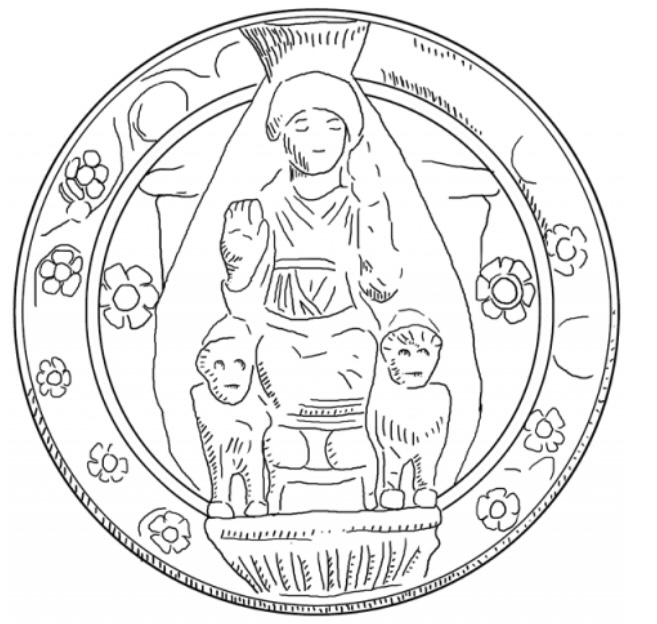
Finally, we return our attention to the Roman tradition, with a depiction of Venus Heliopolitana (Kropp 2010) in which she is surrounded by rosettes. Here, Venus is directly associated with the rosette, further solidifying her connection with the symbol, convincing me that the symbol is commonly associated with the goddess, likely in her aspect as the goddess of fertility, associating her with blooming flowers and spring. With this connection established, I feel confident in turning my attention to a specific inscription in Assisi, the funerary stele of Caius Auburius Auctus, freedman of Caius (CIL XI, 8025).
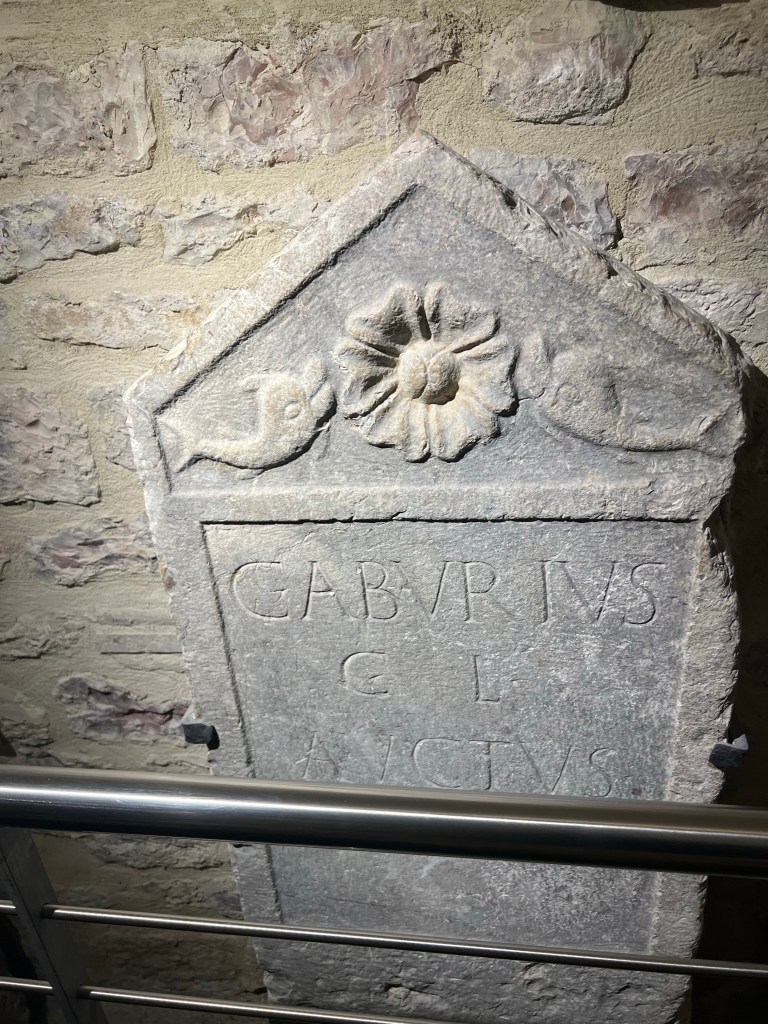
As mentioned above, this funerary monument was erected for Caius Aburius Auctus, who was a freedman formerly belonging to Caius ( C(aius) Aburius / C(ai) l(ibertus) / Auctus) (CIL XI, 8025). Of particular interest is the nomen Aburius, as it likely originates from what is now Spain. As Pena states, “Auburius es un nomen muy escaso en Hispania: tan solo tres casos en el repertorio de Abascal incluyendo el nuestro” (Pena 2004). Paraphrasing a translation of the Spanish, this study of names in Hispania discusses the name Aburius, and says that it is a rare name in the region, with only three cases in the record. Despite being a rare name in the region, it is mainly known from Hispania, suggesting Caius was from what is now Spain.
Knowing his identity, we can now hypothesize on the meaning of the funerary art in greater detail. As discussed, the use of a rosette lends a connection of the monument to Venus in some respect. However, there is a hiccup here, as Caius is clearly not a young girl buried under the auspices of Venus Funeraria, so there must be another explanation.
One possible explanation is that the design was simply a common one for the citizens of the city. As mentioned above, the rosette and fish design of Caius’ marker is notably similar to another found in Assisi. Perhaps the design was popular and was chosen without a deeper meaning beyond aesthetic considerations.
On the other hand, it is possible Caius had some sort of affinity for Venus. Given the presence of dolphins on the stelae, it is possible he was a sailor or merchant, and he felt it important to honor Venus as the protector of sailors. Perhaps she was the patron goddess of his family or his former owner’s family, and as such, he felt he should honor her in his final resting place. By doing so, he carried the legacy of his family and the goddess they held in special reverence with him into the afterlife, and his memory in the world of the living remained entwined with the stories of Venus.
Works Cited
Anđelković-Grašar, Jelena, and Milica Tapavički-Ilić. “Finds in the Late Iron Age Tradition from the Roman Graves of Viminacium.” Studia Antiqua et Archaeologica, vol. 23, no. 1, 2017, pp. 71–82. 2017, https://doi.org/https://hdl.handle.net/21.15107/rcub_rai_262
Brinkmann, Vinzenz, et al. “The Funerary Monument to Phrasikleia” Circumlitio: The Polychromy of Antique and Mediaeval Sculpture, 12th ed., vol. 10, Hirmer, Munich, Bavaria, 2008, pp. 188–213.
Andreas J. M. Kropp, “Jupiter, Venus and Mercury of Heliopolis(Baalbek) » , Syria [En ligne],87 | 2010, mis en ligne le 01 juillet 2016, consulté le 30 juin 2023. URL :http://journals.openedition.org/syria/681 ; DOI : https://doi.org/10.4000/syria.681
Grobler, Estelle Cornelia. “The Rosette Symbol in the Ancient Near East : An Iconographic Approach.” Handle Proxy, 1 Sept. 2021, https://hdl.handle.net/10500/29212
Pena, M. J. «La Tribu Velina En Mallorca Y Los Nombres De Palma Y Pollentia». Faventia, vol. 26, no. 2, January 2004, pp. 69-90, https://raco.cat/index.php/Faventia/article/view/21926.
CIL XI. Miko Flohr, http://www.mikoflohr.org/data/texts/CIL_11_8025__60024/. Accessed 30 June 2023.
 TRAP
TRAP 
Leave a comment