By Jay Falcone
In 1986, a landslide at I Fucoli, Tuscany, exposed the remains of an Etruscan temple near an operational thermal spring, on the road from Chiusi to the ocean. Although fragmentary, the importance of these architectural remains is highlighted by the scarcity of Etruscan rooftop terracottas. Excavated under the direction of Anna Rastrelli and the Archaeological Superintendency of Tuscany, the temple’s pediment was reconstructed and unveiled in 1998 at the Archaeological Museum of Chianciano Terme, the uncovered fragments being used to estimate the proportions of the temple (Rastrelli 1999, 46).
On my visit to the Chianciano Terme Archaeological Museum, I was fortunate enough to view the Etruscan temple’s reconstruction, artfully installed within an adapted palazzo from the 19th century. The reconstruction, a mix of original and replacement terracotta tiles, soars two stories and is overlooked by a viewing platform above. Only the right side of the pediment survives, the rest likely destroyed by a landslide. The temple remains were determined to have been deliberately dumped along the hillside, following its destruction during the 1st century CE (Rastrelli 1993, 465). To the right, a small reconstruction of the temple’s entirety illustrates its condition during the mid-2nd century BCE. This date has been concluded as the terminus post quem of the temple, due to the discovery of a coin from this period during the excavation (Rastrelli 1993, 464).

Figure 1. Jay Falcone. Composition of right side of pediment. Archaeological Museum of Chianciano Terme. Italy, 2023.
During the excavation, archaeological discoveries included votive objects, such as an iron sacrificial axe, two bronze figurines, and “two bronze balance weights, one with two female heads and the other with the heads of a satyr and a maenad, followers of Dionysos.” Temple furnishings found alongside the votive objects included a 5-foot-long “bronze oil lamp decorated with fretwork,” along with the 13-foot-long iron chain used to suspend the lamp (Rastrelli 1999, 44).
The remaining sculpture portrays the advanced level of artistry possessed by Etruscan sculptors working during a period of Hellenistic cultural influence. Inside the pediment, the tympanum includes a bearded male, seated adjacent to a krater. The figure to his left is also a draped male, said by archaeologist, Anna Rastrelli, be stylistically similar to Phidias’ Statue of Zeus at Olympia (Rastrelli 1999, 44). Indicative of the profound Hellenistic influence on Etruscan civilization during the period, the head of Herakles has been positively identified due to his lion-skin cloak, resembling the depiction of Herakles at the 2nd century BCE Pergamon Altar (Rastrelli 1999 45; Rastrelli 1993, 467). The female figure acting as an acroterion, a “winged female genius” originally connected with Aphrodite, was later identified as Thesan, the Etruscan goddess of the dawn, showing the fusion of Etruscan and Hellenistic culture (Rastrelli 1999, 46; Simon 57, 2005). More Hellenistic imagery is included on the cyma molding around the pediment, including a marine thiasos procession with a Nereid riding a sea dragon (Rastrelli 1999, 45).
The sculpture work at I Fucoli finds parallels at other Etruscan sites. The thiasos procession can be found at the temple of Talamone, while the sculptures of children riding dolphins are similar to a depiction of a young Bacchus at the contemporaneous shrine of Bolsena. The female genius, the most celebrated of the ensemble which has become a symbol of the Archaeology Museum, her likeness peppering the gift shop, is comparable to female pediment figures on the Etruscan temple at Civita Alba (Rastrelli 1999, 46). While the reconstruction of the pediment was made possible by alphabetical markings on the cyma, encompassing at least 11 elements in total and comprising a temple 50 feet wide, identifying the cult associated with the temple has been more difficult.
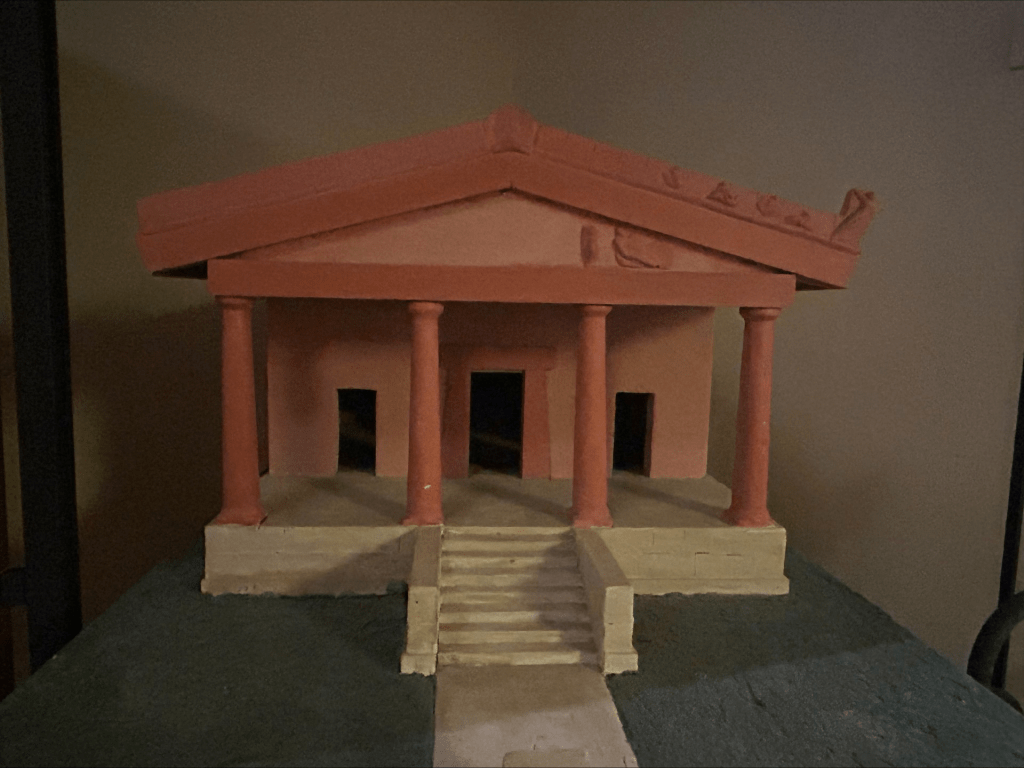
Figure 2. Jay Falcone. Reconstruction of the temple, 2nd century BCE. Archaeological Museum of Chianciano Terme. Italy, 2023.
Anna Rastrelli proposes that the likely answer is a “cult of springs,” connected to the nearby sanctuary of Sillene, where a statue of moon-goddess Selene was found. The scheme of nearby sanctuaries likely encompassed a cult which venerated “the curative properties of thermal springs” (Rastrelli 1999, 46; Rastrelli 1993, 476). In 2005, the ensemble’s symbolism was readdressed by Erika Simon, who posited that the female acroterion on the right of the pediment represents the goddess of dawn, Thesan, in the act of shielding her eyes from the light of the chariot of the sun, possibly located in the center of the tympanum. Flanking Thesan to the left would have been a statue of the moon goddess Selene, the composition facing east in representation of the cycle of the rising sun (Simon, 47-57).

Figure 3. Jay Falcone. Acroterion of Goddess Thesan. Archaeological Museum of Chianciano Terme. Italy, 2023.
While the symbolism of the pediment at I Fucoli can never be ascertained with unwavering certainty, it nonetheless represents the apex of Etruscan sculpture work during the 2nd century BCE, when Hellenistic influence informed their culture. Today, the acroterion of Thesan stands as a representation of the Archaeological Museum of Chianciano Terme, a museum with a worthwhile collection of must-see Etruscan artifacts which warrant greater attention and visitor traffic.
Bibliography
Rastrelli, Anna. 1993. “Scavi e Scoperte nel Territorio di Chianciano Terme: l’edificio sacro dei Fucoli, in La Civiltà di Chiusi e del suo territorio.” Atti del XVII Convegno di Studi Etruschi ed Italici, Chianciano. Firenze. p. 463-476
Rastrelli, Anna. 1999. “Treasures of I Fucoli.” Archaeology 52, no. 1, p. 42–46. http://www.jstor.org/stable/41771477.
Simon, Erika. 2005. “Thesan- Aurora. Zur Deutung des Akroters von Chianciano Terme.” Studi Etruschi, no. 71, p. 47-57.
 TRAP
TRAP 
Leave a comment