Throughout the first few weeks of our time in this program, we have visited many museums. While most visitors to archaeological museums are entranced by elaborate mosaics, impressive sculptures, ceramic vessels, coins, and other ornate artifacts, I have found myself drawn to bones. I think animal bones are often overlooked and undervalued on archaeological sites. While they may not have the aesthetic appeal of many other finds or the grandiosity of large architectural structures, animal bone assemblages can reveal a lot about past human activity and past interactions between people and animals.
The bones displayed in the Museo Diocesano e Cripta di San Rufino in Assisi (seen in the images) below caught my attention. The first thing I noticed was that the labels on several of these bone fragments were misspelled (they should read sheep – not ship – bone). I then noticed that there was no additional information – no placard nearby nor section on the larger informative poster on the wall above providing visitors with information or context about where the bones came from, what information could be gained from the bones, or why they were displayed.
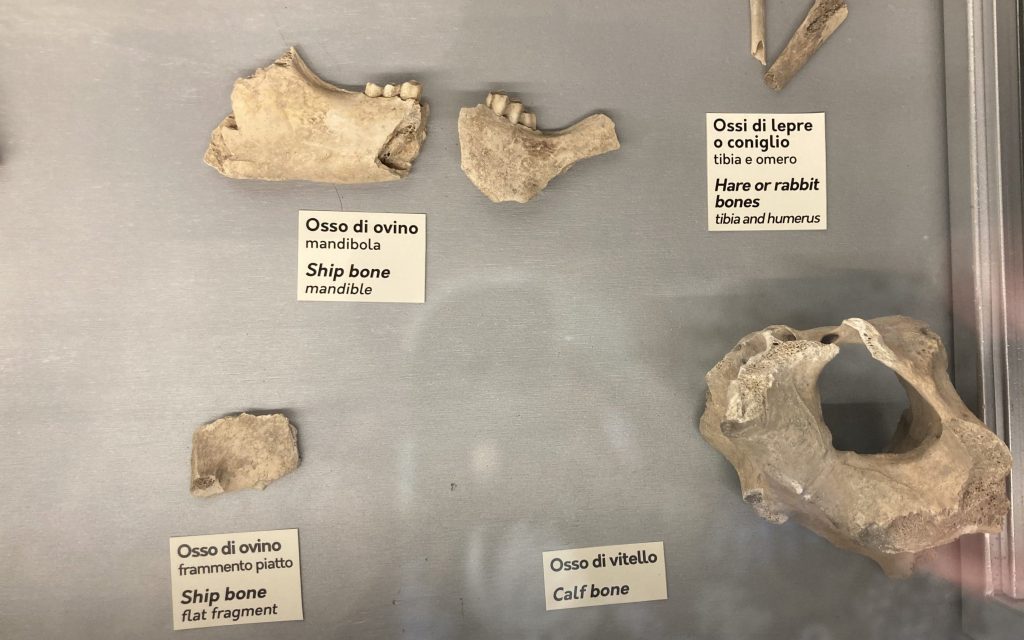
Without any context, these bones are not adding any value to the museum. They don’t tell the visitor any information about the crypts or religion in Assisi. Like any archaeological artifact, bones are useless and provide no information if they are not presented with their context. However, with context, bones and zooarchaeological analysis can provide new insights into animal sacrifices, ancient diets, the use of the space in which they were found, and much more. For example, a large bone assemblage with many cut or butchery marks could indicate that the location in which the bones were found is in or near a kitchen or perhaps a kill site (depending on which skeletal elements are abundant).
In a religious setting, bones could indicate dining or banquets associated with the religious building. For example, in the Sanctuary of Bacchus in Pompeii, a pit near the sanctuary that was marked with flat stones and filled with the remnants of sacrificial animals and pottery dining vessels (along with other archaeological and architectural evidence) has been used to associate this building with banqueting and feasting. The remnants of the pit suggest that meals shared in the sanctuary were considered sacred. (Gazda and Hammer 2000: 61). Many animal assemblages associated with religious sites provide evidence about the types of animal sacrifices that were performed there. Ancient Greek and Roman religions sacrificed animals as a way of establishing and maintaining a relationship with various gods (Faraone 2012: 84). Could the assemblage of animal bones found in Assisi suggest something about dining or animal sacrifice in religion practiced there?
I also noticed that one of the bones had been labeled simply “Calf Bone.” I have recently taken a class on zooarchaeology focused on learning the entire skeleton of different mammalian taxa, so I recognized that this bone was a unique shape and identified it as the atlas bone, which is the first vertebrae of mammals. The atlas connects the skull to the vertebral column and often has human taphonomy marks indicative of dismemberment (specifically removing the head from neck and rest of the body). Were any butchery marks found on this specimen? Again, what information is a museum visitor gaining from this bone display?
Were these bone fragments the only bones that were found in excavations of the Crypts of San Rufino? Why did the museum curators decide to display these specific bones if others were also found? Did they date the bones (either relatively dated based on stratigraphy or more specifically dated? What information is this display trying to convey to museum visitors? Are they there simply for entertainment value?
In order for bone specimens to add value and meaning to this museum, they need to be presented with context including accurate and more specific labels, dates (these bones are even more meaningless if they are modern), any taphonomic marks, and what information we can gain from these bones.
References:
Faraone, Christopher A., F. S. Naiden, and John Scheid. “Roman Animal Sacrifice and the System of Being.” Essay. In Greek and Roman Animal Sacrifice: Ancient Victims, Modern Observers, 84–95. Cambridge: Cambridge University Press, 2020.
Gazda, Elaine K., and Catherine Hammer. “Bacchus/Liber in Pompeii: A Religious Context for the Villa of the Mysteries Frieze.” Essay. In The Villa of the Mysteries in Pompeii: Ancient Ritual, Modern Muse, 59–74. Ann Arbor: Kelsey Museum of Archaeology and the University of Michigan Museum of Art, 2000. O’Connor, Terry. “Taphonomy: From Life to Death and Beyond.” Essay. In The Archaeology of Animal Bones. College Station: Texas A&M University Press, 2016.
O’Connor, Terry. “Taphonomy: From Life to Death and Beyond.” Essay. In The Archaeology of Animal Bones. College Station: Texas A&M University Press, 2016.
 TRAP
TRAP 
Leave a comment