Spello’s Villa of Mosaics
By Isabella Pallotta
People who are drawn to the past and who want to experience how similar or different it was from today would appreciate a display like that in Villa dei Mosaici di Spello. Although this is an example of a high status living space (and not of ‘common people’), the layout and interactive material of the museum offer a connective experience to Roman and high-imperial age people through walkways, videos, museum placement, strata exposure, and kids’ arts and crafts that is not commonly seen.
The most positive attribute of this museum from an archeological perspective is how it was built around the feature. The mosaics were not removed and displayed in a museum. This demonstrates what archeologists call “context”, and maintaining context is a significant struggle for most museums. Building the museum around the villa and maintaining not only the mosaics, but the walls, doorways, and pattern of room placement allows viewers to walk through the museum as if they were walking through a house. To view the locations of mosaics offers meaning and purpose for each mosaic in its respective room, which helps archeologists understand their relationships, determine their message, and spark the imagination of the viewer.
Elevated walkways also allow visitors to move above the mosaics and through the villa as if they are in it, permitting the audience to imagine themselves as the people who lived there, seeing what they saw and picturing the past. There are also video reconstructions playing above the rooms of what it would’ve looked like in its prime, so if the intact mosaics and walkways weren’t enough, there are also evocative images suggestive of the past, asking visitors to immerse themselves.

While excavating, archeologists also kept a three layered stratigraphy of the hypocaust system for a heated floor. One layer shows the brick pilasters underneath that support the floor for hot air flow, one shows the tile floor on top, and one shows the room full of debris, as if just discovered by archeologists.

This presentation allowed me to imagine every stage of the hypocaust, the work that went into making it with the reveal of the brick pilasters, the use of the room by the owners who would only see the tile floor, and the eventual collapse and abandonment of the place covered by dirt with the un-reconstructed portion of the room. Such interactive strategies keep the context of the artifacts and allow spectators to see the villa as a whole: as a place of living and carrying out meetings and daily life. This is better than removing a mosaic and placing it in a museum to be viewed as a piece of art. It brings the a first-third c. AD site to life (Spello’s villa of Mosaics, 2015). Especially in a well-off household such as this one where business deals and other specific activities would take place in certain rooms, it’s important to understand the meaning of each mosaic to hypothesize which activities took place.
The museum not only added these interactive walkways and videos for adults but made other additions to help children “process their experiences” (Crisis, 2017), such as an interactive space with DIY mosaics. This not only gets kids excited and gives them a reason to want to care about the mosaics, but art has been proven to help kids “express their feelings…[when] they lack the vocabulary” to do so with words (Crisis, 2017).
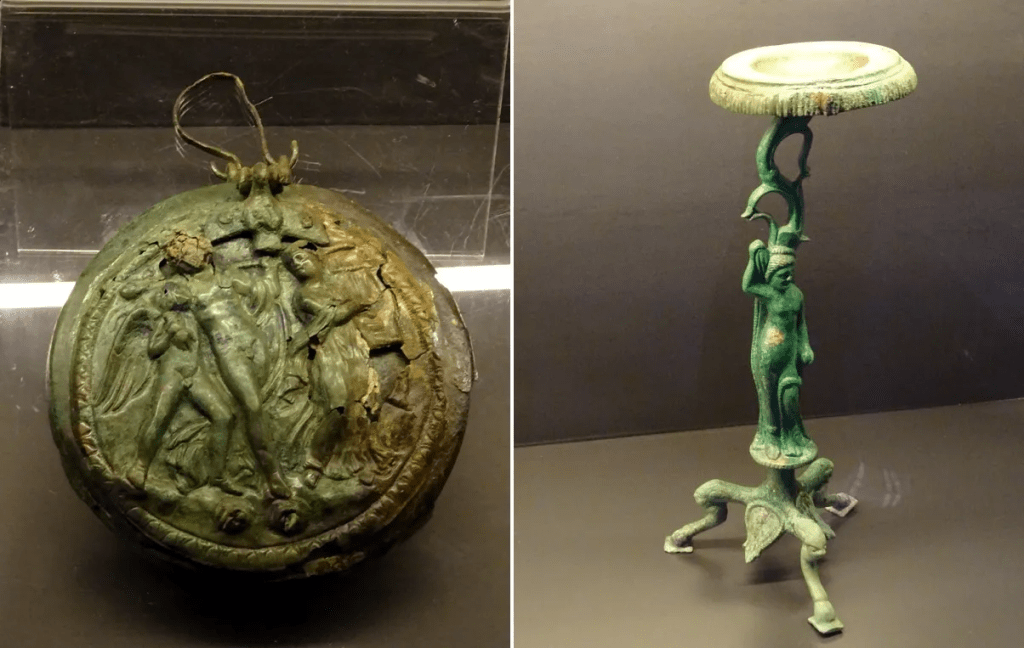
The Museum also chose to to display some artifacts found on the site around the outside of the mosaics in cases. The origins and room of the artifacts was sometimes not given on the plaque, which limited the interpretation of viewers so they could not guess what the room could possibly be used for. This leaves a little mystery and imagination left to the viewer where it doesn’t need to be—knowing the placement of the artifacts would help visitors process the purposes of the rooms.
The Villa dei Mosaici di Spello incorporated context within the museum design through intact architecture and interactive walkways and videos, as well as child and adult friendly layout, to form a great museum experience that challenges spectators to immerse themselves in the homes, decoration, and lives of Romans during the high empire. It is one of my favorite museums I have visited in Italy—the beautiful mosaics and open relaxing design creates an addictive environment that transports you into the past.
Sources
Figure 1: “La Villa Dei Mosaici Di Spello – Comunicato Stampa.” IL TERMOPOLIO. Accessed July 7, 2022. https://www.iltermopolio.com/archeo-e-arte/la-villa-dei-mosaici-di-spello-comunicato-stampa.
Figure 2: “Heat Storage Hypocausts: Air Heating in the Middle Ages.” LOW. Accessed July 7, 2022. https://www.lowtechmagazine.com/2017/03/heat-storage-hypocausts-air-heating-middle-ages.html.
Figure 3: “Spello: Villa Dei Mosaici.” Corvinus, November 16, 2019. https://corvinus.nl/2019/10/01/spello-villa-dei-mosaici/.
AZ, Child Crisis. “5 Incredible Benefits of Art for Kids: Child Crisis Arizona: Safe Kids, Strong Families.” Child Crisis, July 10, 2019. https://childcrisisaz.org/5-incredible-benefits-of-art-for-kids/.
“The Discovery.” Spello’s Villa of Mosaics. Accessed July 7, 2022. https://www.villadeimosaicidispello.it/en/villa/the-discovery/.
 TRAP
TRAP 
Leave a comment