By Megan Outtrim
Prior to starting our dig this season, my fellow students and I had the opportunity to visit several Etruscan, Umbrian, and Roman sites throughout Umbria in order to get a better understanding of the history and archaeology of the region. One of these sites was in the city of Spello—known as Hispellum in ancient times—which began as an Umbrian center before becoming a Roman municipality in the first century BC. Just outside of the town walls sits the Villa dei Mosaici, a monumental, late-imperial Roman villa complex discovered in 2005. The villa has twenty identified rooms, many of which boast splendidly preserved mosaic floors that depict geometric patterns, iconographic images, and nature scenes. A museum was built around the site following the excavations and restorations, ensuring its protection and allowing visitors to view the different rooms and mosaics from catwalks.
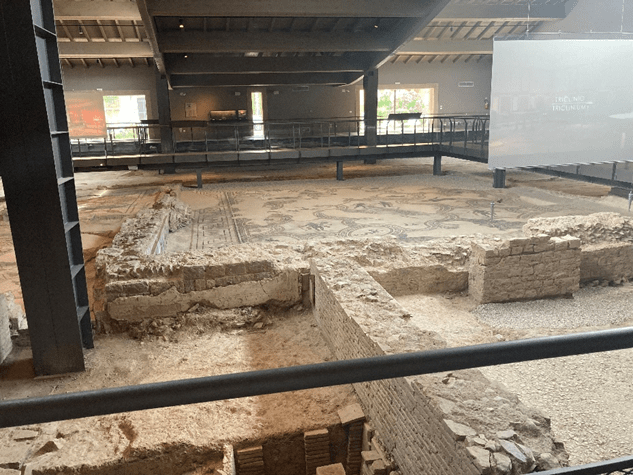
The mosaics in this villa are complex and give us some information on what may have been happening in each room and inside the villa overall. The skill that went into making them—specifically the fluidity of the mosaic designs and color rendering—indicate that the artists probably came from Rome itself, attesting to the wealth of the villa owner (Villa dei Mosaici di Spello). While each mosaic merits examination and analysis, there was one in particular that I found especially fascinating. This is the eponymous floor mosaic in the Radiant Sun Room—a smiling sun with marshy plants radiating out from around it, as well as different species of birds among the flora. These are all within a central octagon surrounded by geometric designs and a square border, itself being off-center to allow room for several connected circles running along one wall of the room; the sun’s face is in the opposite direction of these circles.
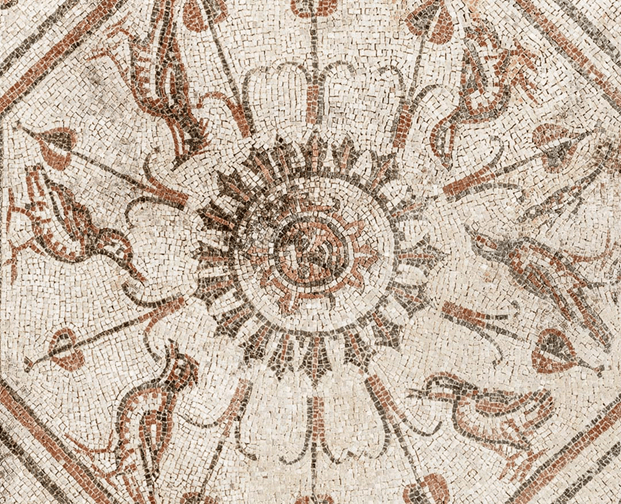
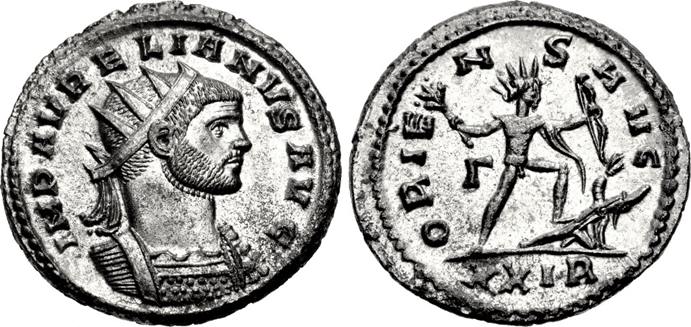
This mosaic floor was intriguing to me because it gives no indication of the room’s purpose, as appears in other mosaics in the villa, and because it is unique compared to other Roman mosaic designs I have seen. While trying to research more about the meaning behind the sun and its facial features, I found no other examples of suns depicted in this way. Generally, Roman depictions of the sun in mosaics and other art forms (reliefs, frescoes, coinage, etc.) had a sun deity fully depicted or the deity’s face with beams radiating out from it. However, I did learn that during late imperial Rome—the time period to which this villa dates—there was an increase in the importance of the solar cult, which had been in decline for a few centuries (Simpson 2020, 65). Emperors like Constantine used depictions of the sun god Sol Invictus as a form of political propaganda, tying their personalities to the deity to promote the message of imperial victory (Manders 2012, 22). This can be seen especially in coinage, where the likeness of an emperor would be on one side of the coin and an image of Sol on the reverse. This appears most heavily on coinage struck during the reigns of emperors who had military troubles in the East, possibly to boost Roman spirits in the face of increasing internal and external threats/general weakening of the empire (Manders 2012, 21). The depictions of Sol Invictus in coinage and building projects, again, follow the typical Roman solar iconography of full deities or deity heads with radiating beams, so while the Spello villa sun mosaic was made in the same period as these other solar images, I doubt that it was meant to have the same meaning.
There are two possibilities I find the most likely for understanding the meaning behind the mosaic in the Radiant Sun Room. The first is that the sun and the natural elements surrounding it (birds, plants, etc.) are meant to emphasize the fertility of the region and the Roman desire to control nature. Roman art often drew upon the natural world in the desire to create a perfect combination of natural beauty and manmade structure, seeking to conquer nature just as Rome had conquered lands from Britain to the Middle East. The portrayal of the sun, plants, and birds could be a continuation of this style of Roman artistry. The fact that the plants are shown with their full flower heads could also symbolize the fertility of Spello’s fields.
The second possible understanding of this mosaic is that it is an example of foreign artistic influence merging with the Roman art of mosaics. While I have not found anything outright to support this, it seems viable since the sun in this room is iconographically so different from the typical Roman style. If the villa owner originated from somewhere else, they could have merged solar imagery from their place of origin with Roman artistic styles, creating a unique piece unlike anywhere else in the Roman world (as is the case with this mosaic).
Overall, my research on this mosaic seems to have left me with more questions than answers, and this only makes my fascination with the mosaic grow stronger. With time, I hope the mystery of this distinctive mosaic will be unfurled and will give us more valuable information about the world of ancient Spello.
Works Cited
Villa dei Mosaici di Spello. “The Mosaics.” https://www.villadeimosaicidispello.it/villa/i-mosaici/
Simpson, Candace. 2020. The Roman Sun: Symbolic Variation in Ancient Solar Worship. Universiteit Van Amsterdam.
Manders, Erika. 2012. Coining Images of Power: Patterns in the Representation of Roman Emperors on Imperial Coinage, A.D. 193-284. Brill.
 TRAP
TRAP 
Leave a comment