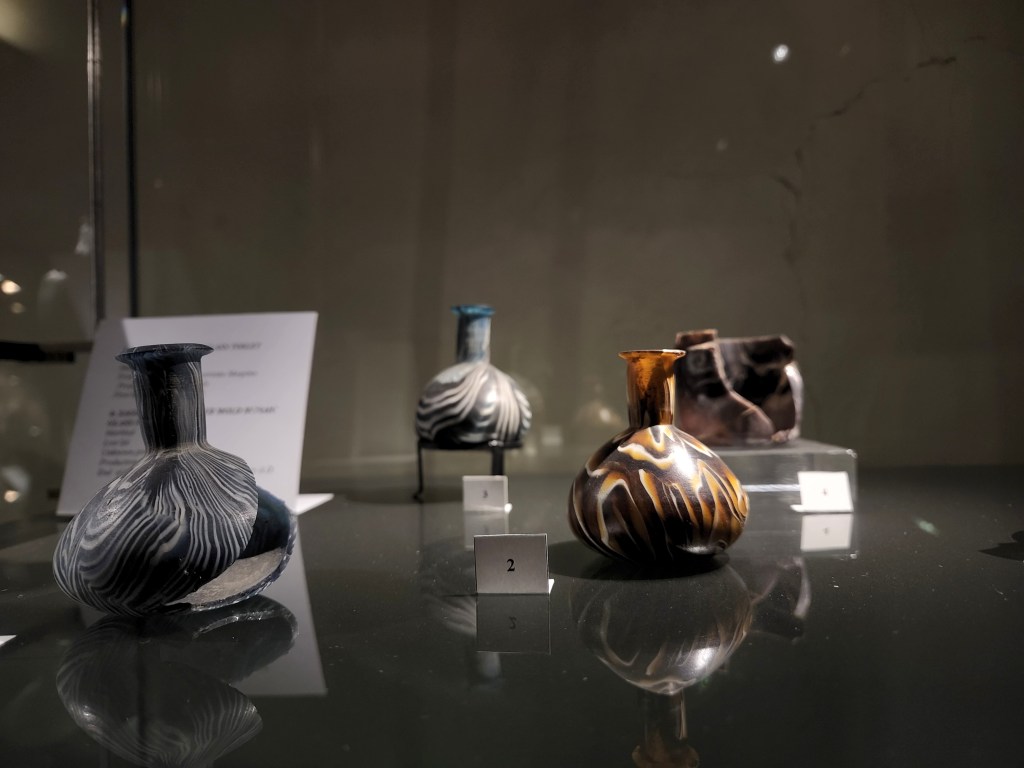
Through the trips we have taken as a class across Umbria and beyond, we have learned quite a lot about Roman hygiene: from the cistern underneath San Rufino and bathhouses of Spello to the vials in the Arezzo Museo Archeologico to the infamous toilets of Pompeii with the classic roman “sponge-on-a-stick.” Out of all of these unique Roman pieces, one set of artifacts in a corner cabinet at the Arezzo Museo, dimly illuminated by an overhead light, caught my attention. After seeing these beautiful glass bottles, glowing under the warm light in brilliant colors, I knew I needed to know more.
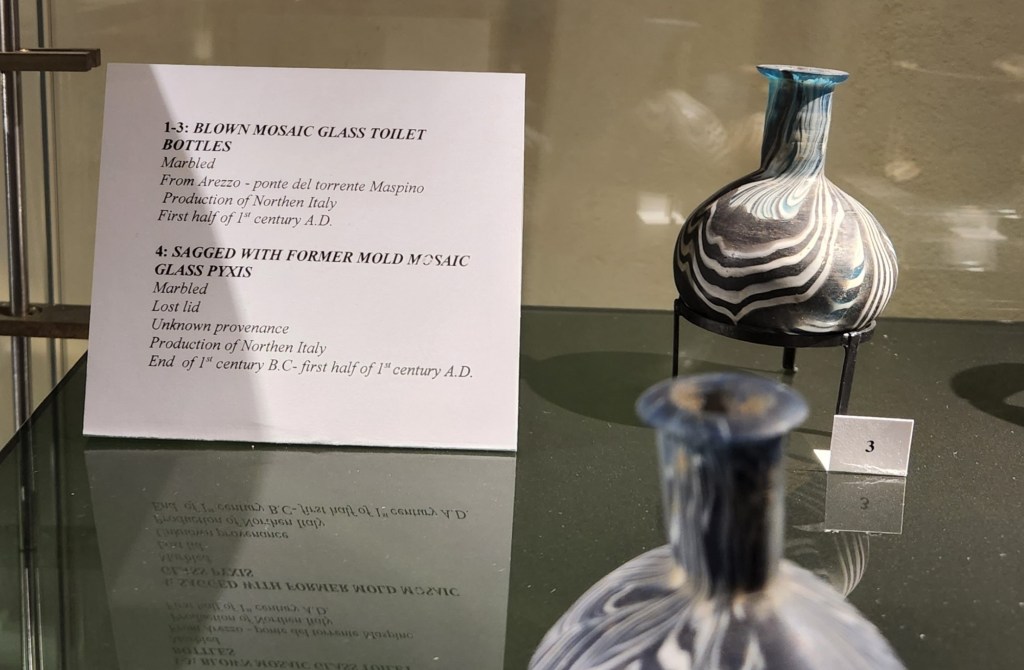
Unfortunately, due to the nature of traditional museum displays, the only information I could find about these little gems was that they were found in Arezzo (near Ponte del torrente Maspino), and made in Northern Italy in the first half of the 1st century AD (See image below). My mind was racing. How did the Romans brilliantly color this glass? How did they create these undulating colors that dazzle in the light? Why were these perfume bottles made in the way they were?
Well, these little bottles have a big history. The mass production of glass blown objects like these began around the time of the rule of Augustus, with the advent of the blow pipe. Northern Italy was an early pioneer in this practice around the 1st Century, coincidentally aligning with the timeline of the rule of Augustus (Stern 1999). This implies these bottles were likely some of the earliest instances of commercial glass blown objects in the Roman Empire, as craftsmen began honing practices still in use today (Whitehouse 1997). In addition, these little bottles exhibit what David Whitehouse calls “color-band” glass, an identifier of the earliest transition from glass casting to glass blowing. The process to get these astonishing colors all swirled together involves both casting and blowing the glass. First, people had to melt, cast, fuse, and swirl logs of color to make a marbled blob of glass. Then they picked up the blob with a blow pipe and inflated it using practices still used today (Whitehouse 1997). These magnificent creations were made into a variety of finished products including: cups, plates, storage containers, and toiletry bottles (Stern 1999).
These colors unravel another piece of the mystery. Romans used a variety of materials to tint their glass before it was cast into logs and swirled into the stunning bottles we see here. In the objects at the Arezzo Museo Archeologico, the primary colors were brown, blue, and opaque white. The selection of these colors reveals a unique trait of these glass vessels. Toilet bottles tended to be simple creations of clear glass, without much effort put into their creation (Harden 1934). These bottles do not fit this standard. Therefore, it is unclear why the artisans created these toilet bottles to be so brilliantly colored. The answer may come from through the analysis of their coloring. The three bottles here are made with opaque white, amber brown, and cobalt blue. These glasses are made by oxidizing antimony, by reducing iron-sulphur compounds, and by adding cobalt respectively (“Roman Glass and its Chemistry” 2015). Knowing the Romans completed all of these chemical reactions with no in-depth knowledge of chemistry shows these craftsmen had been able to hone their craft for generations (Harden 1934). The inclusion of these colors in such a dramatic fashion are enough to say they were not common toilet bottles, according to Harden, but not much more research has been done (Harden 1934).
These dazzling little bottles took me on a wild goose chase to track their origins. Paper after paper, I was able to gain a comprehensive knowledge of Roman glass production, thanks to the little light display these glasses put on in the corner of this quaint museo.
Bibliography
“Roman Glass and Its Chemistry.” RSC Education, 26 Nov. 2015, https://edu.rsc.org/resources/roman-glass-and-its-chemistry/1962.article.
Harden, Donald B. “The Glass of the Greeks and Romans.” Greece & Rome 3.9 (1934): 140-149.
Stern, E. Marianne. “Roman Glassblowing in a Cultural Context.” American Journal of Archaeology, vol. 103, no. 3, 1999, pp. 441–84. JSTOR, https://doi.org/10.2307/506970. Accessed 8 Jul. 2022.
Whitehouse, David B. Roman Glass in the Corning Museum of Glass. Corning Museum of Glass, 1997.
Barag, D. “Two Roman Glass Bottles with Remnants of Oil.” Israel Exploration Journal, vol. 22, no. 1, 1972, pp. 24–26. JSTOR, http://www.jstor.org/stable/27925312. Accessed 8 Jul. 2022.
Flask, Mould-Blown Janus Head. “Two Roman Toilet Bottles From Kom el-Dikka.”
 TRAP
TRAP 
Leave a comment