Matt Roarty
After beginning our lectures, I found myself excited to tour a historic city like Perugia. I assumed that the architecture remaining above ground and the intricate below-ground passages would grab my attention the most, but it was the National Archaeological Museum of Perugia where I found an artifact that fascinated me.
At first glance, it didn’t seem like much. At only about 30.5 centimeters (12 inches) tall and 16.5 centimeters (6.5 inches) across the mirror face , it looked to be a simple bronze mirror with little to no detail. But I stopped for a moment. I was trying to determine what about this piece would signify wealth or importance, when I suddenly realized that I had missed a beautifully engraved scene underneath years of tarnish.
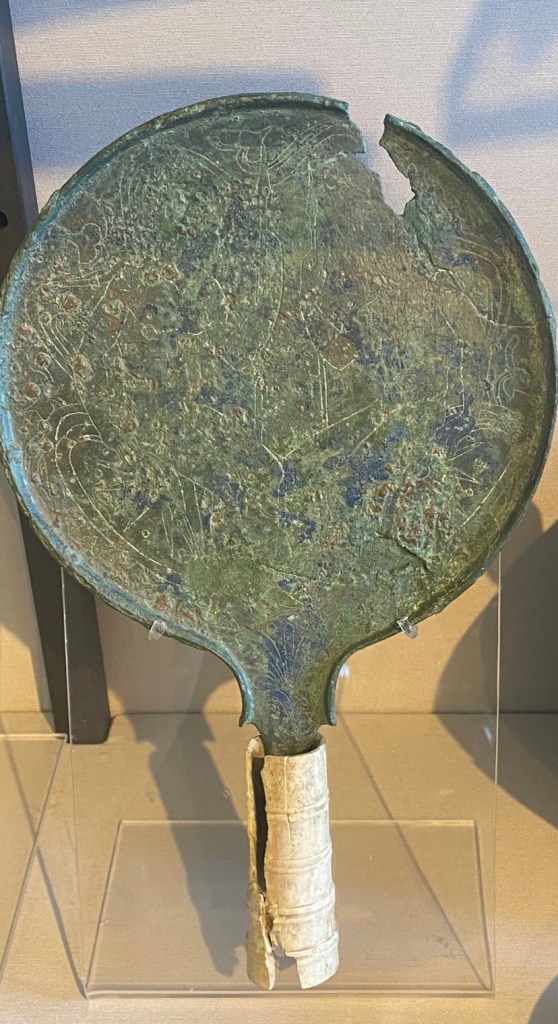
Lines etched into the back side of this mirror seemed sporadic and unconnected, yet after further inspection, figures emerged. Depicted are two nude men, seated upon their shields, with spears in hand facing one another. On the shields were engraved large stars, and surrounding the men were floral design flourishes. I am disappointed to say, however, that the faces of the figures were largely obscured by the condition of the bronze, making it unclear who were depicted. As far as its date goes, mirrors similar in style that I’ve researched (and pictured below) belong roughly around the 5th to early 3rd centuries B.C.E.

This left me with two looming questions: who are the two figures engraved onto the mirror, and most importantly, why?
After visiting other sites and doing some research, I hypothesize that the figures on the mirror are the Dioscuri. The Dioscuri were the legendary twin sons of the Greek god Zeus. Not only are they the patron gods of horses and cavalry, but of sport and guests as well. They’re often depicted as young men, “wearing cloaks and piloi, accompanied by their horses, carrying spears and with stars above their heads.” (Gartrell). These attributes aren’t always followed, however, as a similar Etruscan mirror shows them without their horses (Fig. 2). This image is extremely similar to the one I saw in Perugia which only solidifies my claim of the unknown subject matter damaged over the years.
Now that I had a theory about who might be pictured on the mirror, I was left with the questions of why they were there, and who would have owned the object.
The reason for why the Dioscuri would have been on this mirror is directly related to the question of ownership. The bases for how depictions were chosen include: an owner’s role models, themes that told an inspiring story, or thought-provoking ideas (Carpino, 31). Role models included gods and heroes from myth, like this bronze mirror that depicts Prometheus (Fig. 3).
The Dioscuri are usually associated with horses and cavalry. To own a horse at this time was expensive and required time, money, and manpower, as well as land. Associations with, or aspirations to, wealth and status could be projected through these objects and their divine or heroic characters.
Not only symbolizing wealth and power, these images of fit and handsome, well-sculpted young men carried societal messages about beauty and bodily fitness. The mirror was, after all, an object used for personal grooming, so the image of handsome or ideal bodies would indicate some level of self awareness concerning one’s own body image.
Through my experiences and research, my eyes have opened up to the history and meaning of Etruscan hand mirrors—which I didn’t expect. I look forward to learning more.
Works Cited
Carpino, Alexandra A. 2016. “Marriage and Parenthood on Classical Period Bronze Mirrors: The Case of Latva and Tuntle.” Journal of Ancient Egyptian Interconnections 10 (September): 31–38. https://search-ebscohost-com.arcadia.idm.oclc.org/login.aspx?direct=true&db=asn&AN=118358829&site=ehost-live.
Gartrell, Amber. The Cult of Castor and Pollux in Ancient Rome: Myth, Ritual, and Society. Cambridge ; New York ; Port Melbourne ; New Delhi ; Singapore: Cambridge University Press, 2021.
Images
Figure 2: Kratochvil, Zdenek. Etruscan Mirror. 2015. Wikimedia Commons. https://commons.wikimedia.org/wiki/File:Etruscan_mirror,_engraved_Dioskouroi,_bronze,_300_BC,_Prague,_NM-H10_5943,_151177.jpg.
Figure 3: Bronze Mirror. The Metropolitan Museum of Art. Accessed July 6, 2022. https://www.metmuseum.org/art/collection/search/247074.
 TRAP
TRAP 

Leave a comment