
It is uncommon to find intact cinerary urns from the Roman Imperial period, let alone a glass cinerary urn. However, the Museo Archeologico Gaio Cilnio Mecenate in Arezzo, Italy has its very own glass jar-shaped cinerary urn from Tharros belonging to the second half of the 1st—2nd century A.D.
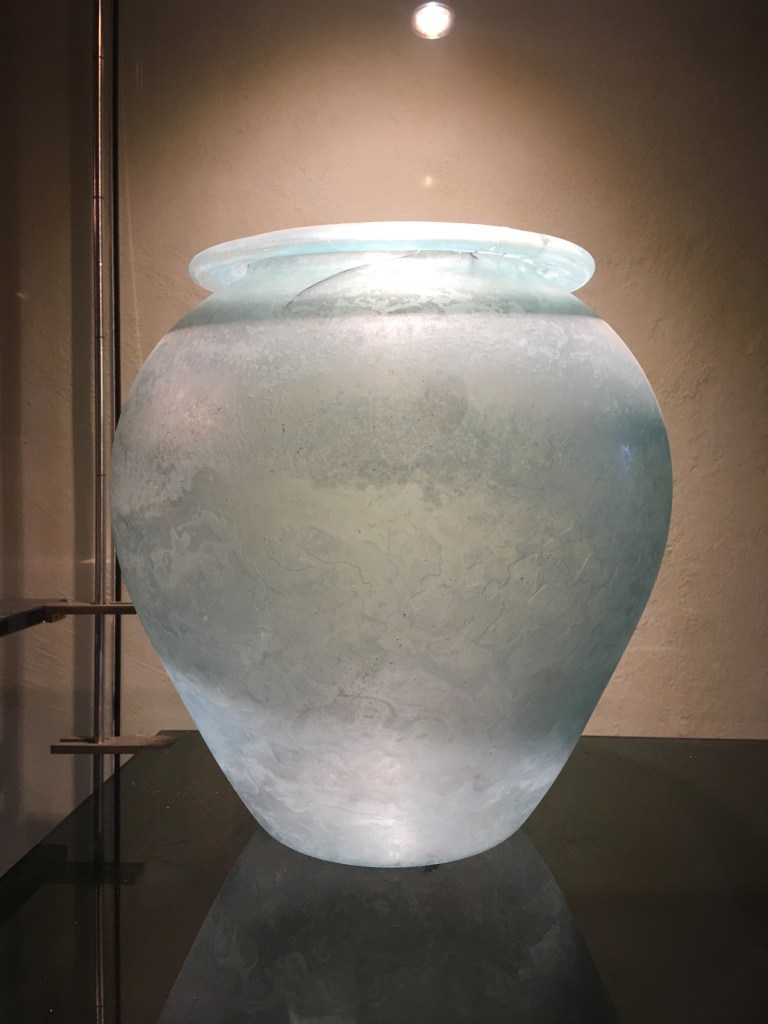
This cinerary urn is a beautiful crystal blue, with only a few (hardly noticeable) cracks along and around the rim. Otherwise, this fascinating piece is completely intact and carefully displayed with its own spotlight in Arezzo’s museum of archaeology (Fig. 1). As soon as I saw this shining blue urn, I knew I had to know more. This led me to learning about the origins of glassblowing in the early Roman Imperial period, when the perfection and commercialization of glassblowing occurred in Italy.
As D. B. Harden, a renowned glass historian, explains, the process of glassblowing includes gathering a chunk of molten glass on a blowpipe about 3 to 5 ft long, expanding the molten glass by blowing, affixing a solid iron rod (also called a punty or pontil) about 2.5 to 3.5 ft long to the bottom of the vessel with a wad of glass, and then separating the vessel from the blowpipe and holding it on the punty while the mouth of the vessel is finished. However, it wasn’t until the year A.D. 70 that many workshops made use of iron blowpipes, as they did not have the proper technology to construct a sturdy iron tube during the Early Imperial period. Before 70, glassblowers likely used clay blowpipes. The transition from clay blowpipes to iron blowpipes is indirectly evidenced by the transition of types of glass works being produced: from small glass bottles and cups to large glass bottles, plates, and cinerary urns with handles. How we know approximately what time period the glass cinerary urn in Arezzo’s museum of archaeology comes from is explained by this transition in glass production, as the cinerary urn is much too large and heavy to have been produced using a clay blowpipe.
As I mentioned earlier, it is uncommon to find glass cinerary urns, whether intact or fragmented. This is likely because the Romans discovered that they could remelt broken glass artifacts and reuse the molten glass for new purposes. This discovery of the potential of remelting and recycling glass led to the intentional collecting of broken vessels for reuse. The dearth of surviving glass cinerary urns is also a result of the long and troublesome process of glassmaking, or more specifically the difficulties of the furnaces the Romans used. Although the Romans invented their own type of furnace specifically for glassworking, with a horizontal heat chamber similar to those furnace glassworkers use today, the Roman furnace was small. Having an interior circumference of only about 45-65 cm and only one working port, this meant that each glassblower needed their own glassworking furnace. In addition, these furnaces needed 24 hours to cool down after a day of work, meaning that each furnace could only be used every other day. Taking into account these factors as well as the amount of time that each vessel would take to produce and anneal, it is no wonder that we see ceramic vessels appear much more frequently in the archaeological record.
The significance of the glass jar-shaped cinerary urn in Arezzo not only comes from its rarity and simplistic beauty, but also from the complexity of its production. Unfortunately, that is also where the Museo Archeologico Gaio Cilnio Mecenate falls short. While it displays this object shining in its brilliance and contextualized by where and when it came from, there is no further understanding to the history of this piece or its creation. Its story remains lost in time, only understood by those who care to learn, and it is instead remembered primarily for its beauty. Although it is important to gain the interest of the public with pretty and shiny objects, it is even more important to educate the public on those objects. Alas, until then, we must educate ourselves.
Works Cited:
Dries, François M. A. van den. “Some Notes on Roman Mold Material and the Technique of Molding for Glassblowing.” Journal of Glass Studies 49 (2007): 23–38. http://www.jstor.org/stable/24191114.
Fleming, Stuart. Roman Glass: Reflections of Everyday Life. Philadelphia: The University of Pennsylvania Museum of Archaeology and Anthropology, 1997.
Lightfoot, Christopher. “A Mold-Blown Head Flask: Late Roman Glass in a Wider Context.” Journal of Glass Studies 62 (2020): 83-94. https://www.jstor.org/stable/26951074.
Stern, E. Marianne. “Roman Glassblowing in a Cultural Context.” American Journal of Archaeology 103, no. 3 (Jul., 1999): 441-84. https://www.jstor.org/stable/506970.
Stern, E. Marianne. “Roman Glass From East To West.” In Glass of the Roman World, edited by Justine Bayley, Ian Freestone, and Caroline Jackson, 77–94. Oxbow Books, 2015. http://www.jstor.org/stable/j.ctt19893xf.14.
 TRAP
TRAP 
Leave a comment