Morgan Lawson
In many of the museums we’ve visited, most often I have found myself surrounded by other students trying to capture the awe of the glittering, magnificent gold jewelry, gemstones, rings, and ornaments in pictures. However, when I explored other assets of ancient clothing, I found myself far more interested in the cloak pins of the ancient world – the fibulae.
In the Arezzo Archaeological Museum (National Archaeological Museum of Gaio Cilnio Mecenate), I found this display of fibulae and immediately became curious about their purpose and wide range of designs. While the bowed-clasp shape is coherent across all of the designs, the size and decorations differ wildly.
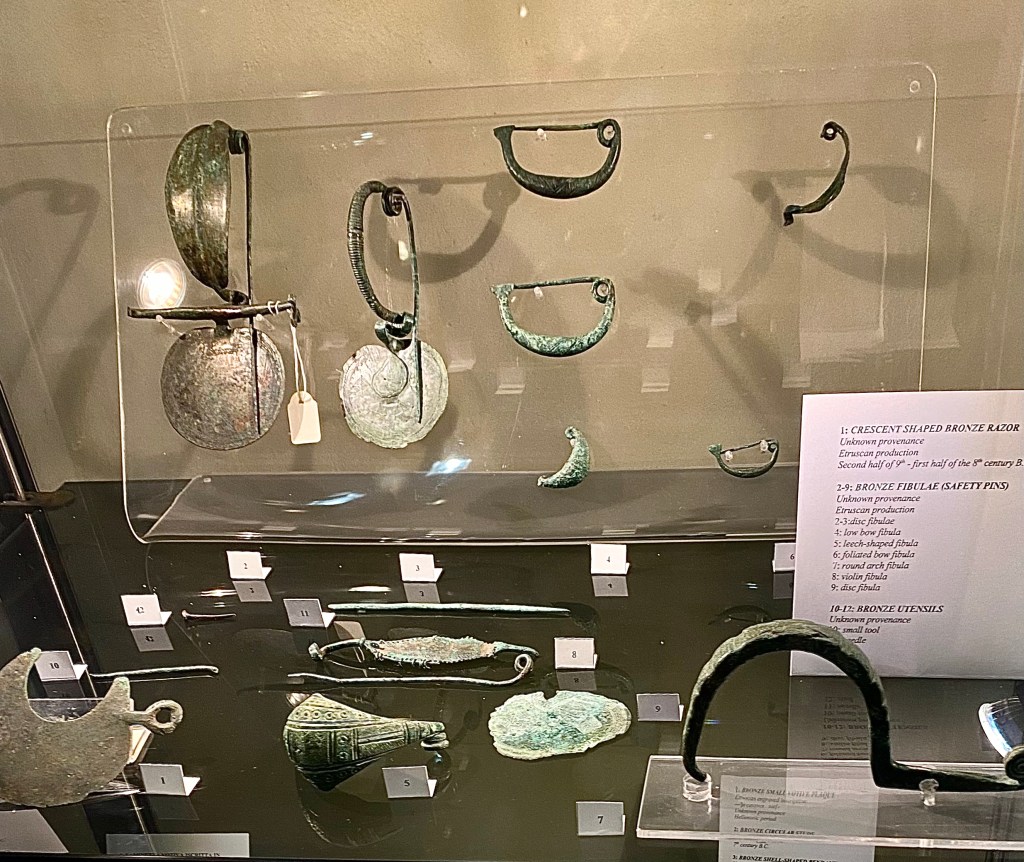
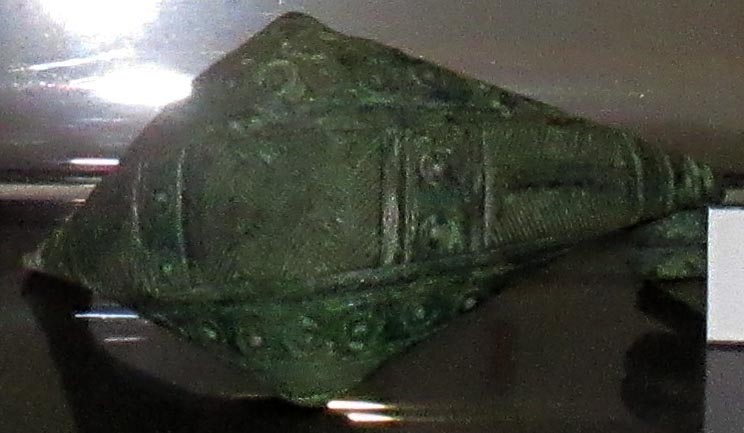
For example, this fibula (pictured in the center bottom of Figure 1, pictured alone in Figure 2), follows the general makeup of a fibula: the bow (front, usually decorative piece, outwardly displayed), the spring (the tense, back pin), and the foot or ‘catch’ for the spring. This fibula is not just for function, though. Very clearly, it was also designed to be an art piece on its own. It is decorated with geometric decoration that required the hand of an artisan. At 7.4 cm (2.91 inches) long, it would have been of significant weight as well, being made of bronze.
This left me with a major question, one that was not answered on any of the museum displays: why are some of these pins so heavy and large? If it’s meant to be a functional piece of fashion, why make them so long or out of such heavy material? For example, this foliated arch fibula (pictured in the upper left of Figure 1 and alone in Figure 3) is positively massive, at 14.5 cm (5.7 inches). At that length and solid weight, it would seem to damage or weigh down any piece of clothing of the wearer to the point of losing all function.
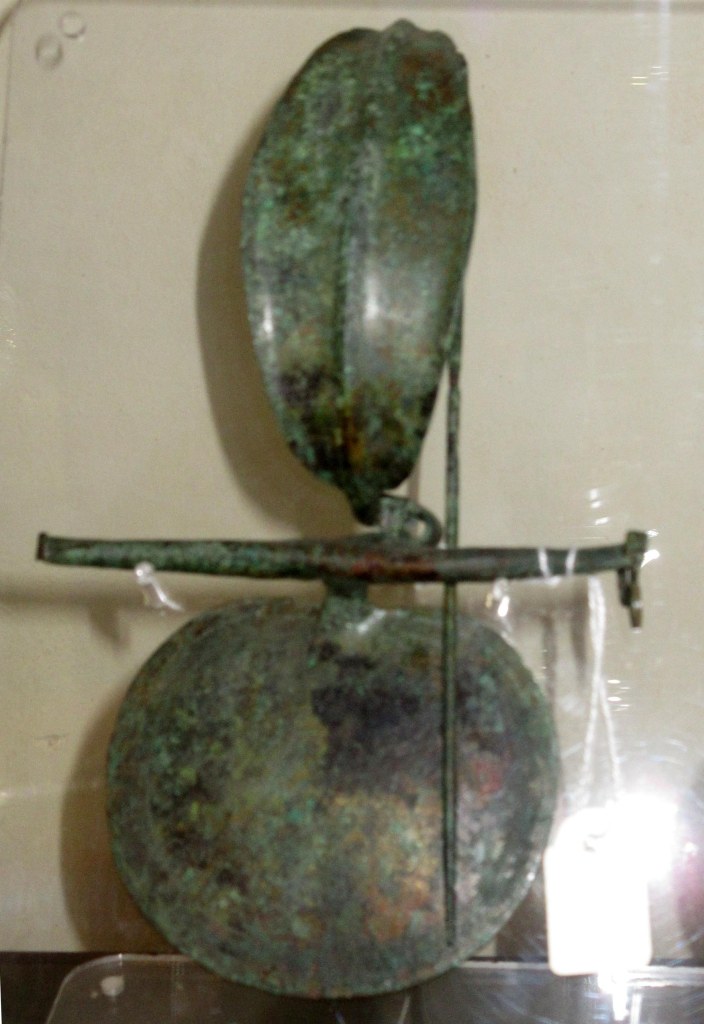
In fact fibulae, at these sizes and intricacy, are common grave goods, meaning that they were specifically made and manufactured to be laid to rest with the deceased. Often, the larger and more ‘inefficient’ the fibula, the larger the display of wealth from the deceased individual. It’s a great signaling device to the surrounding community: if a member of your family is buried in such a lavish and extravagant way in death, where these expensive objects will never see the light of day again, imagine how much wealth they have in the land of the living (Wells 103).
We’ve learned from all of our field trips, from Perugia to Arezzo, that most Etruscan art and artifacts tend to come from the burials. So, while some of the smaller, more portable, and wearable fibulae might have come from the closets of daily fashion for many ancient people, the large and flamboyant 14.5 cm long fibulae were probably crafted for the express purpose of being laid to rest with the deceased.
The unfortunate end to this story is that many fibulae in the glass case in Arezzo lack public (or in fact any) provenance that could be used further to study or understand these artifacts. For example, studies of Etruscan tombs suggest that, in the context of their tombs and presiding grave goods and artifacts, fibulae of certain materials, designs, and shapes might indicate members of different social statuses (Berardinetti 322).
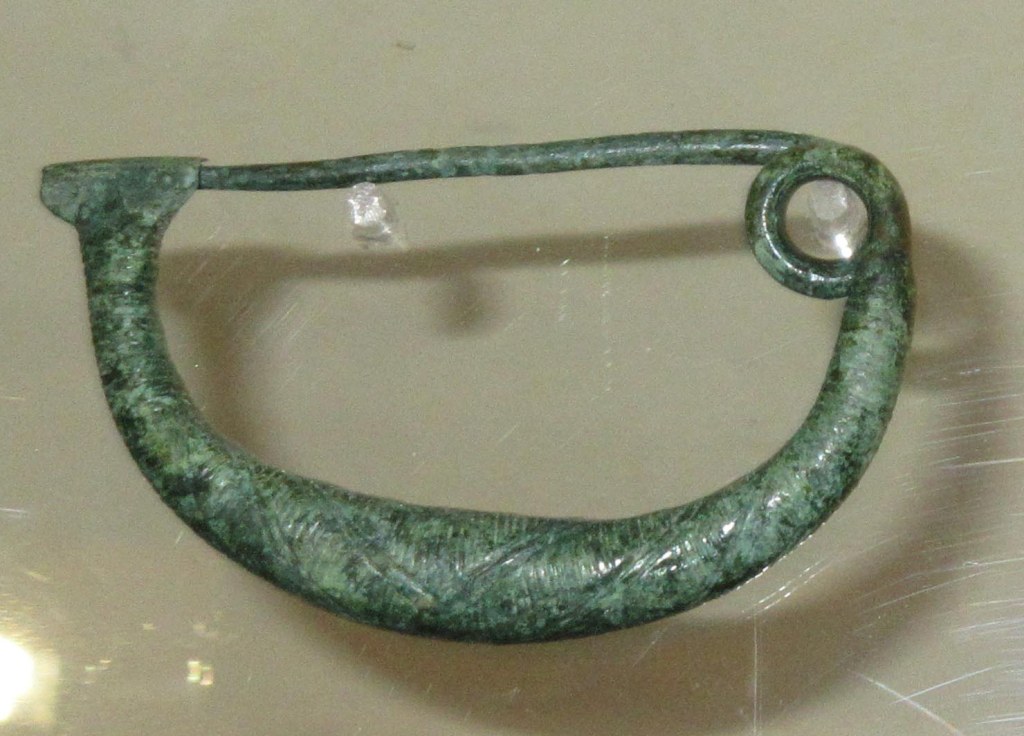
However, because the display in Arezzo lacks the larger context of the tombs or sites in which each of the fibulae were found, it leaves the museum viewer without the vital visual context of the rest of the burial objects. What would aid the display further is a replica showing how the pins would have been worn.
Even with the disappointing lack of context for all of the beautiful fibulae, I still found them far more intriguing than any fantastical golden necklaces or jewels. The personal connection to clothing, from the mundane everyday wearer to the lavishly sculpted burial adornments, tells a story of a rich and complex society, even when the actual textiles of clothing don’t survive.
Works Cited
Berardinetti, Alessandra, Anna DeSantis, and Luciana Drago. “Burials as Evidence for Proto-Urban Development in Southern Etruria: the Case of Veii.” Essay. In Urbanization in the Mediterranean in the 9th to 6th Centuries BC, edited by Helle Andersen, 317–41. Copenhagen: Museum Tusculanum Press, 1997.
“Fibula.” Fashion History Timeline, September 20, 2017. https://fashionhistory.fitnyc.edu/fibula/.
Wells, Peter S. “ATTRACTION AND ENCHANTMENT: Fibulae.” In How Ancient Europeans Saw the World: Vision, Patterns, and the Shaping of the Mind in Prehistoric Times, 99–111. Princeton University Press, 2012. http://www.jstor.org/stable/j.ctt7scgw.11.
Images
Figure 2: Fibula – Spacecraft Arch. 2017. General Catalogue of Cultural Heritage. https://catalogo.beniculturali.it/detail/ArchaeologicalProperty/0900514950.
Figure 3: Fibula – Foliated Arch. 2017. General Catalogue of Cultural Heritage. https://catalogo.beniculturali.it/detail/ArchaeologicalProperty/0900514941
Figure 4: Enlarged Arch Fibula. 2017. General Catalogue of Cultural Heritage. https://catalogo.beniculturali.it/detail/ArchaeologicalProperty/0900514943.
 TRAP
TRAP 
Leave a comment