Within the tragic ruins of Pompeii, a particularly iconic mosaic was found: the “Memento Mori” that now resides in the Museo Archeologico Nazionale di Napoli. It lives on, long after the Pompeians, as a taunting prophecy. The mosaic has been dated anywhere from AD 40-60 (Sogliano, 1874, 9). It’s quite petite, only 42 x 47 cm. It is composed of tesserae and mortar, typical of a Hellenistic mosaic (Dunababin, 1979, 266). I was particularly haunted by its scene, found under three meters of volcanic debris in a town permanently frozen in its final, panicked moment, saying remember that you will die. Freaky, right?
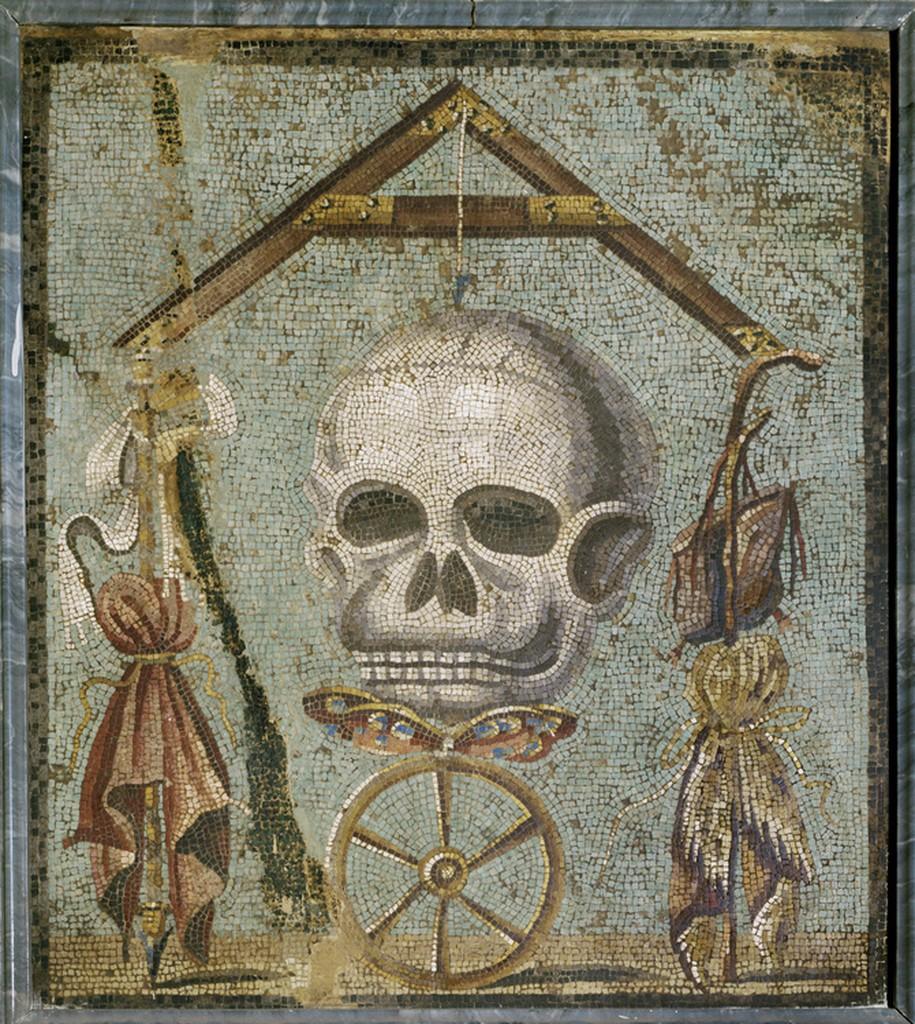
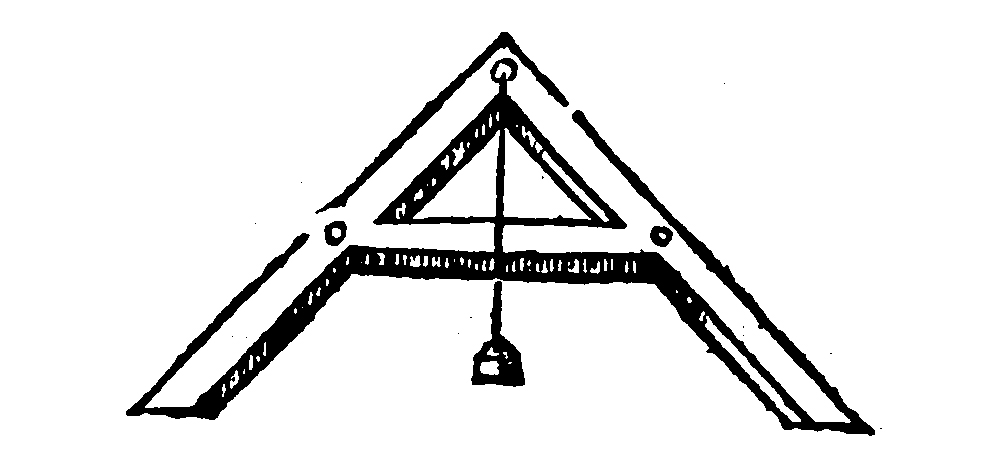
Yet there is much more to this first century AD mosaic than just a morbid reminder. Let’s examine its individual elements (see Fig. 1 and follow along). At the top is a libella (Fig. 2), a measuring instrument that dates back to the Egyptians (Van Heekeren, 2016, 117). The libella could be used as a square and ruler, but used in combination with a plumb line––like in the mosaic––it becomes a level. Below the plumb line is a skull (with ears!), a representation of death (Cuomo, 2007, 99). Death is balanced precariously on a butterfly, a symbol of the soul (Sogliano, 1874, 9). The two are both perched upon a wheel—but not just any wheel—this likely represents the Wheel of Fortune (Cuomo, 2007, 99). The left side of the libella is supported by an ornate spear wrapped in purple cloth and white ribbon; the right is held up by a wooden stick wrapped in an animal hide and a ruck-sack. The luxurious materials on the left side symbolize wealth; the more rustic materials on the right symbolize poverty (Cuomo, 2007, 99). Altogether, the mosaic implies that worldly possessions are trivial in the face of death. Rich and poor are eventually level, though one’s fortune will determine your life and death. Were the delicate tableau to collapse, the butterfly could fly away; the soul could live on.
The placement of the mosaic is even more fascinating: it surfaced the dining table in the outdoor triclinium of VI.I5.2 (Pompeii In Pictures). There is plentiful evidence of a relationship between dining and death. If the “Memento Mori” mosaic on the dining table is not proof enough, one can reference the mosaic of a skeleton carrying wine jugs from the House of the Faun (Figure 3), or the cups with dancing skeletons from the Villa Boscoreale (Van Haeekeren, 2016, 120). Visa versa, there is abundant evidence of drinking and dining at funerals (Roller, 2006, 2-4). Death’s iconography in dining scenarios is likely more playful than morbid. The looming possibility of death at any moment begs the question: why not have fun tonight? Mosaics such as the “Memento Mori ” encourage drinking and merriment.
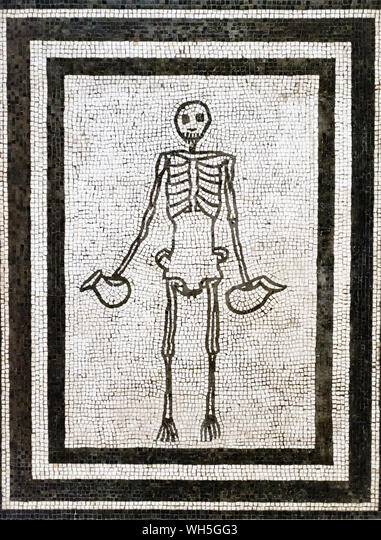
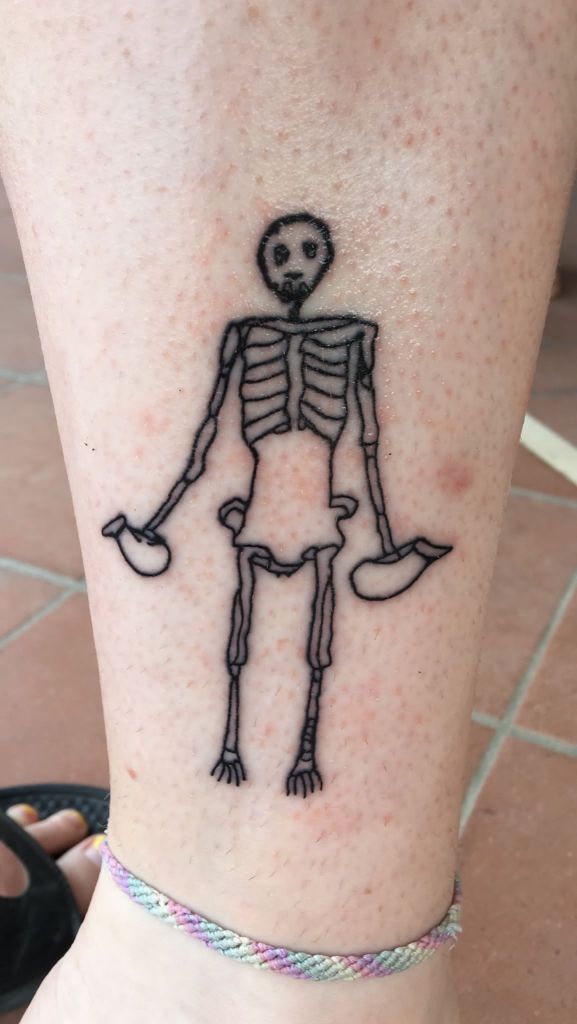
Yet, I believe this mosaic goes deeper. The inclusion of the butterfly directs diners to reflect on the quality of their soul. The props representing wealth and poverty suggest to me that worldly possessions are frivolous, rather than inviting a diner to enjoy their material goods. Compared to the House of the Faun skeleton, who offers wine jugs, the “Memento Mori” appears more critical than accepting of material possessions. Most intriguingly, the skeleton has ears. Most art historians maintain that the Romans did not know what a human skull looked like, yet I find that unlikely (Van Heekeren, 2016, 120). By the first century AD, Rome had seen 400 plus years of battles. Additionally, the main funerary practice was cremation. Plus, the House of the Faun skeleton did not have ears! I wager that the ears on “Memento Mori” are there purposefully. Perhaps the mosaic is emphasizing that death is always listening––act accordingly. A little serious for cocktail hour, don’t you think? It is also important to note that the triclinium is a place for dining with family, friends, and business partners; it is a place to display status (Van Heekeren, 2016, 119). The triclinium is a prominent place to put such decor as this mosaic because it makes a decisive statement about the futility of wealth and class. This mosaic carries more weight, in my opinion, than most other death iconography in dining scenarios.
Pompeii is endlessly fascinating because it is a preserved piece of daily life before Mt. Vesuvius wreaked havoc on unsuspecting residents. Visitors––such as myself–– come to see the tidbits of normalcy, the surviving graffiti on the walls, the preserved family dog, the bread hastily left in the oven. We are so close to the people of the past, yet they are long gone, and we are separated by a volcanic eruption that destroyed them without hesitation. In that way, Pompeii itself is a memento mori. The rich were killed, the poor were killed––death was the ultimate level.
Works Cited
Cuomo, S. Technology and Culture in Greek and Roman Antiquity. Cambridge UP, 2007.
Dunababin, Katherine. “Technique and Materials of Hellenistic Mosaics.” American Journal of Archaeology 3 (1979): 265–77.
Pompeii in Pictures. Pompeii Archaeological Park (website). Last modified 08-05-2022, https://www.pompeiiinpictures.com/pompeiiinpictures/index.htm.
Roller, Matthew. Dining Posture in Ancient Rome. Princeton UP, 2006.
Sogliano, A. Giornale degli Scavi di Pompei: Nuova Serie 3 (1874): 5-11.
Van Heekeren, Vivian. “A Method and an Object: An Art Historical Approach Applied to the ‘Memento-Mori’ Mosaic from Pompeii, Italy.” International Journal of Student Research in Archaeology 1 (2016): 115-123.
 TRAP
TRAP 
Leave a comment