Mahnoor Zahid
I had the chance to visit the Museo Archeologico Nazionale in Arezzo where this gigantic Krater lay in the middle of a dimly lit room, enclosed in a glass box, with lights highlighting it. The red-figure Attic vase was an object of utter fascination: there were zebra printed people fighting a naked man wearing a lion skin, with a second layer of drawing on the neck of the krater, where people seemed to be enjoying themselves and generally just having a great time.
Below I added a picture of the krater which I took during my visit. The artefacts in the museum could be scanned through your phone onto their app, which would pop up information onto your screen regarding the artefact. According to the description, the man adorning the lion-skin was Hercules and the people he is fighting are the all-women Amazon army (Gatto, 2019). You can tell it is their army as the figures have more slender bodies. What drew me to the vase was the fact that the Amazons were clothed whereas Hercules was naked. You can see how it creates narrative bias when telling this story: the naked, chiseled body not only highlights Hercules’s demi-god status, it also sets him apart from the worldy, mortal women. The lion skin further adds into the grandeur and his unadulterated courage, making him fiercer than his opponents.
One thing that I completely missed during my actual visit were the figures in front of the Amazon army who are not dressed as the rest. The one on the ground is Togsis and the archer standing seems to be described as Teisypile. Looking at their attire and their positions in the battlefield, one can interpret them to be leaders or significant figures of the army.
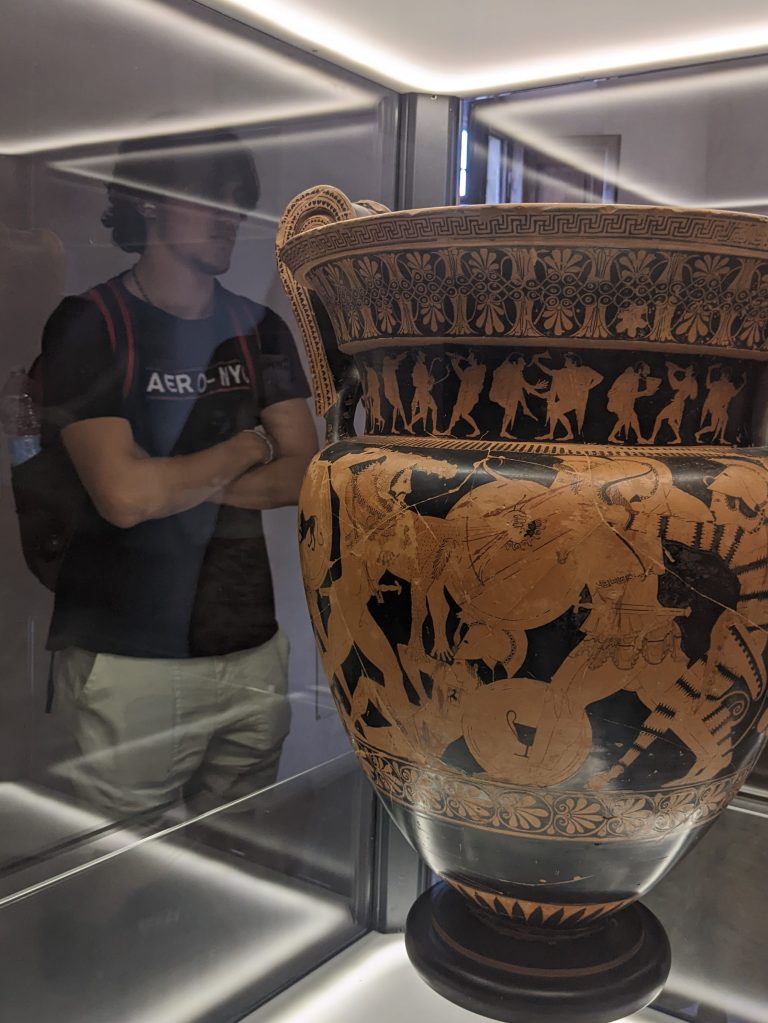
But why are they fighting though? According to the museum inscription, he is fighting against the Amazon Queen Hippolyte, although there is no drawing on the krater that showcases this. Perhaps this interpretation was made in line with the famous story of Eurystheus wanting Hippolyte’s belt so that he could give it to his daughter. The belt was special because it was given to her by Ares, the Greek God of War, himself (Perseus Project). Since Hippolyte hasn’t been shown on the krater, I am personally slightly skeptical of this description as the Amazons and Hercules were famous for having beef as Hera did not want them to have good relations (Ciambaso). Perhaps this might be another skirmish, or another war? The absence of the belt in the drawing also makes this interpretation open for debate.
On the left side of the krater is another man right next to Hercules, holding a shield with a lion inscription. He is interpreted to be Ajax’s father, Telamone. It is certainly interesting to see him alongside Hercules as he is known for fighting alongside Hercules in his battle in Troy, but there are not enough descriptions of him fighting the Amazons.
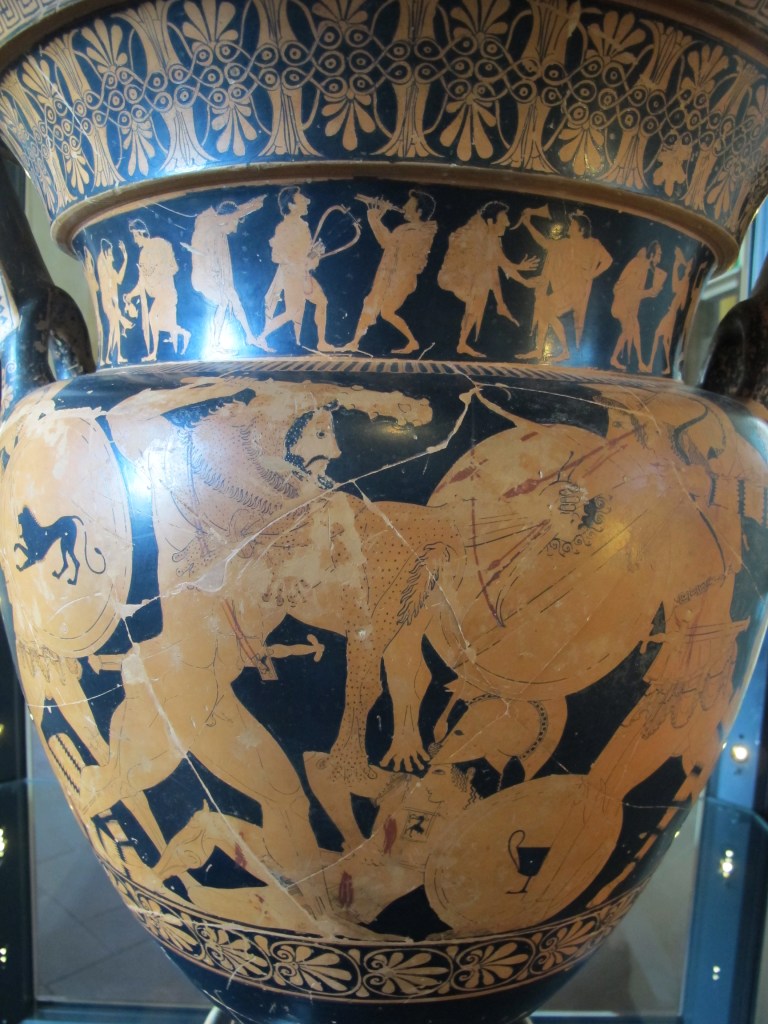
On the neck of the Krater, one can see the scene of Komos, a Greek way of celebration. Unlike Pompe, this method of celebration is more disorderly. The neck of the krater does indeed get the gist of the Komos; while one man drink, another plays the flute while another plays the lyre. This type of celebration is peculiar; there is no evidence of what the people are celebrating. One interpretation could be that the drawing is symbolic of the victory against the Amazons. But there is no symbol telling us what this means exactly, we can only have interpretations. The two different scenes create a very interesting visual contrast for people to see and have a conversation over. One can also argue that the contrast was deliberately made so it could serve as a great way to start your conversation.
But why depictions of a party? The grandeur of the krater suggests luxury, and if I had to make a guess, the krater was used for storing wine. Showing great party scenes would maybe set the mood for you and your guests, or maybe it could be a source of pomp and cheer: you own something that showcases Hercules’s victory, making you part of the winning side, the right side of history. It could also be reminder of how life is short and if one did not celebrate this victories, they might not be understanding the true essence of life. It could also have a more philosophical perspective, showing war and death on the bottom while depicting fleeting, small pleasures of life on the top, highlighting how meaningless human existence can be in light of such great historical events.
Whatever the reasons for this dichotomy, the fact that I am writing about this image and the fact that you managed to read till this end, is enough evidence that the Greeks knew how to create great conversation starters. If this vase is till relevant enough that it takes up space in the middle of a room, the least we can say is that the Greeks knew what they were doing.
Bibliography
Cambiaso, Luca. “Battle between Hercules and the Amazons – the Collection.” The Collection – Museo Nacional del Prado, January 1, 1550. https://www.museodelprado.es/en/the-collection/art-work/battle-between-hercules-and-the-amazons/c047be1e-0bc4-48d7-9f54-f4dacc11fe48.
Maria Gato. Il Cratere Delle Amazoni Di Euphronios. Museo Archeologico Nazionale, n.d.
Perseus Project, ed. “Http://Www.perseus.tufts.edu/Herakles/Amazon.html.” Hercules’ Ninth Labor: Hippolyte’s Belt. Accessed June 29, 2022. http://www.perseus.tufts.edu/Herakles/amazon.html.
 TRAP
TRAP 
Leave a comment