by Kate Sheeley
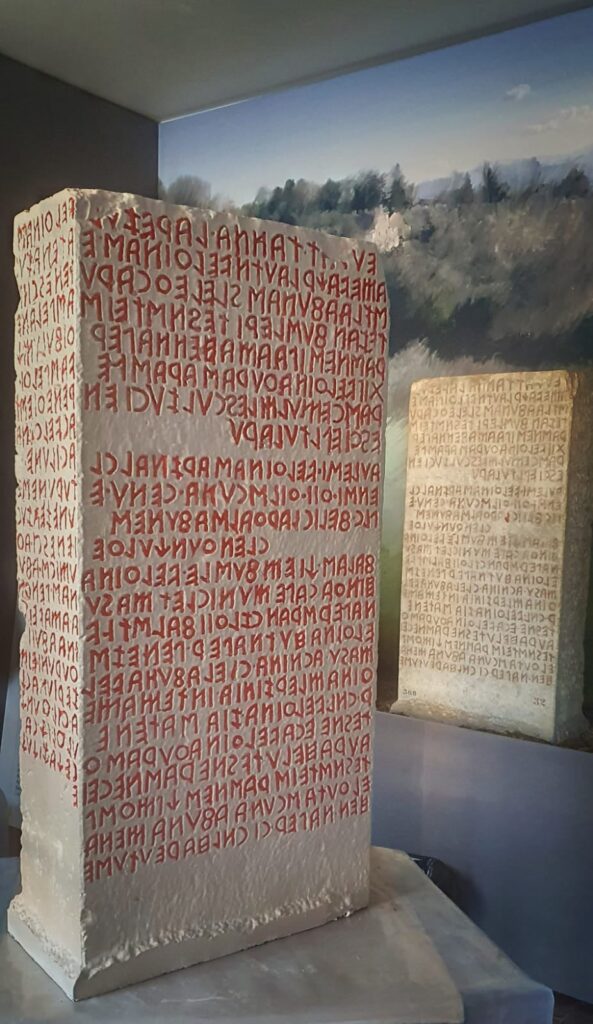
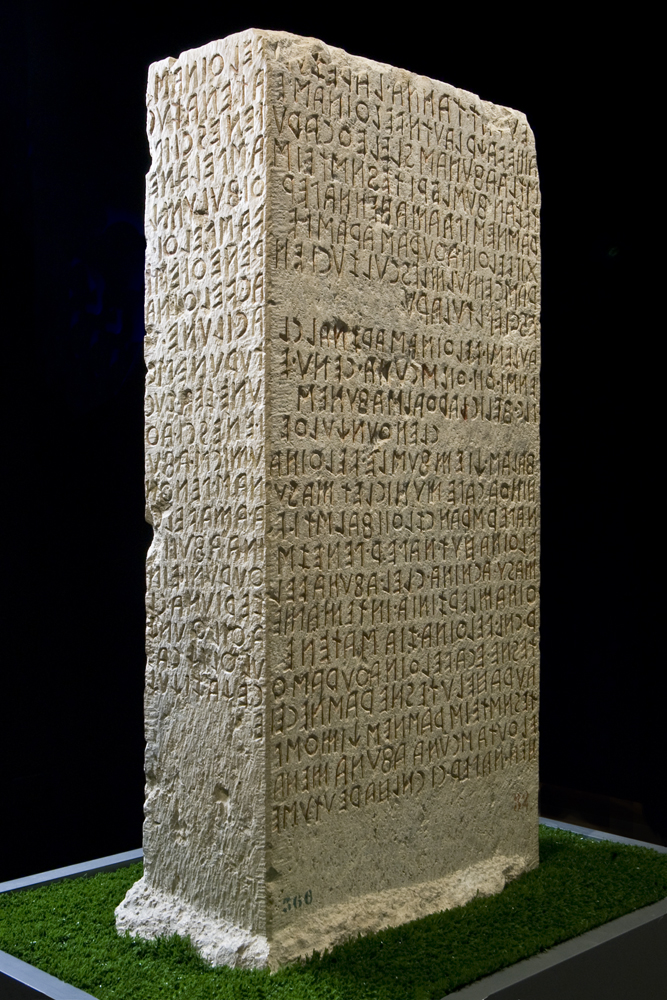
46 lines, 128 words, one hunk of smooth gray rock. A stone inscribed with an unusual language stands in a small, dim room off the beaten path in the National Archaeological Museum of Umbria. Surrounding it are a few displays of related inscriptions, a full size, colored, touchable replica of the artifact—and a flatscreen television larger than the stone itself. These extras draw one’s attention away from the artifact, allowing this mysterious stone to blend into the painted field of flowers it stands against. However, this humble inscription, made to feel even smaller by its museum display, may just be one of the most important archaeological finds in the history of the Umbria region.
This mystery stone is the Cippus Perusinus, or “Perugian boundary marker”. It represents the fourth longest extant text in Etruscan, the language spoken by the native Italic peoples of Etruria, now northwest Italy. Its text is still not fully deciphered, but it appears to be the legal settlement of a property dispute between two local Etruscan families, the Velthina and the Afuna, during the 2nd century BCE (MacIntosh 161). It likely also marks the area of a tomb belonging to the Velthina.
Most scholars agree on at least this much (Meer 201), but this is where certainty about the text stops. Gleaning any more information from the Cippus is currently next to impossible. This is not due to the condition of the writing—the text itself is beautifully preserved—but rather because of the inherent difficulty in understanding Etruscan. Despite being spoken in the vicinity of Rome for much of the Republic (Freeman 82), a very well-documented period, very few useful examples of the language survive. There is some epigraphy, but no dictionaries, no histories, and certainly no libraries.
Inscriptions like these, then, are incredibly valuable in the continuing work of deciphering Etruscan. But why is this the case? What makes Etruscan so rare?
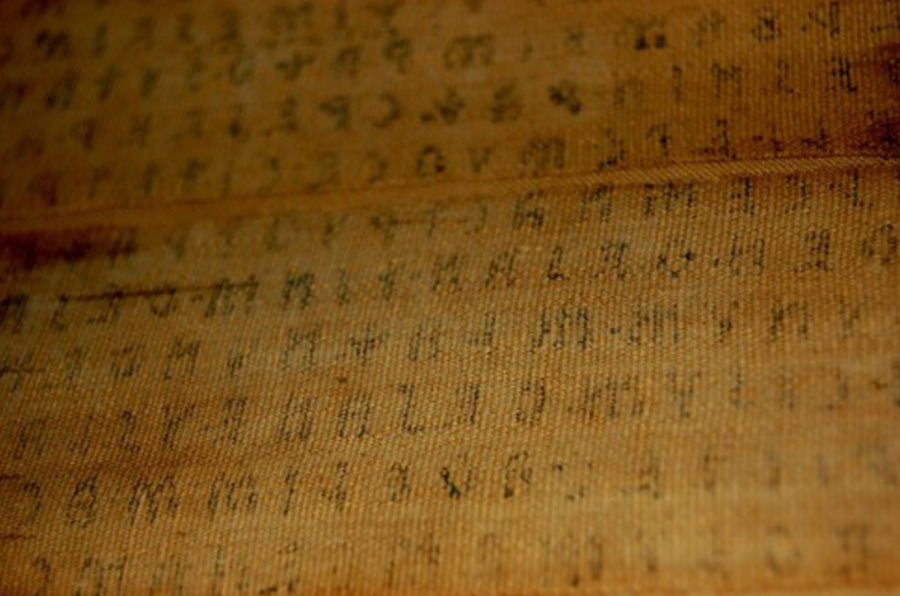
The simplest answer to this question is time. Most people write on what’s cheap and accessible—for us, that’s paper; for the Etruscans, it was parchment, papyrus, wax tablets, and linen. Unfortunately, cheap and accessible rarely translates to permanent. Paper tears, wax melts, and linen decomposes. The very few examples of these materials that do survive are preserved through exceptional circumstances. The only extant linen book, for instance, was bafflingly preserved when it was used to wrap an Egyptian mummy (MacIntosh 460).
While the impermanence of Etruscan daily-use writing is a primary reason for the scarcity of Etruscan, it brings up a more important question: what about Latin? In Italy, one can hardly walk a city block without running into classical Latin. The same is true for the recorded history of Italy—any textbook on ancient Italian history likely starts and ends with Roman sources. Rome’s writing techniques were just as impermanent as Etruria’s, but their language somehow overcame the test of time. Why, then, is so much of the Etruscan corpus lost while so much Latin has been preserved?
This glut of preserved Roman writing is naturally what happens when one culture remains politically and socially dominant for such a long time. Besides inscriptions, any Latin that survives today was done so intentionally, copied by scribe after scribe for millennia. The Romans (and their linguistic descendants) preserved their writings because they considered them valuable. Ultimately, this is the real reason Etruscan died out—the Romans did not deem it important enough to be saved.
The Etruscan language was dead long before its people were. This is a pattern seen again and again with Rome’s conquests—first a city is defeated, then over centuries it is assimilated into the Roman way of life. Though the Romans were more than happy to borrow from the cultures they controlled, especially from the Etruscans, the Etruscan language did not make the cut. Nowhere is this casual linguistic destruction more apparent than in the very city in which the Cippus was found. Perugia, after being co-opted as a battlefield by its Roman masters, was rebuilt and renamed “Augusta Perusia”, a wholly Roman name. The Romanization of Perugia, more or less complete after this point, was so thorough that no evidence remains of its original Etruscan name.
All languages die eventually—that, or they evolve into new ones. It was inevitable that Etruscan was to disappear one way or another. What was not inevitable was the near complete loss of Etruscan at the hands of Roman cultural domination.
Though the content of the Cippus Perusinus is constantly in flux as Etruscologists continue their difficult work, one thing is for certain—it does mark a grave. That grave, though, is perhaps not that belonging to the ancient Velthina family. Instead, it stands as a symbol of the decline and death of the Etruscan language. Perhaps its placement in the museum is appropriate after all: a secluded, somber space that allows the visitor to appreciate both the rarity of the artifact and the gravity of the linguistic loss it represents.
46 lines, 128 words, one burial stone. A wealth of words, not enough to resurrect the language’s lost lexicon, but perhaps enough to make a start.
Bibliography
Meer (van der), L. Bouke. 2017. “Some reflections on the inscription of the Cippus Perusinus.” Studi Etruschi 80: 201-212.
Freeman, Phillip. 1999. “The Survival of the Etruscan Language.” Etruscan Studies 6, no. 2: 75-84.
MacIntosh Turfa, Jean, and Tambe, Ashwini, eds. 2013. The Etruscan World. London: Taylor & Francis Group.
Images
 TRAP
TRAP 
Leave a comment