By Ryan Tomkins
Underneath the Cathedral of the city of Perugia (Umbria) is a structure that supports large portions of the buildings above ground. This structure was built thousands of years ago by the Etruscans who first constructed the city. Before describing the foundations of the present city, one must understand how the Etruscans built with stone. The Etruscans used very large blocks stacked on top of each other, as in image 1 and image 2, yet these two structures had different purposes. Image 1 shows a gate from the Etruscan period that has lasted largely intact until the modern day, while image 2 represents an artificial terrace created by the Etruscans, now beneath the modern city.
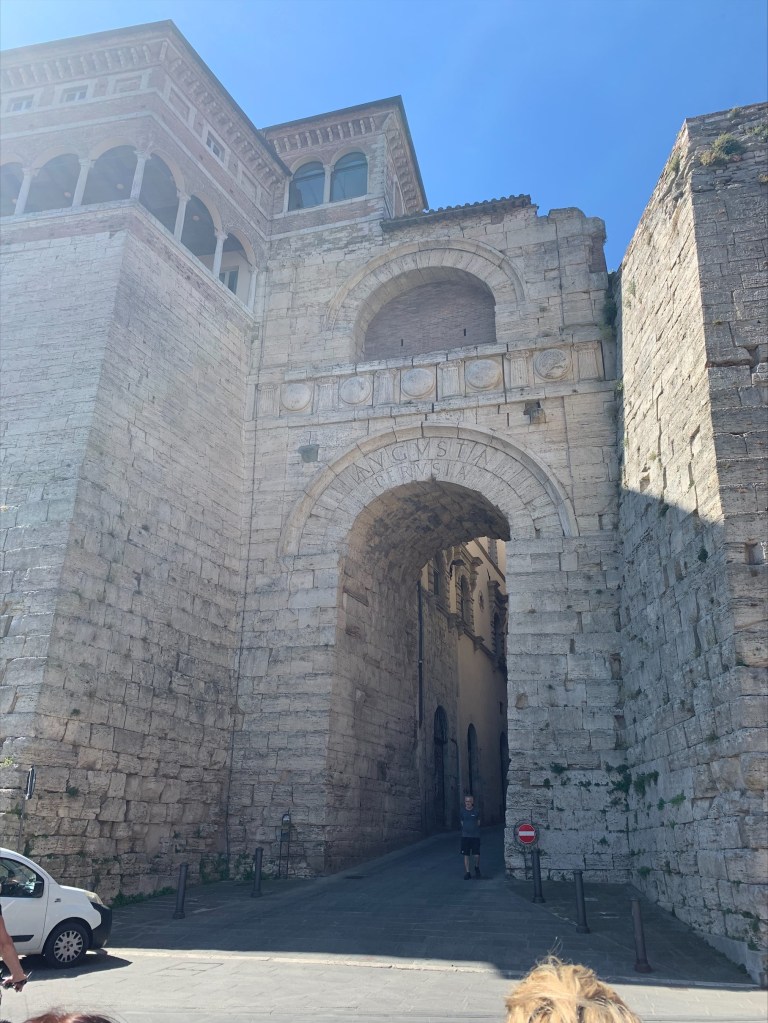
The Etruscans created such terraces to build upon, as well as to build against, in an attempt to tame the hilly terrain of the city. There is still even evidence of a Roman habitation at the base of the underground terrace shown in image 2. This home was nearly completely destroyed when Octavian burned down the city in 41/40 BC. Two decades later, however, Octavian (now Augustus) reestablished Perugia and the terrace saw use even into the modern day.
The Etruscans and most likely the Romans both put a temple atop the terrace. But when the Byzantine Empire controlled Perugia in the sixth century AD, they built a tower at the corner of the terrace to help defend the city. While the whole of the tower no longer survives, the remnants of its base are.
Still later, when the medieval residents of Perugia began construction of the Cattedrale di San Lorenzo (the predecessor to the current Cattedrale) they dug down to the Etruscan terrace walls. They utilized the terrace created over a thousand years prior, for both its architectural stability as well as the flat space that the terrace provided to the Cattedrale. They built arches into the wall itself, even cutting out pieces of this wall so as to insert those arches.
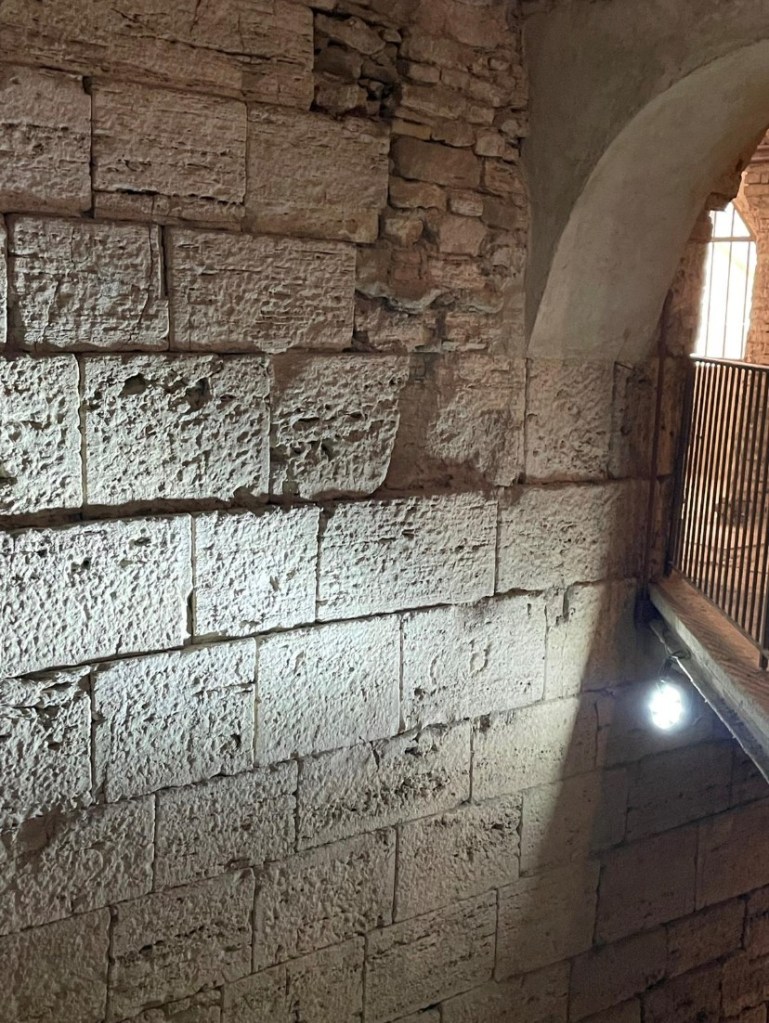
I am still reeling from the people of the medieval times’ ability to ignore historical finds for their own betterment. This terrace wall held up a significant part of the ancient city center. The Etruscans built it to add more land; further south, they also began to fill in a gap between the two hills on which Perugia’s center is built. The Etruscans and Romans started a construction process that has allowed a coherent Perugia community to thrive, and to defend themselves effectively due to its strategic location. The Byzantines and residents of the Medieval period utilized this engineering marvel to live and work.
The Etruscans created a terrace wall that still resides underneath the city of Perugia. It has been there for over two thousand years and is still in constant use. From the Etruscans and Romans who built temples atop it and lived around it, to modern residents who live well above it, this one hidden structure has withstood years of pressure, and has held a city together.
Sources:
Admin. 2022. “Perugia Underground – the Archaeological Area.” Perugia Underground – The Archaeological Area |. June 1. https://www.secretumbria.it/en/perugia-underground-archaeological-area/.
Matracchi, Pietro. 2021. “The Etruscan City Gates of Perugia: Geomatic Techniques for the Documentation and Study of an Urban History Heritage.” Proceedings ARQUEOLÓGICA 2.0 – 9th International Congress & 3rd GEORES – GEOmatics and PREServation. Editorial Universitat Politécnica de Valéncia. December 29. https://www.academia.edu/66347859/The_Etruscan_City_Gates_of_Perugia_Geomatic_Techniques_for_the_Documentation_and_Study_of_an_Urban_History_Heritage.
 TRAP
TRAP 
Leave a comment