As I entered the Piazza del Commune in the city of Assisi, Italy, my eyes fell upon a beautiful building with 6 grand pillars towering over me. I did not know the significance of these pillars at the time or even the name of the building, but I saw a cross above the door indicating that the building currently houses a church. I could tell that this was not a normal church. As the tour guide spoke, everything began to make sense. This was the Church of Santa Maria Sopra Minerva, or the Church of Saint Mary over Minerva. As the name suggests, the building has a complicated history. Archaeological findings suggest that the site of the church was previously the site of an ancient sanctuary, terrace, and Roman temple (Vauchez). The church is not only significant to parishioners and religious peoples, but the building matters to archaeologists who study its multi-layered history. Not only did the building change over time, but our understanding of the building has also changed over time. In this way, individuals can see evidence of archaeological interpretation and biases playing a role in how archaeologists view and interpret material culture.
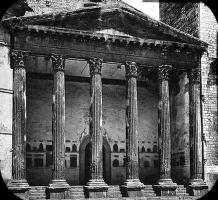
The history of the temple dates back to the 6th-5th century BC, with evidence of a sanctuary beneath the temple. Bucchero and impasto pottery was found in the area, which scholars suggest could have come from a pre-existing terrace seated directly where the church stands today. Bucchero pottery provides evidence of a connection in the area to the Etruscan population, who occupied the area before and during the Roman conquest. The sanctuary and terrace may have been situated in connection to water springs, which supplied the city center (Boldrighini 29).
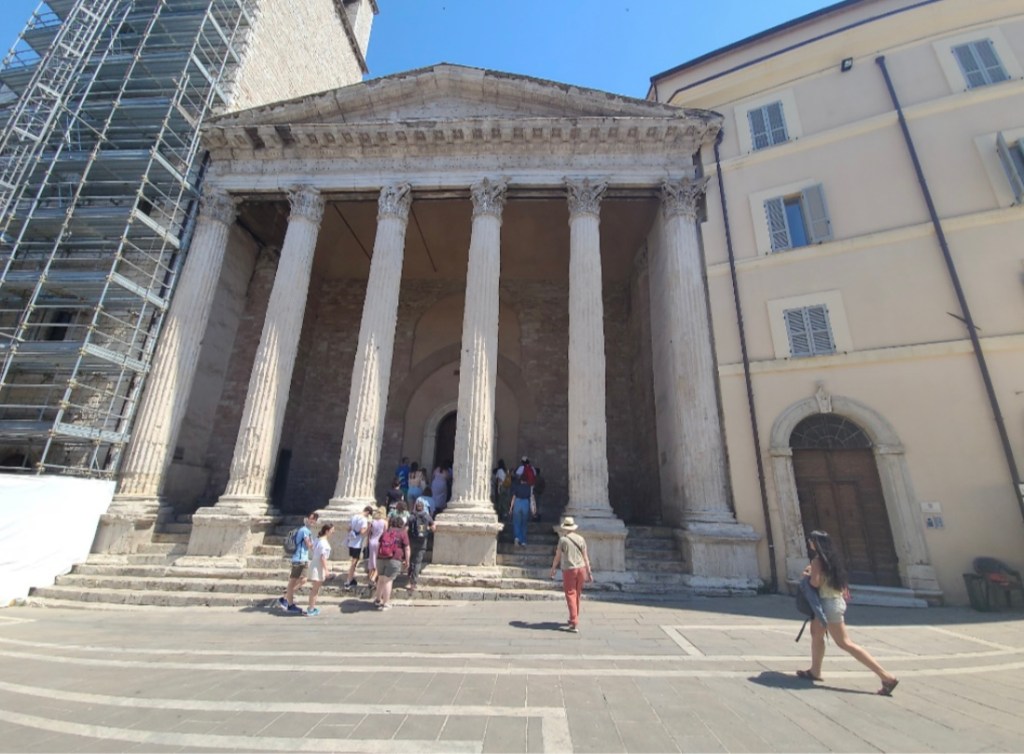
At the location of the ancient sanctuary, a Roman temple was built at the end of the Republican Age or the beginning of the Imperial Age (Ross 57-58). The 6 Corinthian columns which tower above the entrance to the temple provide a well preserved example of Roman architecture (Boldrighini 35).
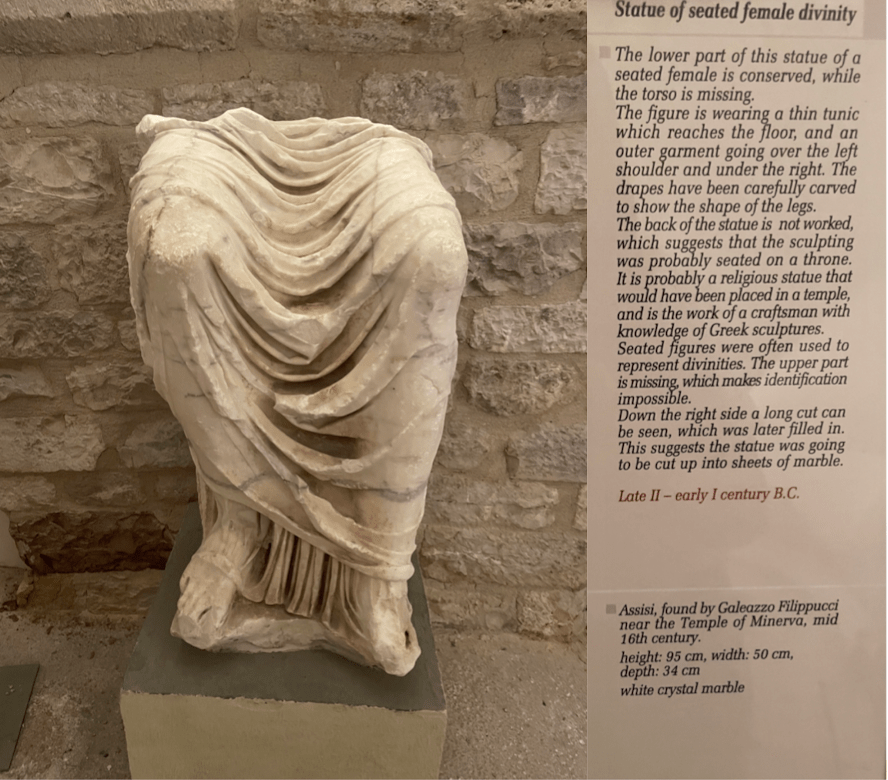
When the temple was found, it got the name ‘The Temple of Minerva’ after the discovery of the lower half of a female deity (Marcattili). The individuals who found the marble sculpture interpreted the sculpture of the female divinity to be Minerva, when in reality it is impossible to attribute the statue to Minerva without distinctive features or an inscription. Figure 3 shows the sculpture people thought was the statue of Minerva; however, the museum plaque does not suggest this connection. The statue is situated in a museum near the temple, somewhat removed from its context. However, the plaque does an exceptional job of not making assumptions about the female divinity, while the individuals who attributed the temple to Minerva made many assumptions. Archaeology involves interpretations and biases, and Gathercole and Lowenthal explain “there can be no archaeologically achieved final truths or wholly objective interpretations” (Swain 10). When later archaeologists questioned the dedication of the temple, more information about and the history of the temple emerged. Moving forward in a post-processual archaeological era, archaeologists recognize that the interpretation of material culture inherently involves bias.
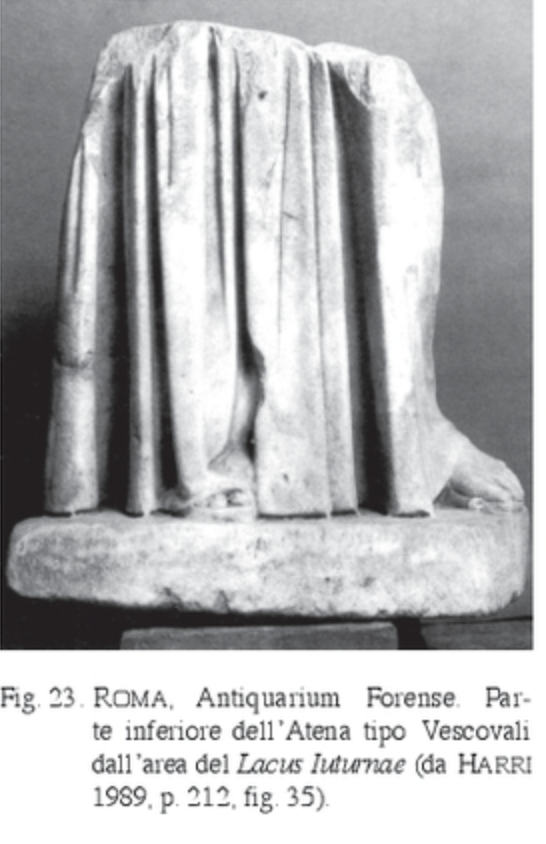
Figure 4 provides an example of a statue of Minerva found in Rome similar to the female statue found at Assisi. This provides evidence that the statue found at Assisi may also represent the goddess Minerva, but this involves an assumption that the bottom halves of other goddesses would not have looked the same. A dedicatory inscription set above the temple was found to read “quattuorviri quinquennales” mentioning two individuals who paid for the building of the temple. Furthermore, a later dedication was found on the lower terrace in front of the temple to the Dioscuri, which some scholars suggest could be evidence that the temple was dedicated to the twin gods instead of Minerva (Boldrighini 35).
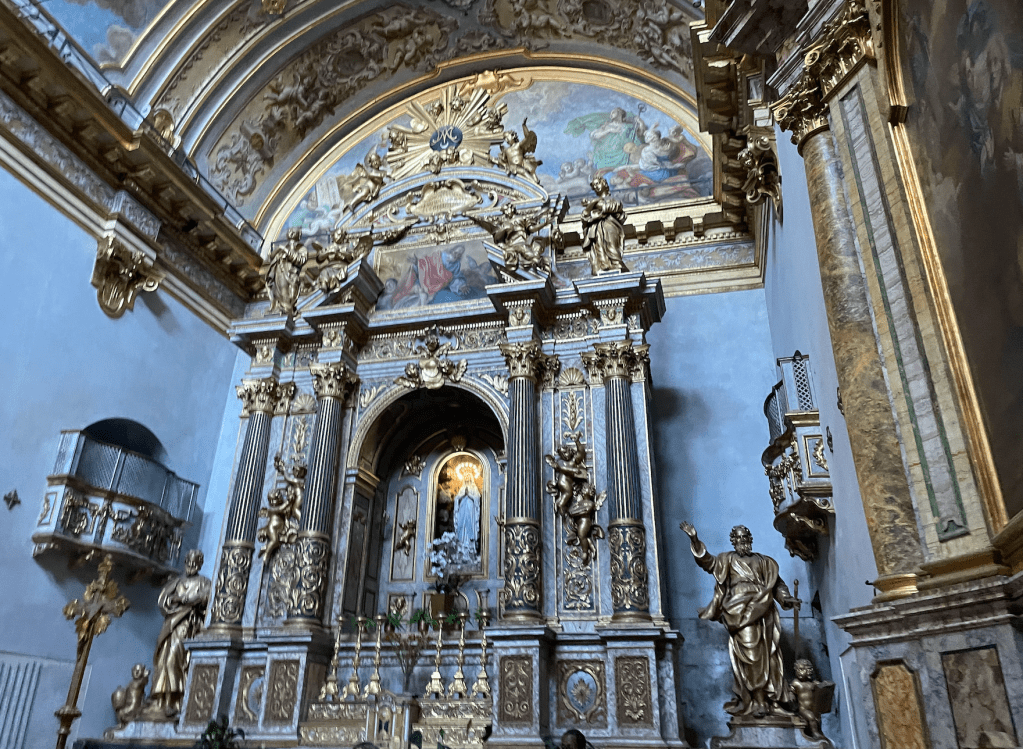
The temple was made into the Church of Santa Maria Sopra Minerva in 1539 and continues to serve as a sanctuary for the community today (Ross 57-58). The church also serves as a window into the past of the Etruscans and the Romans. It connects people throughout time who found sanctuary within its walls.
Works Cited
Bartlett, Kenneth. 2021. The Guide to Essential Italy. Directed by The Great Courses, The Great Courses (Firm), and Kanopy (Firm). Great Courses.11284404.
Boldrighini, Francesca. “Asisium: Some More Aspects of the ‘Self- Romanization’ of an Umbrian Settlement.” Atti IX, no. 2 (2020): 25–54.
Marcattili, Francesco. “TEMPLUM CASTORUM ET MINERVAE (CHRON. 354, P. 146 M) IL TEMPIO DI MINERVA AD ASSISI ED IL CULTO ROMANO DEI DIOSCURI.” Archeologia Classica 64 (2013): 263–94. http://www.jstor.org/stable/26234039.
Ross, Ian Campbell. “Roman Umbria.” Essay. In Umbria: A Cultural Guide, 54–72. Volumnia Editrice, 2020.
Swain, Hedley. An Introduction to Museum Archaeology. Cambridge University Press, 2007.
Vauchez, André, and Michael F. Cusato. “Francesco Di Bernardone.” In Francis of Assisi, 3–32. Yale University Press, 2012. http://www.jstor.org/stable/j.ctt1npq24.4.
Images
Figure 1: “Temple of Minerva..” https://quod.lib.umich.edu/u/ummu2ic/x-ls008287/ls008287. University of Michigan Library Digital Collections. Accessed: June 28, 2022.
Figure 4: Marcattili, Francesco. “TEMPLUM CASTORUM ET MINERVAE (CHRON. 354, P. 146 M) IL TEMPIO DI MINERVA AD ASSISI ED IL CULTO ROMANO DEI DIOSCURI.” Archeologia Classica 64 (2013): 263–94. http://www.jstor.org/stable/26234039.
 TRAP
TRAP 
Leave a comment