As we learned on our trip to Assisi, St. Francis had a long and storied life (1181/2-1226). This is likely why he is such a revered saint today. However, in death St. Francis has perhaps become even more influential. Barely two years after his death, Pope Gregory IX confirmed St. Francis’ miracles, and declared him a saint. The day after Francis’ canonization, the Pope laid the foundation stone for what would become The Basilica of St. Francis in Assisi; St. Francis was buried there soon after its completion.
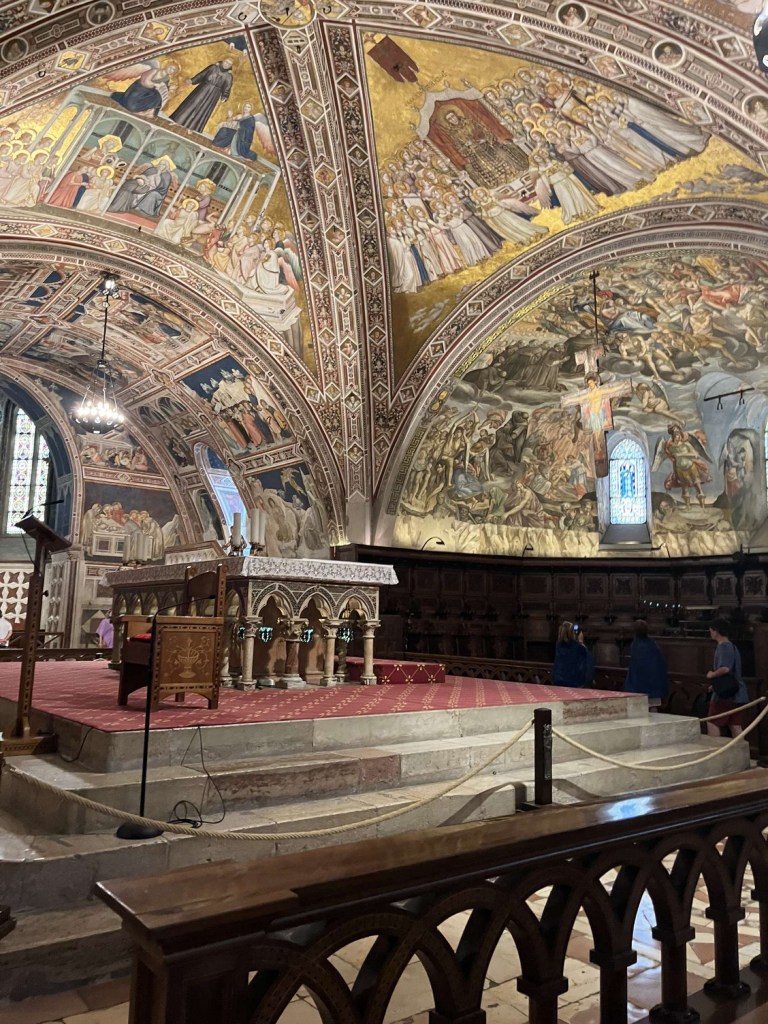
This was not the end of the story, however. His body was soon exhumed and placed in a hidden tomb on the order of one Brother Elias—the cited reason being to protect it from Saracen invaders, but also more generally to guard against the sort of desecration of saint’s bodies going on in medieval Europe at the time. Many saint’s bodies were sundered and distributed in pieces to churches across the continent, with the hope that relics in the sanctuary would add some greater level of divinity to the place.
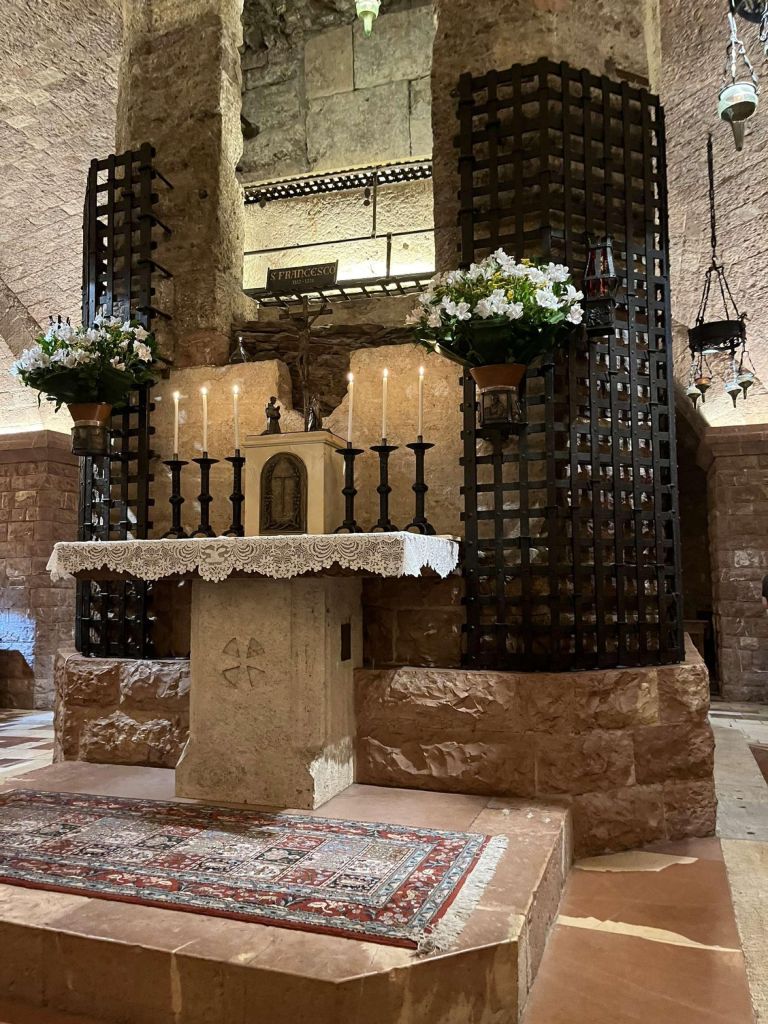
The body of St. Francis remained lost for the better part of the next 600 years, only being found in 1818 after Pope Pius VII commissioned an expedition, with the permission of the local people, into the Lower Church. They found Francis with several coins, beads, a ring, a piece of iron, and his head resting on a stone. One Pasquale Belli then constructed a crypt for St. Francis in the Lower Basilica, using marble in a neo-classical style. The crypt was renovated into its present shape from 1925 to 1932 by Ugo Tarchi, who used a neo-Romanesque style. In 1978, the remains of Francis were examined and confirmed by a commission of scholars appointed by Pope Paul VI, and finally laid to rest in a glass urn within the ancient stone tomb.
Rumors abound about the strange set of items found with Francis’ body; some say they were simply left by Brother Elias to date the tomb, with stranger rumors claiming the secret tomb was sealed by an alchemist or pagan as part of a ritual. What is sure today is that the full and only lightly disturbed remains of St. Francis lie in an urn safely sealed at the bottom of the church. He is surrounded by his four most faithful acolytes: Brother Rufino, Brother Angelo, Brother Masseo and Brother Leo, with one in each corner. Towards the front of the crypt, an urn containg the remains of Jacoba dei Settesoli has been added to the crypt. A woman of Roman nobility who was affectionately referred to as “Brother Jacoba” by Francis, she was a most faithful friend and perhaps the most notable patron of Saint Francis. She was at his side at the hour of his death; supposedly his last request was that she bring him some of her homemade almond pastries, his favorite.
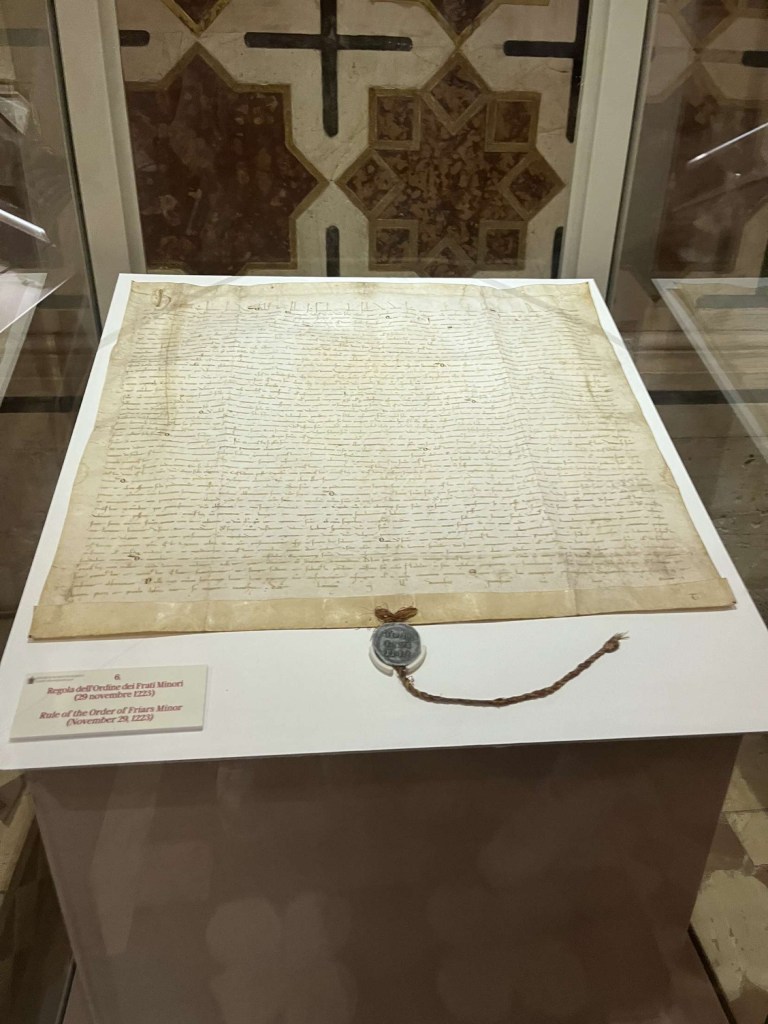
Late in September, 1997, two earthquakes struck near Assisi nearly back to back. They both registered above 5.5 in magnitude and caused damage to or the destruction of several ancient buildings, including the Basilica of St. Francis. While inspecting the damage to the Basilica, two friars and two specialists were killed when an aftershock caused the ceiling vault to collapse. Many frescoes were also damaged or destroyed depending on their location in the churches. Two years of restoration were needed before the church could open again.
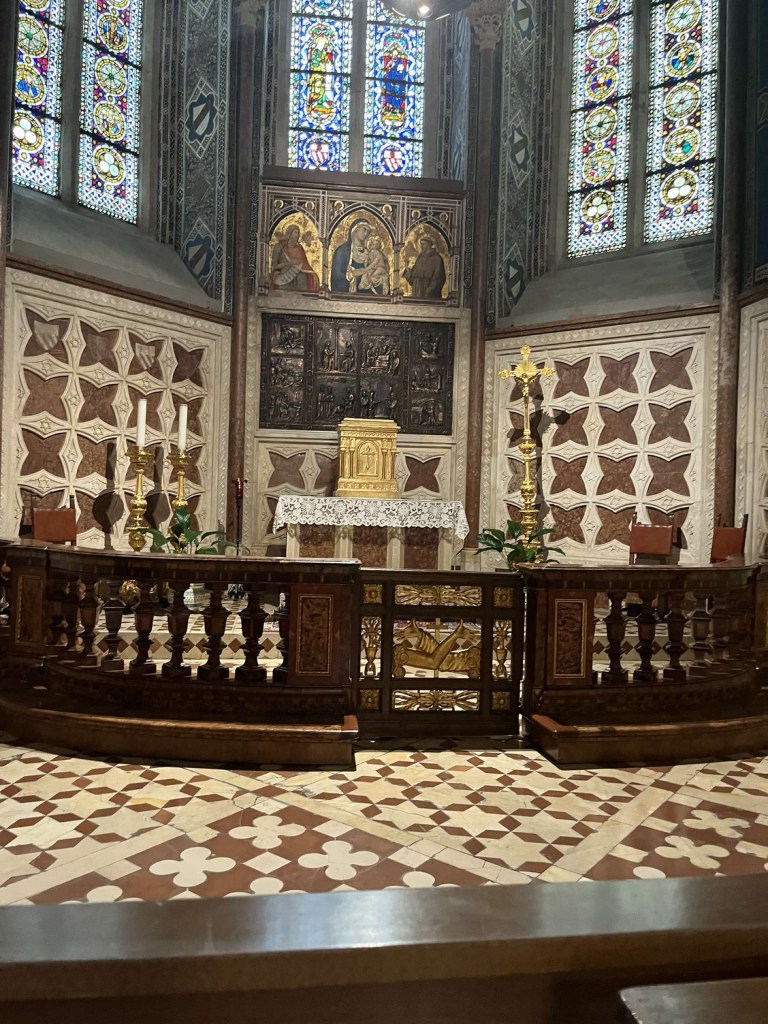
Located in a Basilica of the Catholic Church, one dedicated to an extremely popular and charismatic Saint, this tomb holds a special place in the hearts and minds of the people of Assisi, Italy, and many Catholics the world over. There is belief that even just touching a hand or object to the tomb grants a divine blessing of some order, and regardless of a person’s religious leanings, the magnitude of the faith and reverence built into the tomb cannot be denied.
CItations
Bonsanti, Giorgio (1998). The Basilica of St. Francis of Assisi. New York: H.N. Abrams.
Brady, Ignatius Charles; Cunningham, Lawrence (29 September 2020). “St. Francis of Assisi”. Encyclopædia Britannica. Encyclopædia Britannica, Inc. Retrieved 5 October 2020.
Bonaventure; Cardinal Manning (1867). The Life of St. Francis of Assisi (from the Legenda Sancti Francisci) (1988 ed.). Rockford, Illinois: TAN Books & Publishers
Chesterton, Gilbert Keith (1924). St. Francis of Assisi (14th ed.). Garden City, New York: Image Books
Editor, ChurchPOP, et al. “12 Fascinating Facts You Didn’t Know about the Great St. Francis of Assisi.” 12 Fascinating Facts You Didn’t Know About the Great St. Francis of Assisi –, 28 Apr. 2017, https://www.churchpop.com/2015/10/03/12-fascinating-facts-you-didnt-know-about-the-great-st-francis-of-assisi/.
Editor, ChurchPOP, et al. “The Mystery of the Hidden Tomb of St. Francis of Assisi.” ChurchPOP, 28 Mar. 2017, https://www.churchpop.com/2016/10/04/the-mystery-of-the-hidden-tomb-of-st-francis-of-assisi/.
 TRAP
TRAP 
Leave a comment