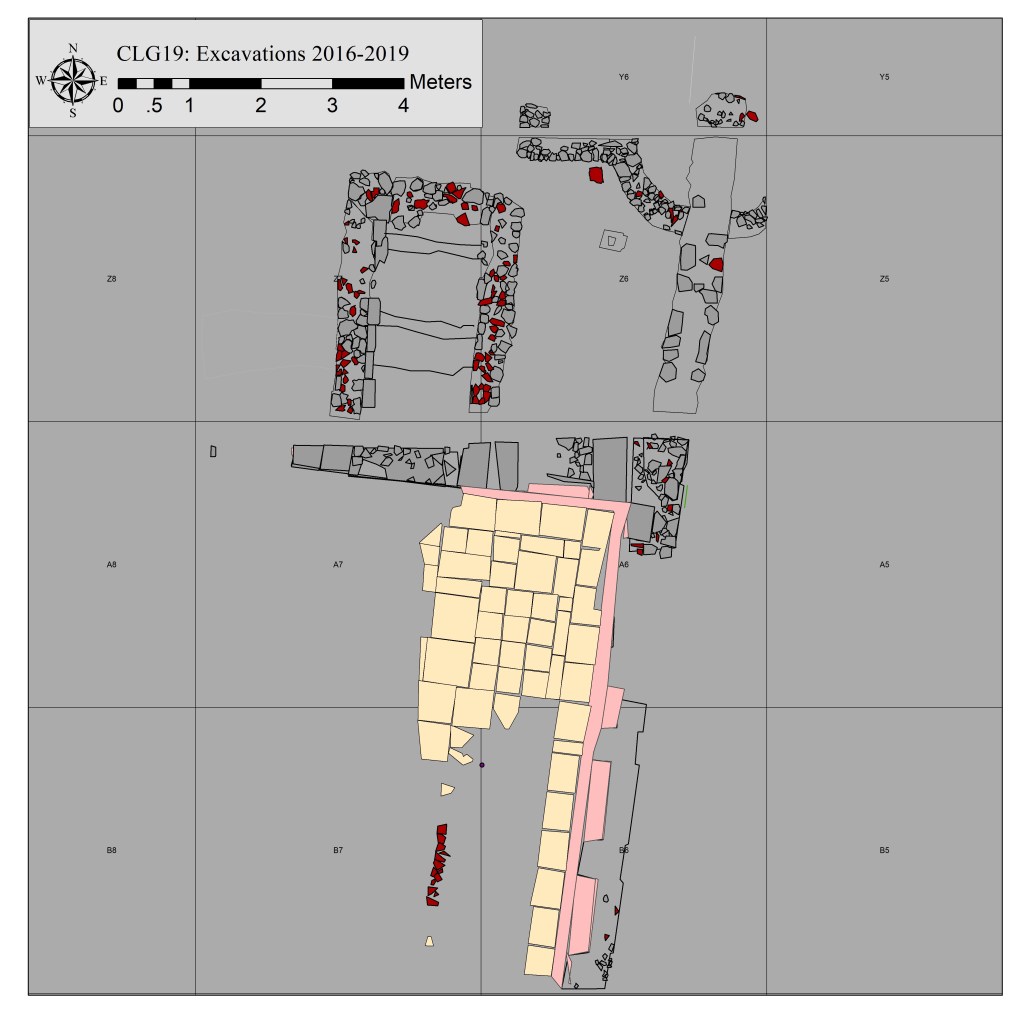
The fourth season of excavations at the Vaiano-Gioiella Villa site took place during June and July of 2019 with work continuing in both the Central Area and the Bath House. In the Central Area, we expanded to the south and concentrated on clearing the layers of fill inside the structure first identified in 2018. By the end of the 2019 season, we had uncovered the eastern and northern walls of a monumental building, which we are now identifying as a Roman nymphaeum. This structure appears to have gone through at least three architectural phases and is connected to the ‘stairway’ to the north that was uncovered in 2017. The northeastern corner of the building may also have served as the foundation for the much later north-south concrete wall also excavated in 2017. Towards that corner, at the end of the 2018 season—on the last day of the season—we reached a small section (ca. 30 cm x 30 cm) of tile flooring nearly two meters below the modern ground level. This floor was cemented against what appeared to be a segment of a thick-walled cocciopesto (i.e., waterproof) basin.
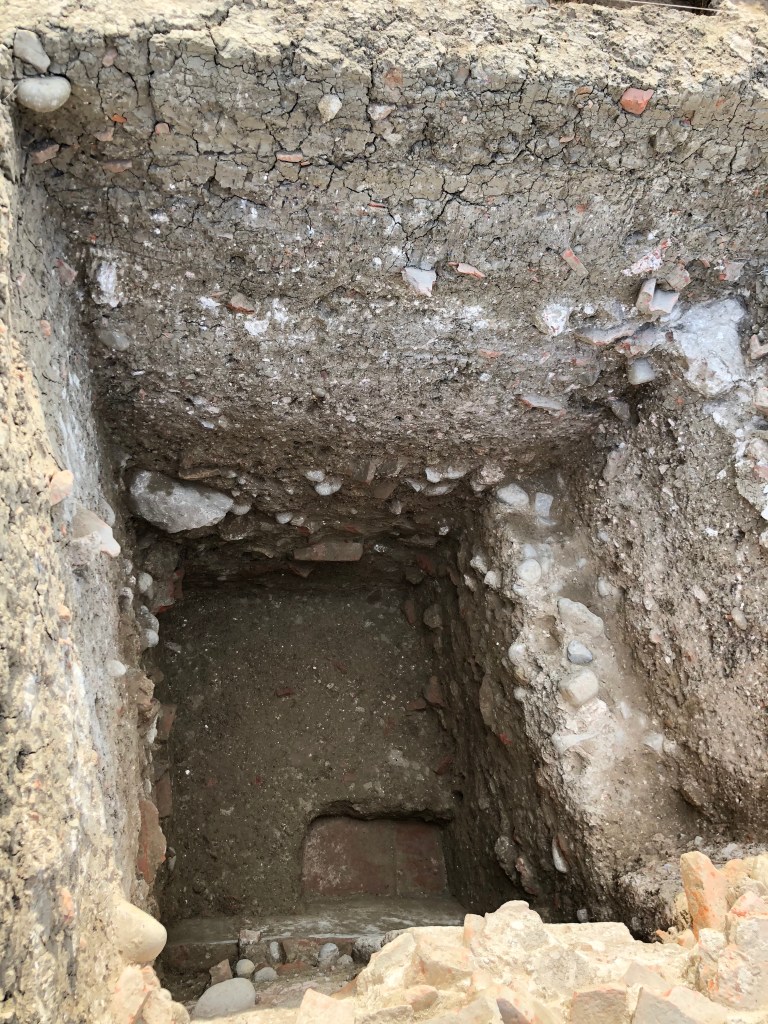
At the time, we concluded that this was probably part of a production area of the villa at that the waterproof basin with the tile floor would have been used to collect liquid, possibly from a wine press. This hypothesis was supported by a curious aperture in the north-south cobble and tile wall above the basin. This opening, which is too small to be a window, could have held a wooden beam over the basin as part of a pressing operation. One feature that we could not explain, however, was the two ashlar limestone blocks stacked on top of each other which looked like they were floating above the basin.
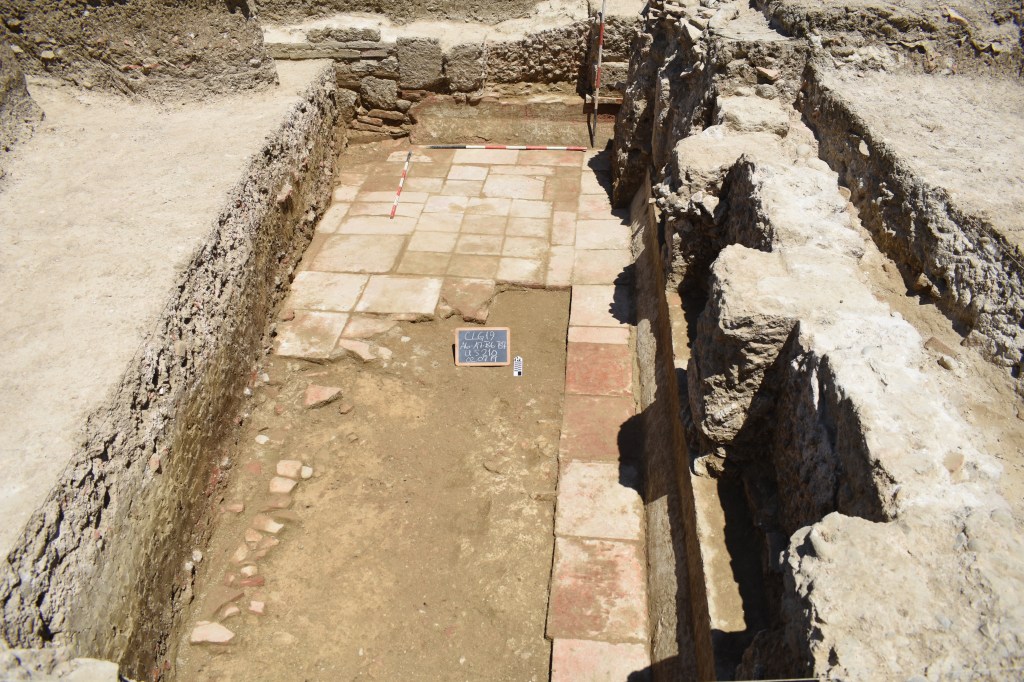
In 2019, we were eager to return to this area of the site, working in previously opened trances as well as opening new trenches to the south. The 2019 season began slowly because of intense rains, which flooded the trenches (and which confirmed that the cocciopesto could retain a lot of water). Work in the new trench to the south of the basin uncovered in 2018 quickly revealed that the north-south wall constructions were continuing to the south and were aligned with the top of the cocciopesto basin. As we removed the upper strata of debris, it became clear that this wall was composed of ashlar pillars alternating with recessed walls faced with plaster decoration, creating a series of niches. These niches rest directly above the top of the thick-walled cocciopesto basin. By the end of the excavation season, we were able to expose the tile floor level on both the east and north sides of the room. As we discovered in 2018, the floor tiles are cemented against the cocciopesto, creating a water-proof pool. On the cocciopesto of the basin appears to have been cut right at the eastern line of the stairs. Whether this was done to block up or make room for the stairs is not certain. In the north-east quadrant of the room the tile floor is well preserved but towards the center and south o the room there are missing tiles.
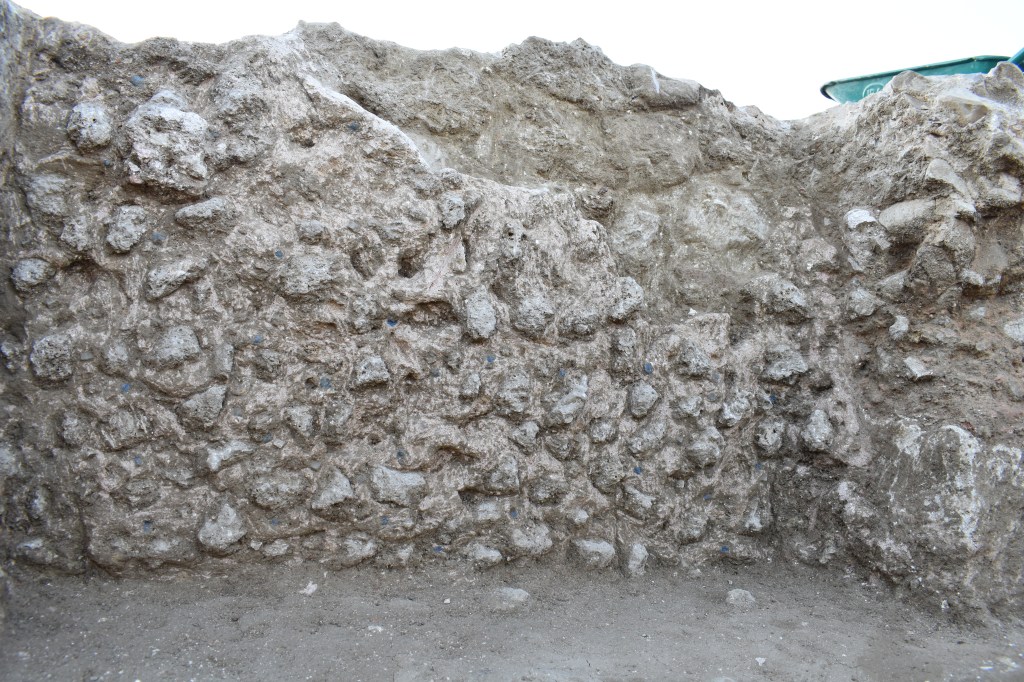
Careful cleaning of soil compacted against the decoration revealed small stones and even smaller pieces of blue-glass tesserae set into the plaster creating the effect of a cave interior. This type of decoration—mimicking the natural world within the built environment—is found in imperial villas around the Bay of Naples, but no examples in Central Italy are known to date. Moreover, the limestone pillars appear to have been heavily plastered decorated with intonaco; some intonaco fragments were found in a position indicating that they had slipped off the pillars as the backing plaster fell away. Over 500 fragments painted in bands of red, yellow, white, and black have been recovered so far.
At this point in the excavation, we project that there will be five niches on each side of the building with two on the north, one on either side of the stairs. This would make a total of twelve. The overall size of the building is at least 6.5 m x 8.4 m, which would make it a very large dining room. Also notable, is the fact that looking to the south from the center of the room (where the stairs are located) one has a perfect view across the Chiana (Clanis) river valley towards the city of Chiusi (Clusium). This presumes that the south side of the building would have been open, something that we need to confirm with further excavation.
The decoration, the waterproof basin and tile floor, and size and orientation of the building all suggest that this structure likely functioned as a nymphaeum, that is a monumental dining/celebration hall with a water feature.
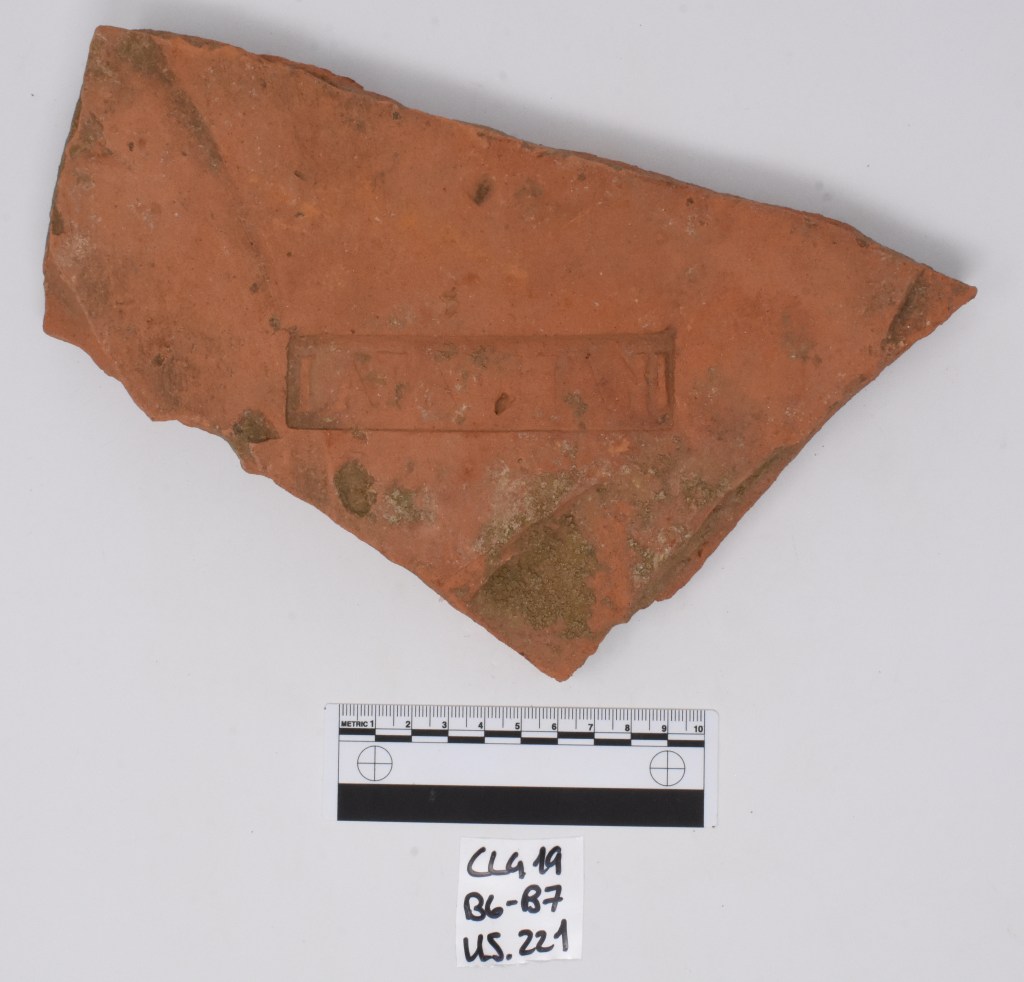
Materials recovered from the fills inside this nymphaeum include a wide variety of ceramics and building materials of mixed dates. The deposition of the upper fill is a relatively late accumulation that occurred as the land was worked over for agricultural purposes and materials were pushed down from the upper terrace of the Villa. However, as noted in 2018, as we get closer to the tile floor of the building, we encounter larger fragments of cooking wares and amphora, some of which can be partially reconstructed. These materials are concentrated towards the north, which suggests the deliberate dumping of objects from a kitchen or storeroom into the open, but unused, nymphaeum building. From the upper fills the most notable finds of 2019 are two complete and identical brick stamps preserving the name L.ATALLIANI (“of Lucius Atallianus”). Three partial stamps bearing this name have been recovered in previous seasons.
In 2019, we also continued excavation on the lower terrace where we had previously identified three rooms of a bath complex, including an apsidal room with a partially preserved hypocaust floor.
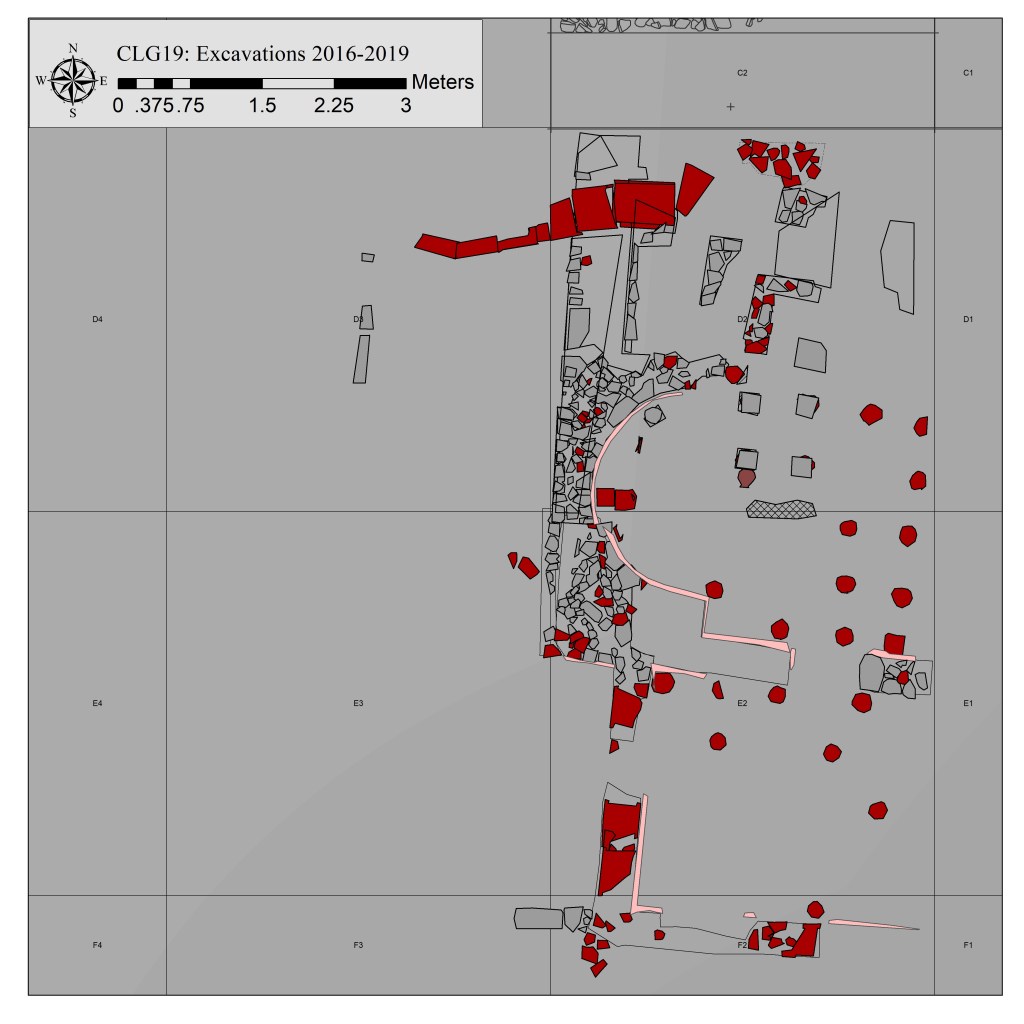
New excavation on the lower terrace was extended to the west for three reasons: 1) to determine the construction of the exterior wall of the apsidal building, 2) to understand the nature of the later reuse of the bath building, and 3) to connect stratigraphically the central and lower terraces. The exterior wall for the apsidal room, constructed of cobbles laid in rough rows, was built directly into a cut in the natural sand sediment. There does not appear to be a foundation trench and no datable material was recovered from around that wall. To the north of the apsidal structure, we did find the continuation of the later drainage channel first seen in 2018. A deposit of burnt material around and inside the tiles used for the drain, suggests there may have been kiln activity in the area and/or the final destruction of the building happened due to fire. Unfortunately, at the level of the drain the site has been heavily disturbed by modern ploughing. As in previous seasons, almost no pottery was found in the bath area. On the other hand, some singular pieces of interest came from the fills in this area: a well-cut marble cornice piece, marble wall revetment, and a fragment of a millefiori glass vessel; tantalizing examples of the luxury this villa once enjoyed.
 TRAP
TRAP 
Leave a comment