A few weeks ago, we went to the National Museum of Archaeology in Chiusi, where there is a special cinerary urn that I had noticed during research for a previous class. This urn depicts Deiphobus’s attack on Paris. Through research, I have found that this cinerary urn exemplifies how the Greeks influenced the Etruscans and how the Etruscans manipulated Greek myths.
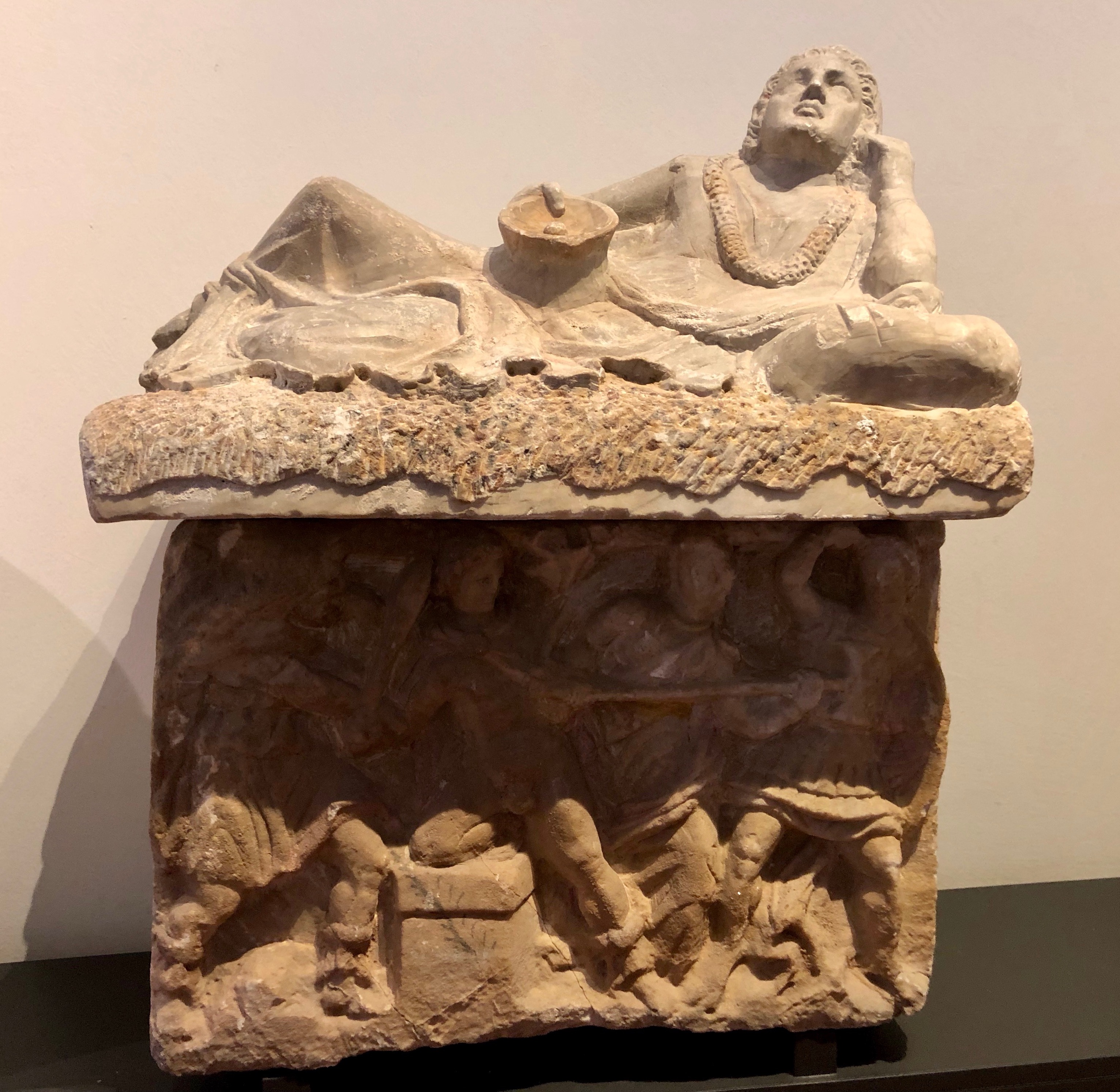
These urns were used by Etruscans to hold the ashes of their dead and were shaped differently depending on the region and the time period. During the seventh to sixth centuries BCE, Etruscans from Chiusi preferred Canopic urns to hold their dead (Huntsman 2014, 141). Then, during the fourth to first century BCE, Chiusi continued to prosper, so more people had access to formal burials. Therefore, burials became more complicated, with the incorporation of more complex urns (Huntsman 2014, 143). The urn that I had learned about is from this period.
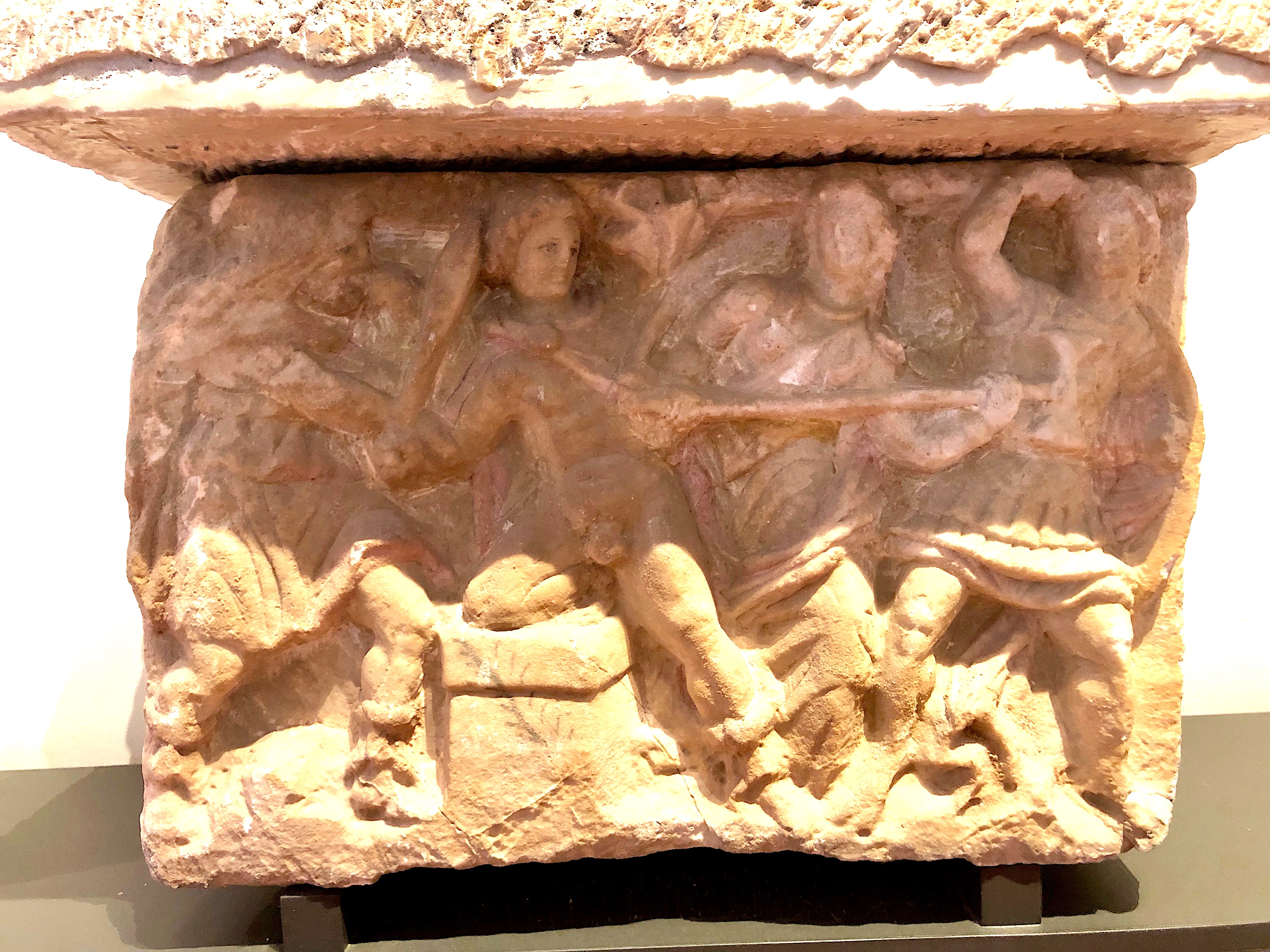
While much of Euripides’s Alexandros has been lost, many fragments remain. This urn depicts the scene of the attempted attack on Paris and his recognition. The first in a trilogy about the Trojan War, Alexandros tells the story of Paris—or as he was called as a baby, Alexandros. Before Alexandros was born, Hecuba, queen of Troy, had a dream that he would bring ruin to Troy (Karamanou 2013, 416). In response, he was left to the elements to die but was taken in by a herdsman who gave him the name Paris (Karamanou 2013, 416). Eventually, Paris went to Troy and competed in games held in the lost Alexandros’s honor, which he won (Karamanou 2013, 416). However, in his rage at having been beaten, Paris’s brother Deiphobus plotted with Hecuba to kill Paris (Karamanou 2013, 416). While it is unsure from the fragments how the next scene begins, the scene on the urn depicts how it ends: Paris seeks shelter at the alter of Zeus Herkeios while Deiphobus tries to kill him and Kassandra tries to stop Deiphobus. However, the Lexicon Iconographicum Mythologiae Classicae (LIMC) shows this image under the header of “Alexandros threatened by Kassandra armed with a double-edged axe and/or Deiphobos” (LIMC 1994, 959). Therefore, it is unsure whether Kassandra threatens or protects Paris.
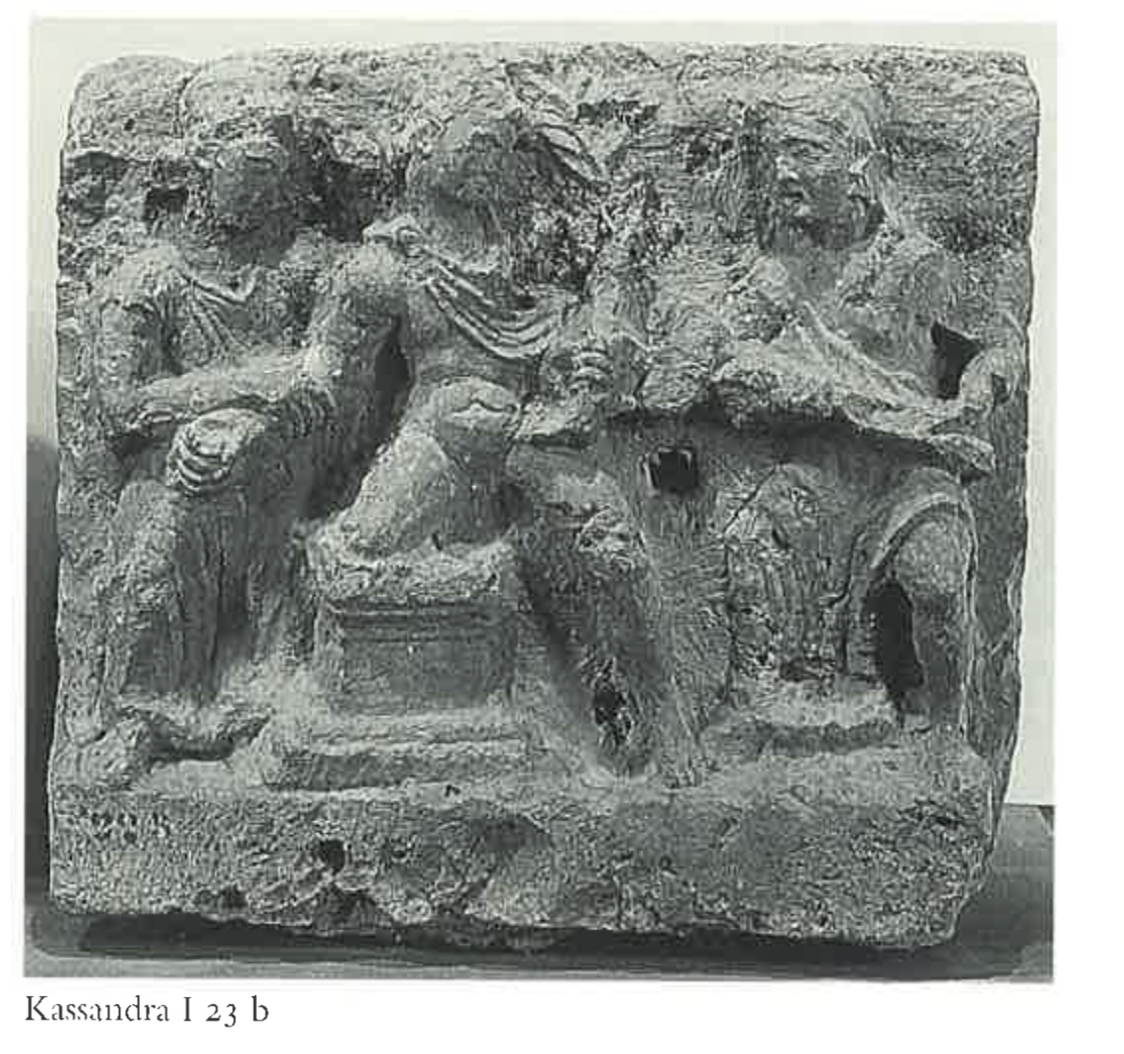
Another inconsistency is that there is a fourth figure on this urn. Going left to right along the urn, there is the unknown figure, Paris kneeling on the altar, Kassandra wielding a double-edged axe, and Deiphobus. There are also a few thought provoking details to the figures. The figure to the far left wears boots and a headdress, which might indicate priestly ornaments. Painted on the altar is a palm-branch, which is the symbol of Paris’s victory of the games (Karamanou 2013, 419). Kassandra wields the double-edged axe in what appears as a forward motion toward Paris rather than a backward motion toward Deiphobus. However, on an urn from Perugia which depicts the same scene, there are only three figures: Deiphobus on the left, Paris in the middle, and Kassandra on the right. This urn is depicted below.
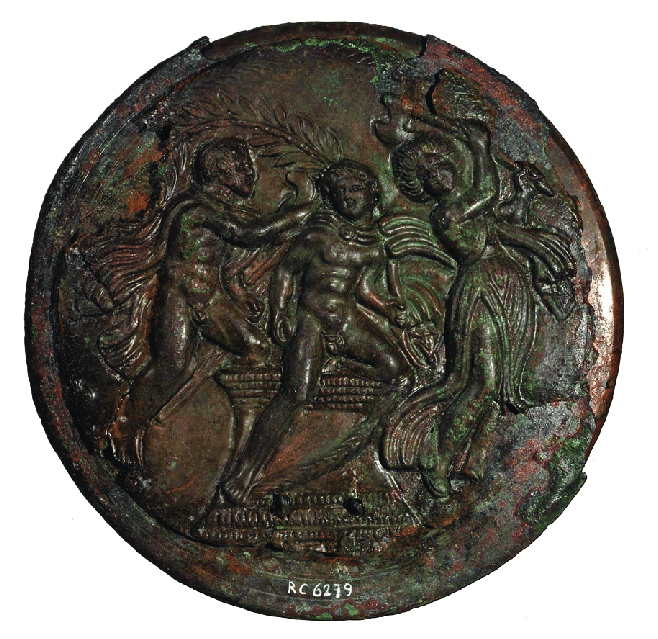
Furthermore, on the back of a bronze mirror, also from the Hellenistic period, there are—once again—only three figures: Deiphobus, Paris, and Kassandra. Like the urn in Chiusi, Paris kneels on the altar, and he holds a palm-branch. Once again, Kassandra swings the double-bladed axe. However, Karamanou suggests that the attacker is Hecuba instead of Kassandra because she had been part of the plot to kill Paris (Karamanou 2013, 419-20). These differences in theory show how the myth might have been re-imagined.
Another question arises. How did a Euripidean tragedy get to Etruria? One theory is that the mirror-backs, and maybe the urns, might have been modeled after a fourth century South Italian vase-painting that is now lost (Karamanou 2013, 423). Another theory is that “educated Etruscans . . . commissioned artists to reproduce these scenes” (Karamanou 2013, 424). Furthermore, “South Italian tragedy-related vase-paintings were . . . usually used for funerary purposes” (Karamanou 2013, 424). Maybe Etruscans had enjoyed these tragedies during their lives and wanted them depicted; maybe they thought that they taught the living important lessons (Karamanou 2013, 424). Either way, they thought that this Greek tale was relevant to their lives.
Finally, Etruscan mirrors and urns are important to look at because of their uses. Mirrors show what people want to create in their identities and what they want to reflect (Izzet 2005, 4-5). Additionally, mirrors were often found in tombs (Izzet 2005, 16). Mirrors and urns showed what scenes were relevant to Etruscan society. They also show how Etruscans might have manipulated Greek mythology to better represent themselves, or what they wanted represented (Izzet 2005, 16). Therefore, no matter the goal, Etruscans imagined and re-imagined the Euripidean tale of the attack against Paris.
Bibliography
Huntsman, Theresa. “Hellenistic Etruscan Cremation Urns from Chiusi.” Metropolitan Museum Journal 49, no. 1 (2014): 141-50. doi:10.1086/680029.
Izzet, Vedia E. “The Mirror of Theopompus: Etruscan Identity and Greek Myth.” Papers of the British School at Rome 73 (2005): 1-22. http://www.jstor.org.duproxy.palni.edu/stable/40311089.
Karamanou, Ioanna. “The Attack-Scene in Euripides’ “Alexandros” and its Reception in Etruscan Art. Bulletin of the Institute of Classical Studies. Supplement, no. 126 (2013): 415-31. http://www.jstor.org.duproxy.palni.edu/stable/44215429.
Lexicon Iconographicum Mythologiae Classicae (LIMC). Zürich: Artemis, 1981.
 TRAP
TRAP 
Leave a comment