This past week, we discovered a purple piece of volcanic rock known as andesite at the Gioella-Vaiano archaeological dig site in trench B7. Professors Rebecca Schindler and Pedar Foss both hypothesized that it may have been used to line the entrance to a stokehole in a hypocaust or kiln at the villa since andesite is heat resistant. However, the Romans also used volcanic rock and ash in their architecture.

According to legend, when Romulus founded Rome in 753 BCE, he settled Rome on the Palatine hill. This hill, along with the other six hills of Rome, were remnants of an eroded volcanic plateau; this meant that the hills contained volcanic deposits. The earliest use of volcanic rock in Roman architecture was in the 6th and 5th century BCE when the Romans quarried tuff rock from the Palatine hill (Jackson and Marra 2006). Tuff formed when lava or limestone consolidated to create mineral cements that bonded to create the rock. Although it was a pyroclastic rock, tuff was not that durable, because it is fairly porous.
However, Roman expansion allowed for the discovery of other types of tuffs that were stronger than that from the Palatine hill because the acquisition of land and the creation of infrastructure made them more accessible. According to Jackson and Marra (2006), the Romans had discovered and used seven different tuffs in their architecture by the end of the Roman Republic in 27 BCE. Tuff was used among other materials in building construction and was sealed in place with concrete.
It is notable that the Romans also used volcanic ash, known as pozzolana, in their concrete. Romans used pozzolana because it created such a strong mortar for concrete that it could even be used for underwater construction. Scientists, using Marcus Vitruvius’s writings on Roman architecture as a guide, discovered that when cement containing pozzolana interacts with seawater, the water crystallizes the ash within the mixture which creates Al-tobermorite and phillipsite (Ahmad 2017). Additionally, it uniquely cured without drying, which made it ideal for constructing thick foundations (Marder and Jones 2015). These features made pozzolana popular in concrete because it allowed for strong, durable structures.
The most intelligent and grand use of volcanic rock and ash by the Romans was at the Pantheon in Rome. First built by Agrippa and rebuilt by Hadrian after the earlier version burned down, it exhibits the height of Roman engineering. The Pantheon is most famous for its unreinforced concrete dome—still the largest in the world—which we saw firsthand during our overnight trip to Rome.
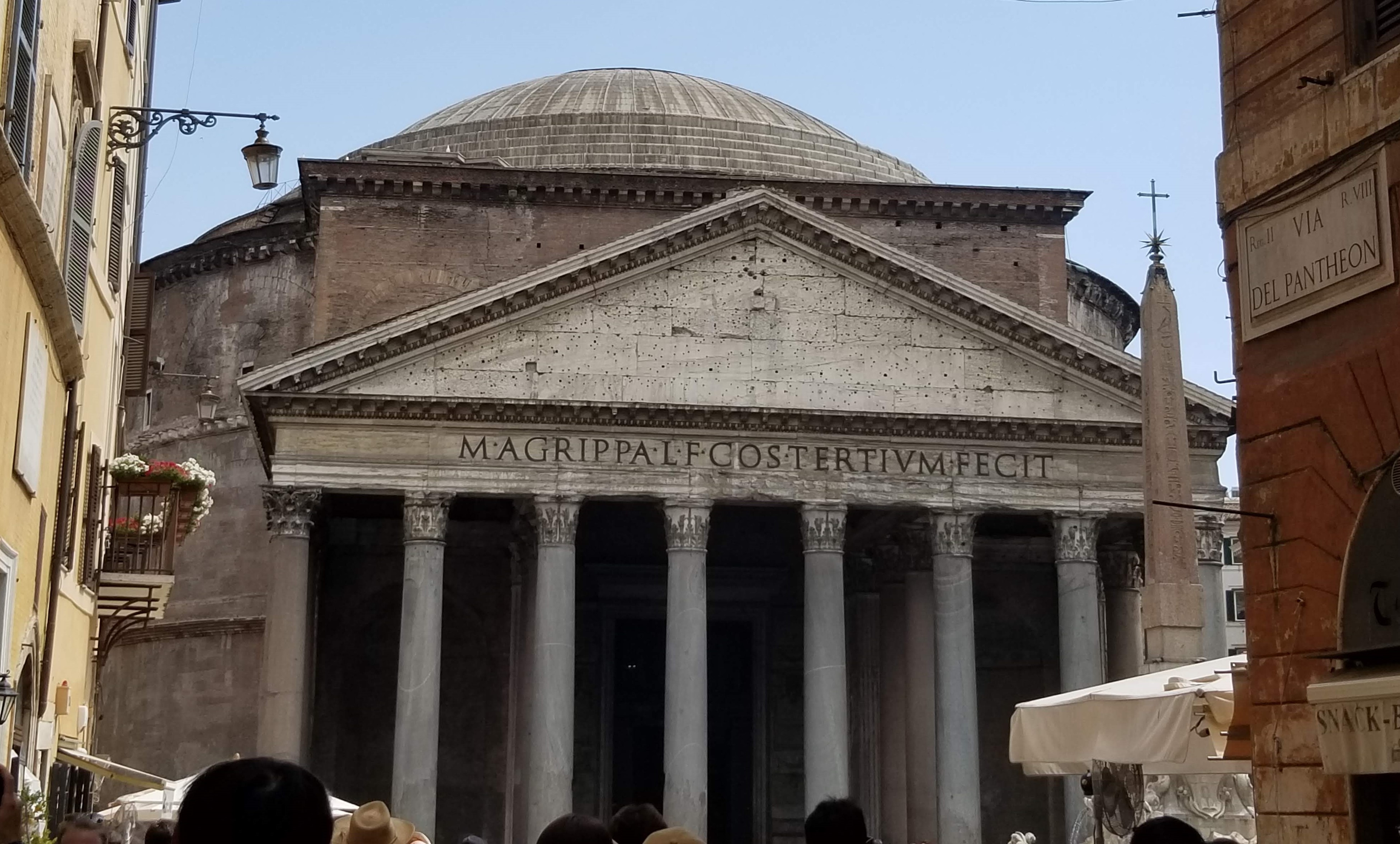
To support the weight of the dome and keep it from breaking under pressure, the architect needed to somehow make the dome lighter. This was achieved in three ways. First, the architect utilized five rows of coffers on the inside of the dome to use less material; the second method involved gradually reducing the thickness of the dome as it rose; the last method involved volcanic stone and ash.

To make the dome lighter, the architect used his knowledge of the different characteristics of volcanic stone to his advantage. At the bottom of the dome, the architect placed brickwork and stress-resistant tuff connected by a concrete mixture of pozzolana and lime (Marder and Jones 2015). As each upper layer was added, the architect mixed in various types of volcanic rock into the concrete mixture of pozzolana and lime in order of increased lightness. From the heaviest volcanic stone to the lightest stone, the order of fillings was as follows: Cappellaccio tuff, tufo giallo, pumice, and volcanic slag. The strategic use of these volcanic rocks reduced the weight of the materials as the structure rose which reduced the compression on the lower layers, creating less thrust on the structure below (Marder and Jones, 2015).
Given that we discovered the presence of volcanic rock at the site, and given how the abundance of volcanic rock made it cheap to purchase, I am curious whether we will find volcanic tuff in the villa’s foundations. Furthermore, I wonder whether the concrete we have at the site includes pozzolana. Unfortunately, since Romans usually used local materials, that is unlikely. However, Professor Jim Mills said that if we wanted to test for volcanic ash, we could take a thin section of the mortar at our site and analyze its composition using petrography.
Works Cited:
Ahmad, Zahra. 2017. “Why Modern Mortar Crumbles, but Roman Concrete Lasts Millennia”. Science, July 3, 2017. https://www.sciencemag.org/news/2017/07/why-modern-mortar-crumbles-roman-concrete-lasts-millennia.
Jackson, Marie, and Fabrizio Marra. 2006. “Roman Stone Masonry: Volcanic Foundations of the Ancient City.” American Journal of Archaeology 110: 403-436.
Marder, Tod A., and Mark Wilson Jones, ed. 2015. The Pantheon: From Antiquity to the Present. Cambridge: Cambridge University Press. doi:10.1017/CBO9781139015974.
 TRAP
TRAP 
Leave a comment