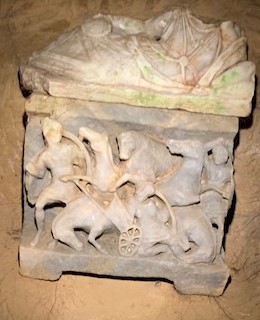
The tombs of the ancient Etruscans are one of the few ways people today can glimpse a civilization that dominated Italy and the Italian political and cultural scene in the 6th century. The tomb containing the urn pictured above is the Tomba della Pellegrina, located in present day Chiusi (known in antiquity as Clevsin by the Etruscans and as Clusium by the Romans). This tomb dates to the 4th century, when Etruscan political independence began to decline with the onset of Roman power. Other powers also rose to challenge the Etruscans, including Syracuse, who effectively ended Etruscan influence in Campania in two victories at Cumae in 504 and 474. This urn does not focus on these defeats. Instead, the urn has a scene of a battle between a warrior on the ground and a warrior on a horse, with a comrade of the dismounted warrior on the left appearing to be crushed. The two can be distinguished as comrades due to the similar appearance of their shields, which are almost as large as the body, and have the same oval-like shape. This style of shield is a prime characteristic of a Gallic warrior, making this scene a Celtomachia with its Etruscan horseback hero on the far right of the urn fully equipped in armor (Holliday 26 – 27). The Celtomachia, a depiction of battle with Gauls, began to appear on Etruscan funerary ornamentation in the 5th century (Holliday 24). Why would a funerary urn for an Etruscan man or woman depict this? The answer is twofold. Firstly, the depiction of the Gauls on funerary art tracks a Greek tradition. Secondly, it is a way to represent actual historical events and concerns of 4th century Etruria.
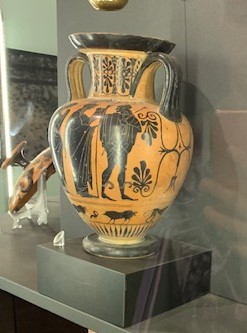
The Etruscans loved to imitate Greek art and pottery. In the numerous Etruscan tombs that have been discovered, the largest sample of Greek art comprises pottery of Etruscan craftsmanship. This transplantation of Greek artistic forms and scenes continued onto funerary urns. Contact with the Greeks was long prevalent when Chiusi and Volterra became the main producers of funerary urns, and the appearance of the Celtomachia began to increase (Holliday 27-28). One vital ritualistic reason for the urns was “symbolically [to allow] the deceased to take part in important social rites alongside other deceased family members and with the necessary accoutrements” (Huntsman 149). Etruscan tombs would frequently be visited by the family members, always reminding visitors of the ever-looming presence of the Gauls.
By the 4th century, the Gauls were a prominent player on the Italian peninsula. “By the early fourth century” the Gauls moved south and put pressure on the northern regions of Italy, eventually pushing Etruscan political power back into the Etruscan heartland (Holliday 29). The Gauls continued to raid throughout central Italy, culminating in the Sack of Rome in 390 BCE, which nearly saw the city of Rome destroyed due to Roman interference in an Etruscan-Gallic dispute (Hook). Rome too became an enemy of the Etruscans, who by 396 BCE were themselves on the defensive after the Romans destroyed Veii (Holliday 29). Thus, the threat of Gallic warriors raiding the lands of Etruria and the Romans strongly encroaching on Etruscan life disrupted prosperous Etruscan cities and gave urn makers a historical basis for artistic and violent representations of battle. The figure on the right of the urn, wearing more ornate armor, looking to strike at the enemy from horseback, is how the Etruscans would view themselves in comparison to the Gauls. This pose is a “common representation of Greek mythology”; the noble warrior striking down the barbarian (Holliday 26). The Etruscans, using this Greek conception, looked to idolize their fallen and inspire their own people against the enemy. This does not mean that the Gauls were more barbaric or violent then any other group in Italy. This was a tumultuous time of warfare for Etruscans looking to maintain their power, Romans looking to usurp it, and Gauls playing a role in both conflicts. No one group was better than the other. The Celtomachia is the Gallic facet of this uncertain time for Etruscans. It is most likely that these urns “were very likely made for men who had fought in the wars against the Celts”, which shows that the Celtomachia had a personal effect on Etruscans (Holliday 40). Since they had to battle Celts and fight off raids, they looked to the Celtomachia to shape ways to honor and commemorate their valiant family heroes.
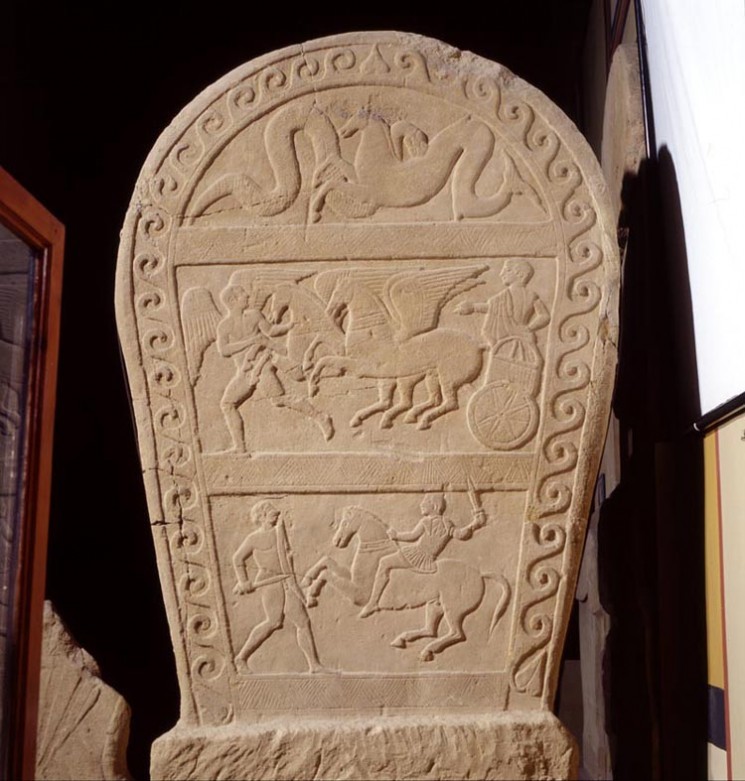
The Celtomachia appearing on funerary urns found in Etruscan tombs were more than just pieces of art. They represent a century of Etruscans under siege by Gauls and Romans. The Gauls were just one enemy, but they were a constant threat to the Etruscan cities in their twilight, potential raiders and bringers of sorrow. By designing Celtomachia for their urns, the Etruscans looked to honor fallen family members as well as mirror Greek artistic conventions for battle against foreign foes. These urns were more than just tombs for the dead, but made a cultural statement for the Etruscan people.
Work Cited
Edwards, I. E. S., J. B. Bury, S. A. Cook, F. E. Adcock, M. P. Charlesworth, C. T. Seltman, John Boardman, Averil Cameron, Peter Garnsey, Bryan Ward-Perkins, and Michael Whitby. The Cambridge Ancient History. 2006.pg. 152
“Felsian Burial Stele.” Digital image. Archaeological Museum of Bologna. Accessed June 6, 2019. http://www.museibologna.it/archeologicoen/percorsi/66287/id/75034/oggetto/74544/.
Hook, Judith. “Rome after the Sack.” The Sack of Rome, 2004, 181-91. doi:10.1057/9780230628779_13.
Holliday, Peter J. “Celtomachia: The Representation Of Battles With Gauls On Etruscan Funerary Urns.” Etruscan Studies 1, no. 1 (1994). doi:10.1515/etst.1994.1.1.23.
Huntsman, Theresa. “Hellenistic Etruscan Cremation Urns from Chiusi.” Metropolitan Museum Journal 49 (2014): 141-50. doi:10.1086/680029.
 TRAP
TRAP 
Leave a comment