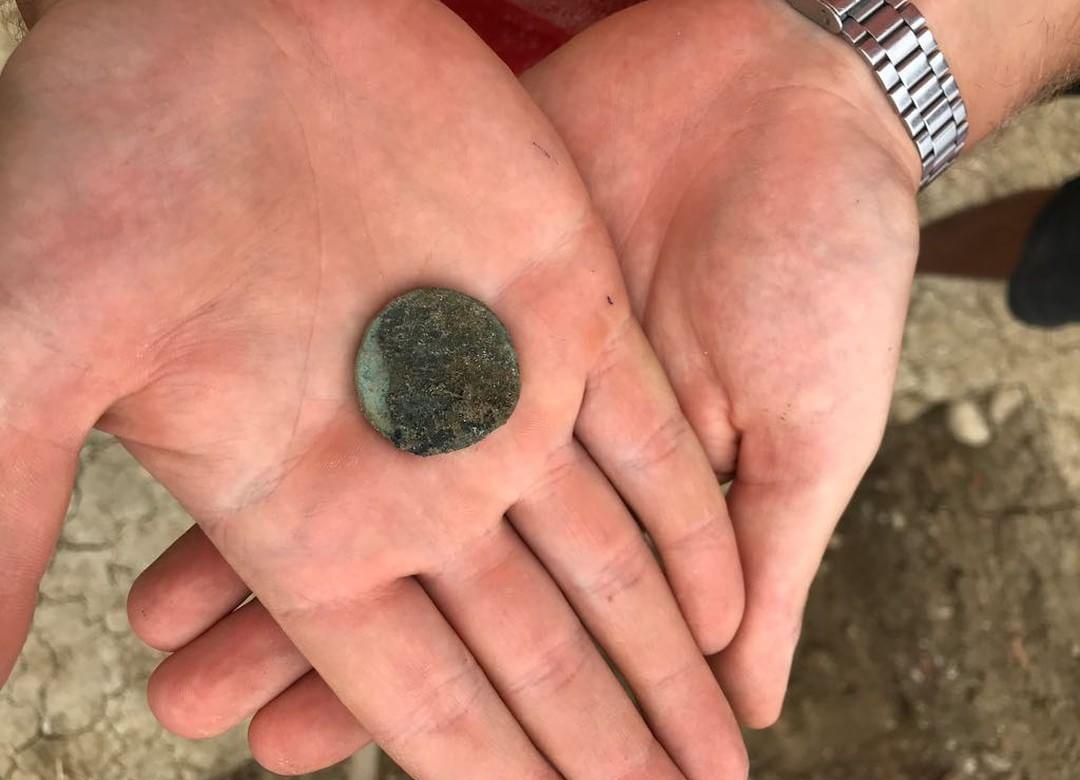
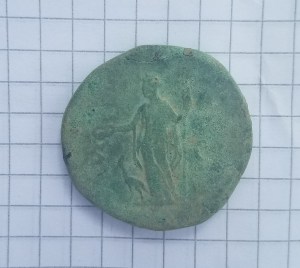
On June 22, my trench (A6) discovered a coin resting between clumps of clay. The coin rested in a pile of disturbed soil with only the eye-catching green hue drawing our attention and halting our trench’s progress. We removed the coin from the trench and began inspecting it, looking for visible details to date the coin and pondering what the coin’s discovery meant for our trench. Both sides of the coin had a layer of clay build-up covering portions of the images but the clay did not hide the word AVGUSTA. At first, I was excited to have an artifact in my trench with text but after clearing the clay away we discovered a more interesting detail. With a steady hand (and a dental pick), the clay layer on the obverse was removed, revealing the name FAVSTINA and a female profile (Figure 1). The reverse side of the coin featured a female figure holding a staff in her left hand and a bird to her right (Figure 2).
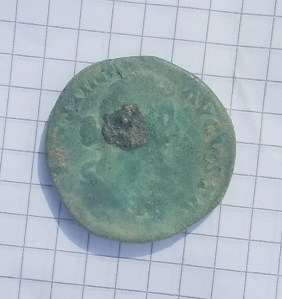
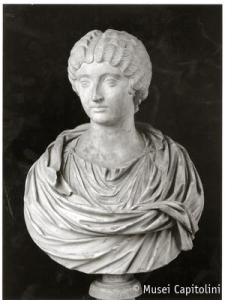
The woman featured on the obverse side of the coin is Faustina the Younger (AD 128 – 175), daughter of the emperor Antoninus Pius and wife to Marcus Aurelius. Faustina is identifiable by her wavy hair pulled into a bun which hangs low on the back of her neck and her hooked nose. Faustina’s low bun hairstyle did not come until later in her life, after AD 160, so this coin portrays an older Faustina. She was the only child of Pius to reach adulthood and the birth of her first child – the Antonine heir – was a big deal and led to her receiving the title of empress before her husband was named emperor. The birth of her first child after only a year of marriage showed that the line of succession was secure. It was then that Faustina received the official title Augusta, an honorary title few empresses prior to her were grantedfrom the Senate. While there is much to be said about this coin, the most important takeaway from its discovery is what the coin can tell us about our site. With the coin dating to AD 161 to 175, we know that the clay fill we were digging in my trench dates to AD 161 at the earliest.
The reverse side of the coin (Figure 2) shows Juno holding an offering bowl in her right hand, a scepter in her left hand, and her symbolic animal, the peacock on her right. Faustina began appearing on Roman coins in association with Juno, the goddess of marriage, protector of children, and wife of Jupiter; Juno’s image emphasized Faustina’s status as Augusta and her relationship to the previous emperor Antoninus Pius and the current emperor Marcus Aurelius. By the end of her life, Faustina and Aurelius had twelve children. The fertility of the couple was celebrated in a time when most Romans struggled with infertility, which further solidified her association with Juno as a protector of children. While Faustina is not the first Roman woman to be compared to Juno, she established herself as a dutiful Roman wife when she ensured the line of succession of her family by giving her husband an heir and accompanied Aurelius when he went on campaigns (Faustina was named mater castrorum, “mother of the camp”).
Of course, other coins of Faustina the Younger are not limited to only images of Juno on the reverse side. Faustina is often portrayed with what are considered the traditional Roman goddesses — Diana, Venus, and Juno — along with the personifications of joy, concord, happiness, and mirth. On some coins, Faustina is even shown holding one or more of her children. These images help reinforce her piety and motherliness.
I have rarely seen images of ancient women without their husband’s profile next to or overlapping their own on coins. The coin of Faustina the Younger shows an older woman, well established among her people, and representing hopes and ideals of the Roman people. The Senate’s naming of Faustina as Augusta before her husband became emperor is especially interesting. Finding this coin at our site reinforced my interest in the portrayal of women in antiquity and sparked a fascination in a form of art I had not previously considered — coins.
Works Cited
“Aureus (Coin) Portraying Empress Faustina the Younger, AD 161/175, Issued by Marcus Aurelius.” The Art Institute of Chicago. http://www.artic.edu/aic/collections/artwork/5648
Boccaccio, Giovanni. 2003. Famous Women. Harvard University Press.
Burns, Jasper. 2006. Great Women of Imperial Rome: Mothers and Wives of the Caesars. New York: Routledge.
 TRAP
TRAP 
Leave a comment