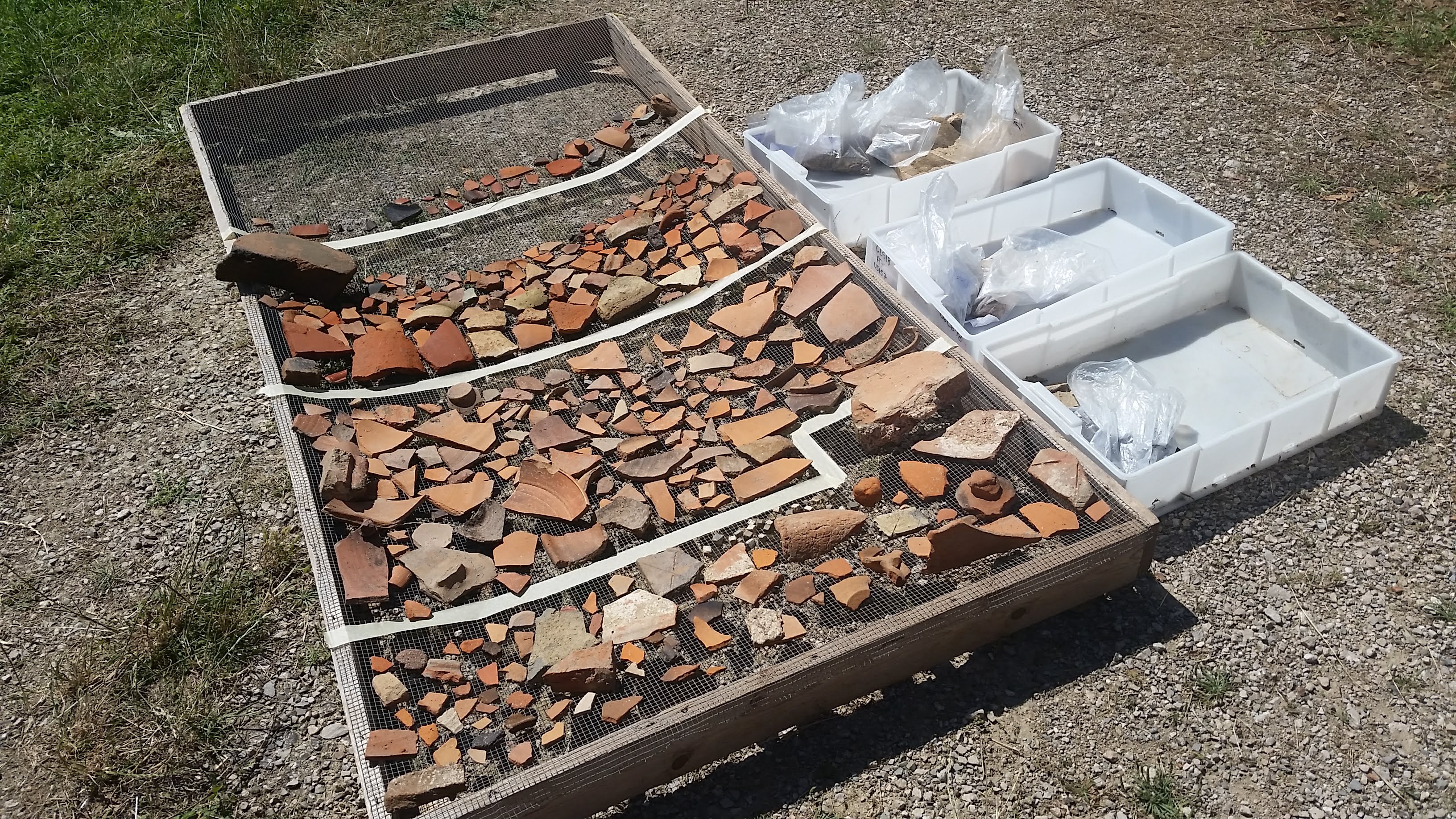
Imagine yourself stepping into a museum where you’ve been promised fantastic displays of ancient pottery. Now, picture the pottery itself. It’s likely that you’re envisioning interestingly decorated, seemingly complete artifacts. If you take a closer look at museum pottery, though, you may notice that many of the ceramics are actually a patchwork of old and new material. This realization struck me as I wandered through archaeology museums in Chiusi and Chianciano. You see, unless you’ve been blessed by some otherworldly deity, most pottery that you uncover as an archaeologist comes up looking like an expert-level jigsaw puzzle (see figure A). How, then, do these fragmented remains become pristine-looking museum displays? This transformation occurs through the meticulous process of ceramic conservation and reconstruction.
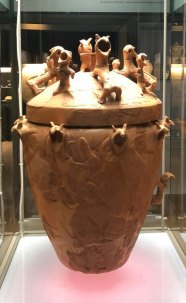
The story of ceramic conservation and reconstruction begins with a single question: why? In the case of museum display, conservators complete ceramic reconstructions for educational, commercial, and practical reasons. Educationally, a complete artifact provides viewers with a more concrete idea of the item’s use and purpose. Most museum-goers are not experienced archaeologists, so fragmented bits of pottery hold little meaning; therefor, complete artifacts better cater to the general public. Additionally, completed ceramics result in a more impressive spectacle; thus, they attract larger crowds. While putting on a show isn’t really the main goal, museums must consider the commercial logistics of hosting exhibits. If no one tours museums, they won’t stay open. From a more practical standpoint, ceramic reconstruction helps to stabilize artifacts. Especially in cases where there are heavily fragmented sections or missing parts, reconstruction serves to protect pottery from falling apart by providing structural support (See Figure B: notice the lighter, reconstructed sections. Without these additions, the vase would be unable to stand on its own).
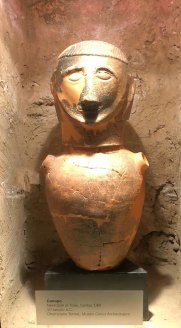
After understanding why we reconstruct pottery, one must consider a few basic principles when it comes to reconstruction. As Professor Schindler explained to me, with ancient ceramic restoration, modern additions must be distinguishable and removable from the original artifact. The practice of having differing new and old materials ensures that reconstructed fills remain unmistaken for ancient ones, and alerts viewers to the possibility that new additions may not necessarily be 100% accurate (See Figure C: note the highly distinguishable orange fill that contrasts with the ancient, much grayer ceramic material). The ideology of distinguishability wasn’t always the case, though, which is why some older reconstructions don’t follow this practice. Another important principle to bear in mind is artifact safety. New additions must not compromise the original artifact, and should be thoroughly considered before approval.
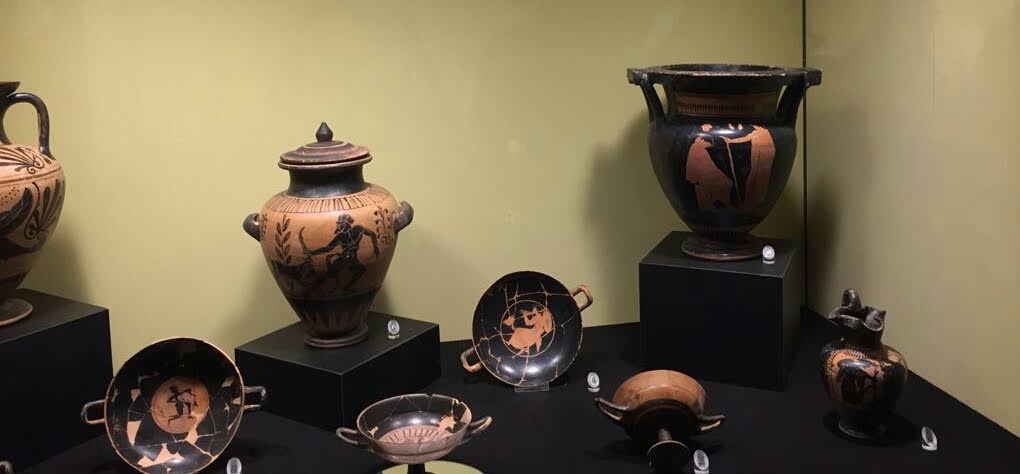
In regard to the process of restoration itself, techniques are highly subjective to individual pieces, but there are a few overarching steps. Interestingly, ceramic restoration dates back to the Romans themselves. Archaeologists have found evidence of the Greeks and Romans using “clamps, dowels, and rivets” to repair pottery- techniques which were used until the 20th century (Koob 1998, 50). Fortunately, ceramic restoration for museums no longer uses these practices. The first step involves identifying the type and material of your artifact. From there, you can then select appropriate adhesives and fillers. Although you are working with ceramic material, you should never use heat during the restoration process (Larney 1971, 69). In most cases, ceramic reconstruction does not involve traditional pottery-making methods. After examination and identification, you should thoroughly clean and dry your artifact. While most pieces have been washed before being sent to a conservator, reconstruction requires a more precise cleaning. If you are reconstructing a previously conserved piece, it’s necessary to remove old adhesives and repairs (Larney 1971, 70). Following cleaning comes bonding, which involves a trial run (often using Sellotape) and a final application of adhesive, which depends upon the type of ceramic material (Larney 1971, 71). From bonding, one moves through the processes of reinforcing, filling, and retouching, with reinforcing being mainly necessary before long-distance travel (Larney 1971, 74-75). Throughout these steps, you should use bonders and fillers that do not expand or contract when dried. Check out figure D to see an example of a finished display with reconstructed pottery.
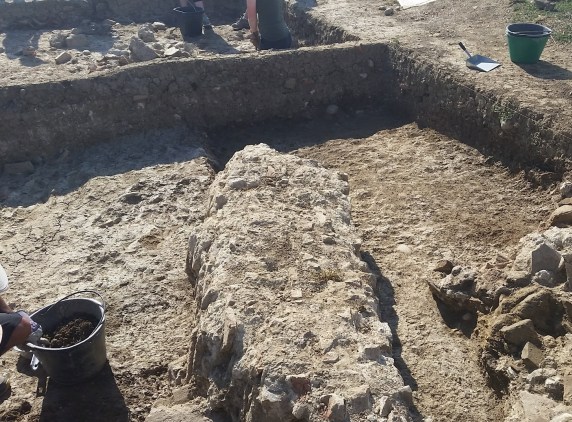
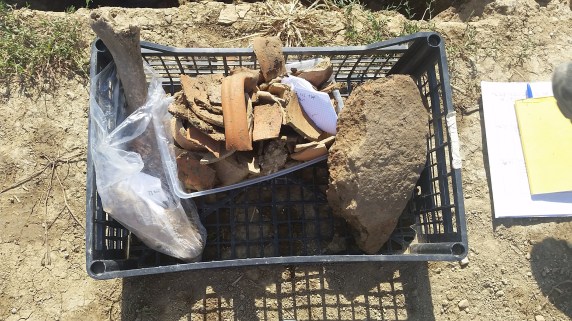
So, what does ceramic restoration look like at our site? Currently, we’re still in the digging and research phase, so we’re primarily focused on fieldwork (See Figures E and F). As we gather ceramic material, we wash, record, and process finds. Eventually, we plan to construct our own museum displays based on the research we’ve completed. Reconstructed or not, ancient ceramics are pretty cool.
Bibliography:
Koob, Stephen. 1998. “Obsolete Fill Materials Found on Ceramics.” Journal of the American Institute for Conservation, Vol. 37, No. 1(Spring, 1998), pp. 49-67. http://www.jstor.org/stable/3179911
Larney, J. 1971. “Ceramic Restoration in the Victoria and Albert Museum.” Studies in Conservation, Vol. 16, No.2 (May, 1971), pp.69-82 //www.jstor.org/stable/1505454
 TRAP
TRAP 
Leave a comment