Understanding the environment is useful in archaeology for multiple reasons. It is necessary to answer research questions regarding the landscape, layout, and function of a site. There are various methods of examining the ancient environment, including, on Roman sites, carbon analysis and art historical examination. Carbon analysis provides solidly scientific evidence, as remains can be identified down to exact species. While art historical examination can be accurate and specific as well–and more cost effective–it can be difficult to be as precise if the art is not well-preserved.
Carbonized plant remains are typically preserved well in the Italian environment, as at our Gioiella Roman Villa site. In particular, we have found a substantial amount of carbonized wood remains, which I find particularly interesting because even after several centuries it is still visibly identifiable as wood. When samples such as these are submitted to a lab, they are studied under a microscope so the cell structure is visible. This allows researchers to identify the species of tree or shrub.
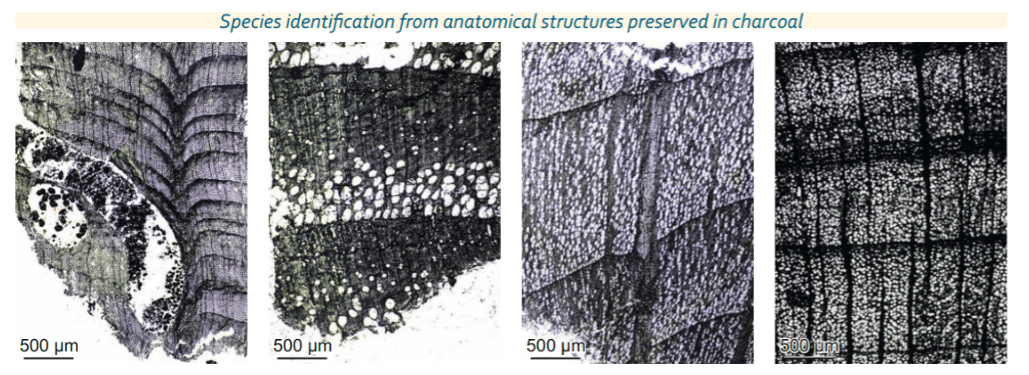
However, carbon analysis is not limited to wood. For instance, at Pompeii, 24 species of plants were identified from seeds, nuts, grains, and fruit carbonized during the destruction of the city by a volcanic eruption. There are no such examples at the Gioiella site, and if there are non-wood samples to be found they certainly won’t be as expansive as in Pompeii. These hypothetical samples would most likely be seeds and they would most likely be found in a kitchen area, which has not been located yet (but you never know).


Alternatively, examination of artistic depictions of flora is a more traditional approach to ancient environmental research. Several major works of art have been intensely studied in order to identify all of their vegetation. One example that I saw on our group trip to Rome was the Ara Pacis Augustae, an altar dedicated to Augustan Peace. It is ornately decorated with people, animals, and plants all living in harmony. The simple, yet effective, museum in which it is housed featured a comparison between the art and what the plants look like in reality, which gave me a new appreciation for the art historical approach–some of the plants are more recognizable than others.


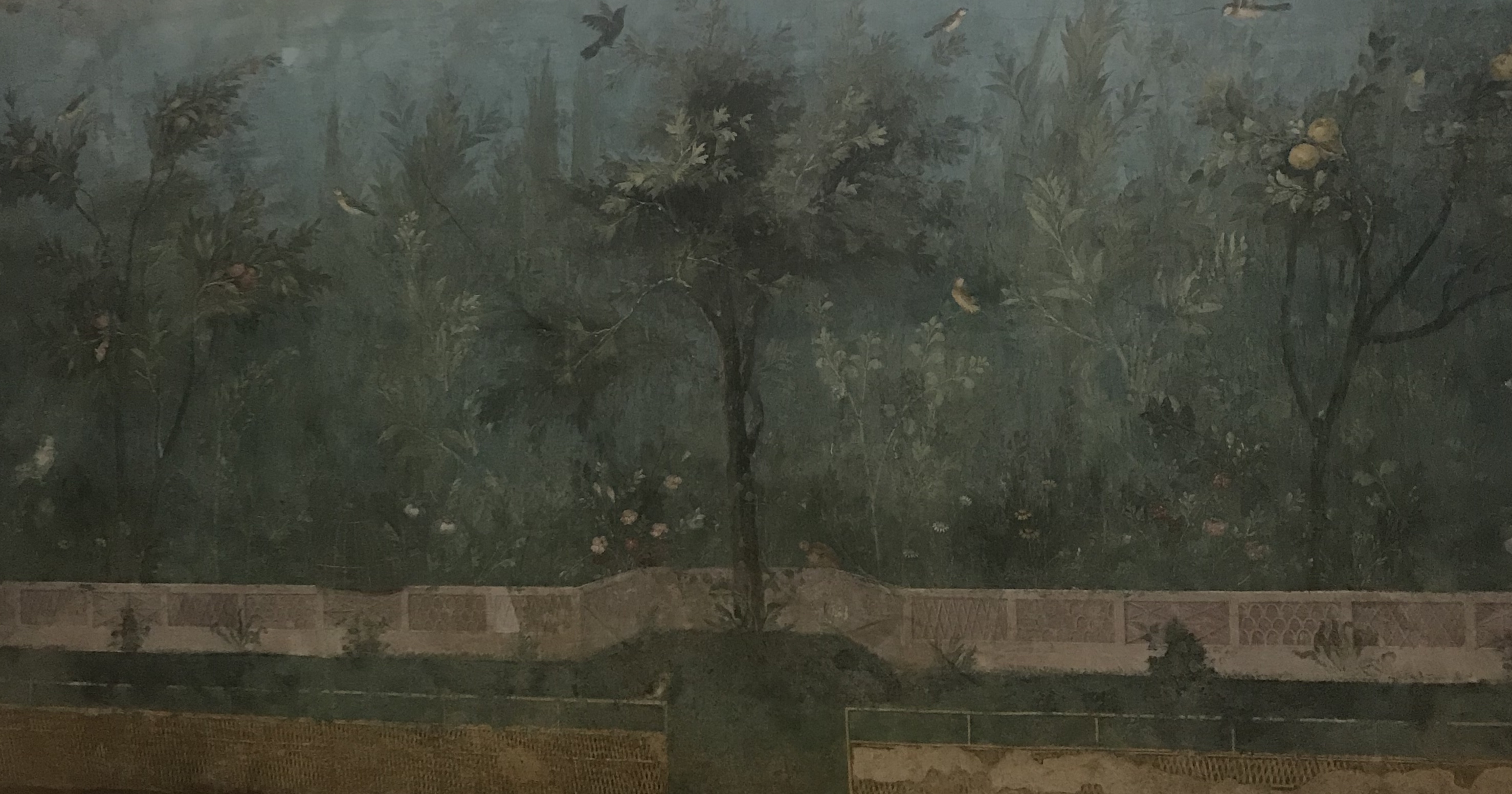
Another famous example is the garden frescoes at the Villa of Livia in Prima Porta. It is one of the best visual examples we have of Roman gardens due to the exceptional quality and sheer volume of plant life. Research has been “based on the most diagnostic morphological aspects, such as the general habit of the plants, typology, shape, size, and color of the fruits and flowers, if present, and the morphology and layout of the leaves” (Caneva, Giulia & Bohuny, Lorenza 2003), which is a complicated way to say that the scholars examined all the aspects of the plants in the frescoes and then compared them to actual plants.
I get to see an example of plant life popular in Roman art and still visible across the Italian landscape today while I eat my lunch at the dig site. It is an acanthus plant, also known as Bear’s Breeches, which was the model for the capital on Corinthian columns.


Seeing and experiencing the broad differences in ancient floral analysis has only ignited my passion further. I have always been enthusiastic about archaeology and plants, but they weren’t so deeply connected. Now that I have gained firsthand experience of the excitement of pulling a particularly beautiful piece of carbonized wood out of the ground, or recognizing a plant that I see everyday in the art that I admire, I’m becoming more and more excited for my future career.
Works Cited
Caneva, Giulia & Bohuny, Lorenza. (2003). Botanic analysis of Livia’s villa painted flora (Prima Porta, Roma). Journal of Cultural Heritage – J CULT HERIT. 4. 149-155. 10.1016/S1296-2074(03)00026-8.
H. Schweingruber, Fritz & Börner, Annett. (2018). Fossilization, permineralization, coalification, carbonization and wet wood conservation. 183-192. 10.1007/978-3-319-73524-5_13.
Meyer, Frederick G. “Carbonized Food Plants of Pompeii, Herculaneum, and the Villa at Torre Annunziata.” Economic Botany 34, no. 4 (1980): 401-37. http://www.jstor.org/stable/4254221.
Stuart, Revett. (1827). Antiquities of Athens, Plate VII, Chapter III, Volume 1. http://digi.ub.uni-heidelberg.de/diglit/stuart1827bd3?sid=8461e29284ea86dce8e8fc722cdd5306&ui_lang=eng
Wall Text, Ara Pacis Museum. Rome, Italy
 TRAP
TRAP 
Leave a comment