From the moment I excavated and held my first little piece of Terra Sigillata, to the time we found a piece of it proudly displaying the fingerprint of its maker, I knew that I had to learn more. In certain areas of our Roman villa located between Umbria and Tuscany, dating to the 2nd century BC to the 3rd century AD, Terra Sigillata is a relatively common find.
What is Terra Sigillata?
There are two classes of pottery in the Roman world, coarse wares and fine wares. Terra Sigillata is a type of fine ware pottery commonly used as tableware in the Roman world. It would have been used for everyday eating and drinking. The words “Terra Sigillata” translate to “stamped earth.” This name is used because it is made in a mould that gets impressed with stamps. This standard fine tableware usually appears either orange, terracotta, or red. The color of the vessel can depend on where it is made or how it is made. This type of pottery was mass produced, as it appeared all over the Roman world, even in places as far as Africa and Britain. Terra Sigillata was typically produced and popular anywhere from the 1st century BC to the 3rd century AD.
Terra Sigillata was produced in different places at different times. One of the first places it was produced was in Arezzo, Italy, about 55 km. north of our villa. This Italian-type Sigillata produced in Etruria also had a branch of factories in Pisa.
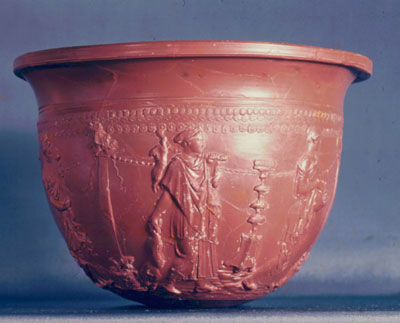
Arretine Ware
Emma Watts-Plumpkin, Terra Sigillata, 2013, https://www.world-archaeology.com/features/roman-mediterranean-stamping-ground/
Ca. AD 60, Gaul took over the production until the 1st or 2nd century AD, when North Africa took over production. It was produced in Tunisia from 2nd century AD to the 6th century AD.
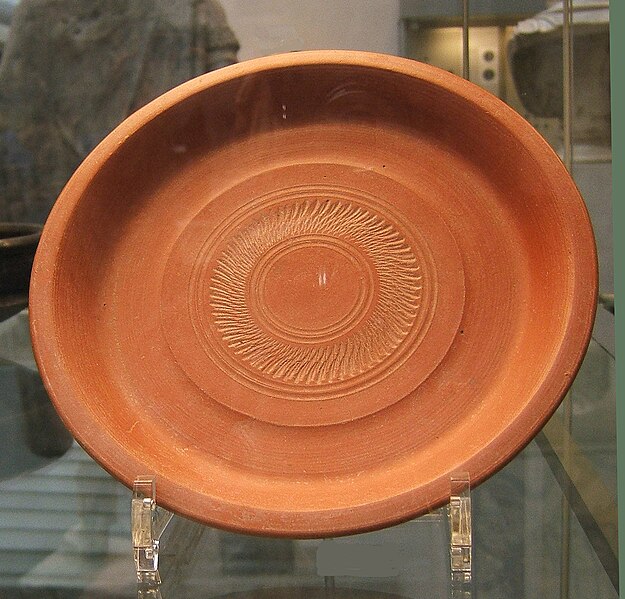
Sigillata Africana
Laurent Gasca, Sigillata Africana, 2012, http://aruqeomed.blogspot.com/2012/10/la-ceramica-sigillata-africana.html
The different areas in which this gloss pottery was produced varied slightly in their production types and formulas, allowing for Sigillata to be dated more easily. The location of production can also be identified by its color and style.

http://www.wikiwand.com/de/Terra_Sigillata
How Does this This Relate to our Site and our Roman Villa?
Terra Sigillata is being found at our site and in our trench (A7) that my group is excavating this summer. This finding allows us to better date a stratum, giving us a Terminus Post Quem (the date after which a stratum had to have been deposited). The stamps and type of Sigillata allow for easier dating as well. On our site as a whole, Arretine Ware has been found, as well as African Red Slip Ware. So far, Sigillata from Gaul has not been found. As well as dating, the location where this tableware is found allows us to see its possible relationship to the location and the consumption or creation of food. If found in a large concentration, it is possible that the area was used for either function. In trench A7, a few small pieces of African Red Slip Ware as well as Arretine Sigillata have been found, not enough to indicate function. The other thing Terra Sigillata can tell us about is the trade, economy, and everyday life in the Villa during the Roman Empire. The fact that African Red Slipware has been found shows that commonly used items were traded long distance across the Mediterranean to our site.
Britannica, The Editors of Encyclopaedia. “Terra Sigillata Ware.” Encyclopædia Britannica. March 24, 2011. Accessed June 19, 2018. https://www.britannica.com/art/terra-sigillata-ware.
“Everyday Dining: Terra Sigillata.” Johns Hopkins Archaeological Museum. Accessed June 19, 2018. http://archaeologicalmuseum.jhu.edu/the-collection/object-stories/the-roman-house-at-hopkins/everyday-dining/.
“History of Terra Sigillata Ceramics.” The Spruce Crafts. Accessed June 20, 2018. https://www.thesprucecrafts.com/history-of-terra-sigillata-ceramics-4071467.
“North African Red-slipped Ware – Potsherd.” Accessed June 19, 2018. http://www.bing.com/cr?IG=67EDE49C7DF945CD88AD79685814C9E3&CID=115A1BDC593962072BEC17CF58C4636C&rd=1&h=oAaWNNd9hcgCtDge6FjhpIsIzN6Z7qXC3ExEH-15LwM&v=1&r=http://potsherd.net/atlas/Ware/NARS&p=DevEx.LB.1,5120.1.
“Roman Period Pottery.” 99 Red Balloons | Object Retrieval. Accessed June 19, 2018. http://www.ucl.ac.uk/museums-static/digitalegypt/pottery/samian.html
 TRAP
TRAP 
Leave a comment